Vapor Condenser Applications


Standard and Custom Condensing Equipment

A condenser looks like a simple piece of equipment until you have to make one work. The duty is rarely pure saturated vapor, the noncondensable load is rarely what the datasheet said, and the pressure drop you can afford is often far smaller than the geometry wants. We size condensers against the real condensing curve, the real gas loading and the real turndown range — then supply them in the construction and alloy the service actually needs.

  • Sanitary & Clean Steam: Drainable, cleanable 316L condensers for clean steam, evaporator vapor and product-contact duty in food and dairy plants.
  • Pharmaceutical & Bioprocess: ASME BPE hygienic construction with double tubesheets where a tube leak cannot be allowed to reach the product.
  • Vacuum & Surface Condensing: Vacuum condensers and turbine surface condensers where pressure drop and air in-leakage decide performance.
  • Solvent & VOC Recovery: Condensing duty where recovery yield and emissions compliance move together, cutting the load on carbon beds and oxidizers.

Chemical & Pharmaceutical
Food & Beverage
Process & Utility

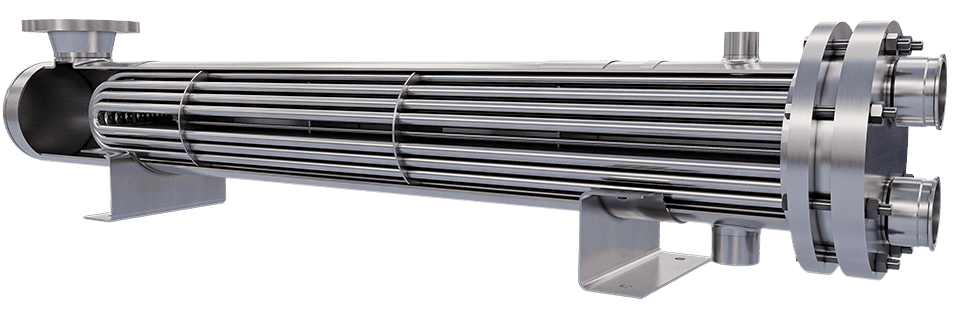
Stainless steel condenser tube bundle

Condensing Solutions

We supply heat transfer equipment, and condensing is the duty we are asked about most often. It is also the duty most often specified badly — not through carelessness, but because a condenser has more ways to disappoint than a liquid-to-liquid exchanger does. Noncondensable gas blankets surface. Condensate floods tubes that cannot drain. A multicomponent vapor condenses across a temperature range that a single calculation will not describe.

So the questions we ask at quotation are about the things that actually decide performance: what is in the vapor besides the condensable fraction, what pressure drop the process can genuinely tolerate, where the unit will sit relative to what drains into it, and how far the duty turns down. From there we select the construction — shell and tube in the right TEMA configuration, air cooled where water is short, spiral where the stream fouls, plate where a close approach in a small footprint matters.

We work with established manufacturers rather than building to a single house design, which means the recommendation can follow the duty. If a duty is better served by a construction we would make less money on, that is still the recommendation you will get. Call and talk it through with an engineer: 1-805-484-2992

Common FAQs

A vapor condenser is a heat exchanger whose job is to turn a vapor back into a liquid by removing its latent heat to a cooler medium, usually water or air. The condensate is collected and either returned to the process, recovered as product, or sent to drain, while any uncondensed gas is vented to treatment or to a vacuum system. Condensers appear throughout industry — on distillation columns, evaporators, reactors, sterilizers, dryers, vent lines and steam turbines — and the same basic function serves very different purposes: recovering a valuable solvent, holding a vacuum, protecting a downstream filter, or meeting an emissions limit.

Far more often than fouling, the cause is noncondensable gas. Air in-leakage, nitrogen from a blanket, inerts carried with the feed or gas coming out of solution all migrate to the condensing surface and form a film the vapor must diffuse through. That film is a much larger thermal resistance than the tube wall, and it collects in the coldest, most stagnant part of the bundle — exactly where you least want it.

The second most common cause is condensate that cannot drain. A condenser that floods from the outlet end back loses surface progressively, which looks like fouling from the control room but will not respond to cleaning. Both are design problems and both are much cheaper to address before fabrication than after startup.

It depends on the duty, and the honest answer is that no single type wins across the board. Shell and tube is the default because it is the most configurable — vacuum through high pressure, almost any alloy, vapor on either side. Air cooled units remove the need for cooling water entirely. Spiral exchangers handle fouling streams and deep vacuum and can mount directly on a column. Plate exchangers give the closest approach in the smallest footprint on clean duty. Double pipe suits small, high-pressure or very low hold-up duties.

The selection questions that actually matter are: how large is the volumetric vapor flow, how much pressure drop can the process afford, does the stream foul, and does either side need mechanical cleaning.

Material is only the starting point. A genuinely sanitary condenser is built so that every wetted surface can be cleaned and every drop of condensate can leave:

  • Surface finish:316L wetted parts mechanically polished to a specified maximum roughness and passivated, because roughness governs how easily a surface cleans and how readily a biofilm anchors.
  • Drainable geometry:Sloped shells, low-point drains and no crevices or dead legs where warm condensate can sit between production runs.
  • Sanitary connections:Clamp fittings or extended tube weld ends rather than threaded or standard flanged joints.
  • Double tubesheets:Where a tube leak could put utility fluid into product or WFI, a vented interspace turns a silent contamination failure into a visible one.

For pharmaceutical work, ASME BPE also governs weld procedures, dead-leg ratios, examination during fabrication and the documentation package your qualification effort will need. A unit that meets its thermal duty but arrives without that paperwork cannot be qualified.

The more of the following you can give us, the closer the first quotation will be:

  1. The vapor: flow rate and full composition, including the noncondensable fraction. If you do not know the gas loading, say so — we will size for a realistic figure rather than assume zero.
  2. Conditions:operating pressure, inlet temperature, and the condensate condition you need at outlet including any subcooling.
  3. The coolant:what it is, the temperature it arrives at, how much is available, and its quality.
  4. Constraints:allowable pressure drop on both sides, materials or code requirements, hygienic standards, available space and orientation.
  5. Reality:expected turndown, known fouling history, and how the unit will be cleaned.

Quote Request Form:

Questions?

1-805-484-2992

Quotes - Engineering - Sales