1-805-484-2992
Quotes - Engineering - SalesAPI Process Condensers
Solvent Recovery, Reactor and Dryer Condensing for API Manufacture
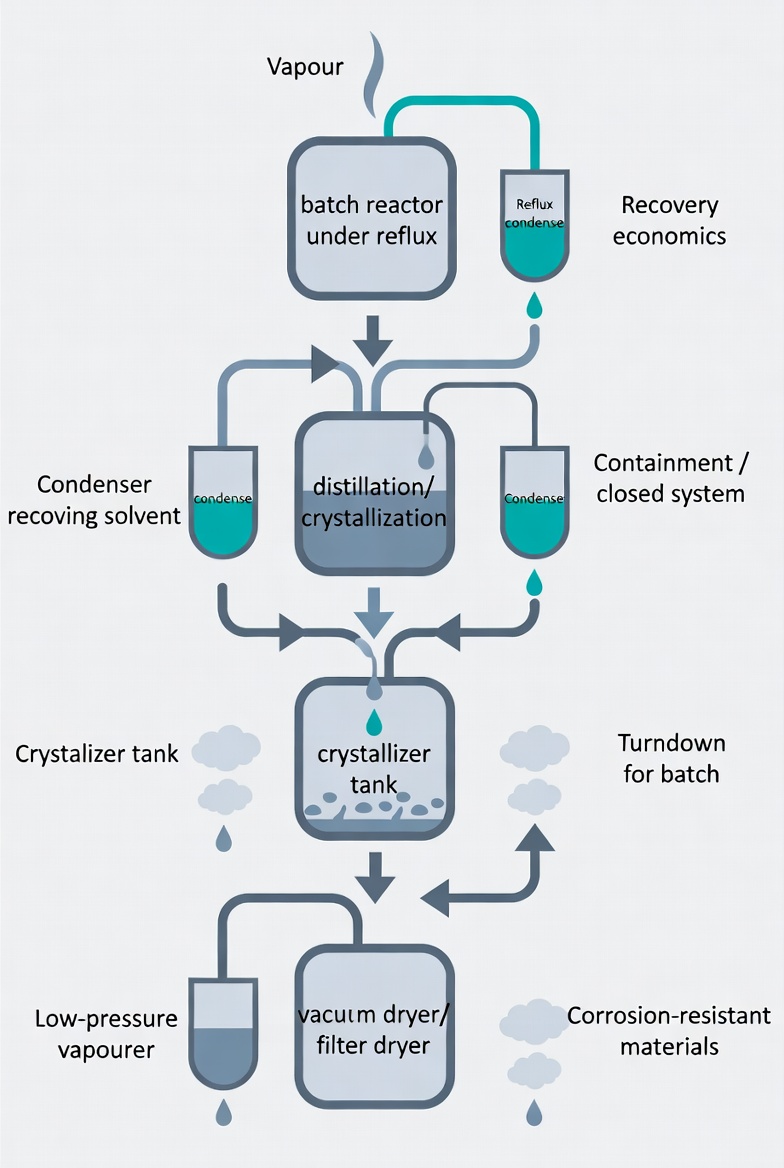
API and intermediate manufacture is largely solvent chemistry carried out in batches. Reactions run under reflux, products are isolated by distillation and crystallization, solids are dried under vacuum, and at nearly every step a vapor stream has to be condensed. The condensers doing that work sit at the intersection of three pressures that do not naturally align: recovery economics, containment and emissions compliance, and materials compatibility with genuinely difficult chemistry.
Recovery is a real line item. Pharmaceutical solvents — acetonitrile, methanol, THF, DCM, DMF, toluene, IPA and the rest — are expensive to buy and expensive to dispose of. Solvent that leaves as vapor is paid for twice: once at purchase and again at destruction. A condenser rated properly across the whole condensing curve, rather than at a single design point, recovers materially more of it, and on a multi-campaign facility that difference compounds over the life of the plant.
Batch operation is the hard part. A continuous column reaches steady state and stays there. A batch reactor does not: vapor rate, composition and temperature all move through a charge, and the condenser has to work at the start of a distillation and at the end, when rate may have fallen by most of its initial value. A unit sized only for peak duty will have far more surface than it needs at the tail of the batch, which sounds harmless but changes how the condensing surface behaves and can make control unstable. Turndown is a design input, not an afterthought.
Containment. Many API intermediates are potent compounds where operator exposure limits are measured in micrograms. That pushes toward closed transfer, fully welded construction where practical, minimized flanged joints, and vent paths that route to treatment rather than to a roof. Where a reflux condenser can generate its reflux internally and avoid a drum, a pump and their associated seals, that is a containment gain as well as a capital saving.
Corrosion. Chlorinated solvents that hydrolyze to trace HCl, acid-catalysed reactions, halide salts, and cleaning cycles that swing between caustic and acid at temperature all attack the wrong material quickly. 316L handles much of this duty; where it does not, the answer may be a higher-nickel alloy, a duplex grade, tantalum or a graphite unit. Getting this right depends on knowing what is actually present in the stream, including the minor components, so tell us about the trace chemistry as well as the bulk.
Vacuum drying and stripping. Removing the last solvent from a solid under vacuum produces a low-pressure vapor stream where allowable pressure drop governs the design. A condenser that adds too much resistance limits the achievable vacuum and stretches cycle time on every batch.
Related pages: pharmaceutical condensers for hygienic and bioprocess duty, reflux condensers for knock-back arrangements, and solvent recovery condensers for the recovery and emissions side.