
1-805-484-2992
Quotes - Engineering - Sales| PRODUCT | STYLE | TEMA TYPE | SHELL |
| Reboiler / Condenser | Kettle Style | BKU / AKT | K, oversized |
Kettle Style K Shell Exchangers
Enlarged Vapor Space for Separation and Low Pressure Drop
A kettle exchanger is defined by its shell rather than its bundle. The TEMA K shell is deliberately oversized relative to the tube bundle inside it, typically holding a horizontal U-tube or floating head bundle in the lower portion of a much larger vessel. The empty space above the bundle is the whole point of the design.
What the vapor space does. When liquid boils on the outside of a bundle, the vapor leaving carries entrained droplets. If it leaves immediately it takes that liquid with it, which fouls downstream equipment, upsets a column's mass balance and can damage a compressor. A large vapor space slows the vapor down, gives the droplets time and distance to fall back, and delivers dry vapor at the outlet. That is why the K shell is the standard construction for kettle reboilers on distillation columns and for flooded chillers in refrigeration, where liquid refrigerant boils on the shell side and dry vapor must reach the compressor.
The reboiler and the condenser are two halves of one system. On a distillation column, the reboiler supplies the vapor that rises through the trays and the condenser at the top removes it again. Their duties are linked through the column's energy balance: change one and the other has to follow. When we size a column overhead condenser we ask about the reboiler for exactly this reason, and a kettle reboiler's characteristics — its liquid inventory, its response time, how it behaves at turndown — show up in how the condenser and reflux system have to be controlled.
Kettle geometry for condensing duty. The same enlarged shell has real value on some condensing services. Because the vapor space is large, the vapor-side pressure drop is extremely low, which is exactly what vacuum condensing requires. Because there is volume below the bundle, condensate can accumulate and be drawn off under level control rather than needing a separate receiver. And where a condensing stream carries noncondensable gas, the generous space helps the gas separate and collect where it can be vented rather than blanketing tubes. A K shell is not the cheapest way to condense a clean vapor, but where disengagement, holdup and minimal pressure drop all matter together, it is a genuinely good answer.
Bundle types. Because the shell is oversized and the bundle sits in a pool, the bundle needs to accommodate thermal expansion and come out for cleaning. U-tube bundles are the most common choice, giving the TEMA BKU designation. Floating head bundles are also used where straight tubes are wanted.
Related: thermosiphon for the natural circulation alternative, U-tube bundles, and vacuum condensers.
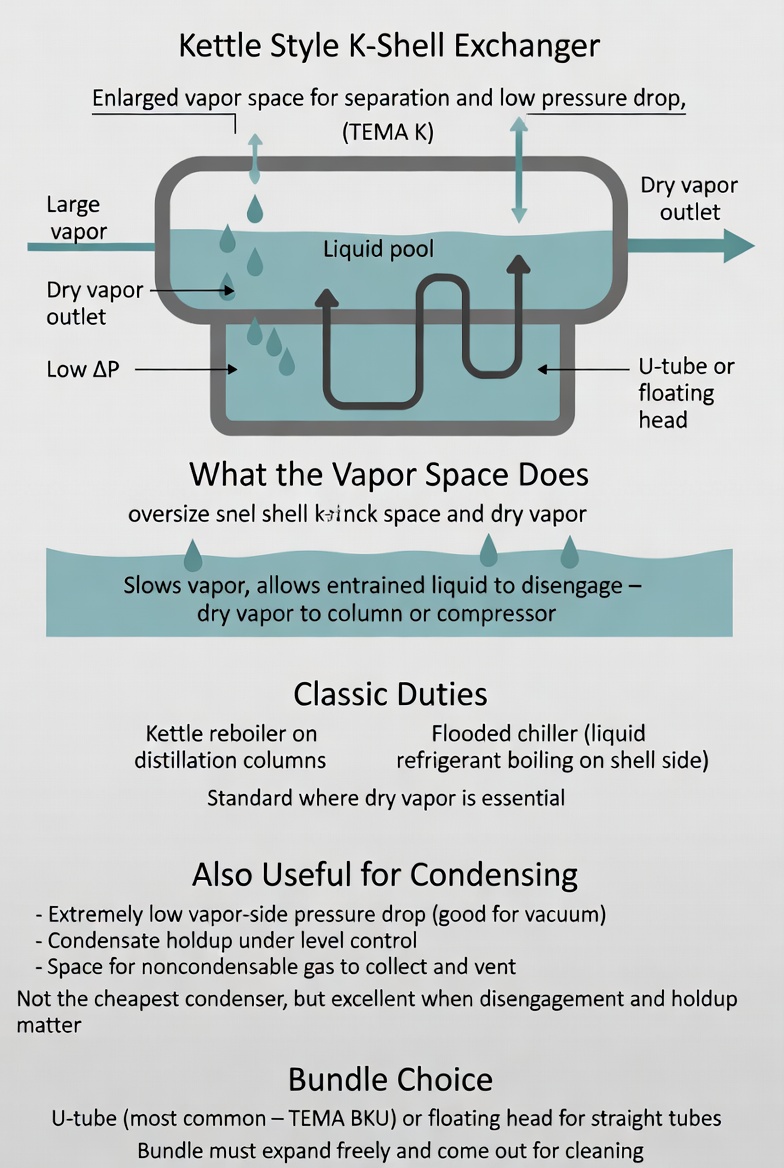
Kettle Style Configuration
The K shell is specified around the vapor space required for disengagement, the liquid level to be maintained, and the bundle type needed for expansion and cleaning.
Configuration
- TEMA Types: BKU, AKT
- Shell: K, oversized
- Bundle: U-tube or floating
- Level Control: Weir or external
Features
- Large disengagement space
- Very low pressure drop
- Condensate or liquid holdup
- Removable bundle
- Dry vapor at outlet
Typical Condensing Duty
- Column kettle reboilers
- Flooded chillers
- Vacuum condensing duty
- Refrigerant evaporators
- Vapor-liquid separation
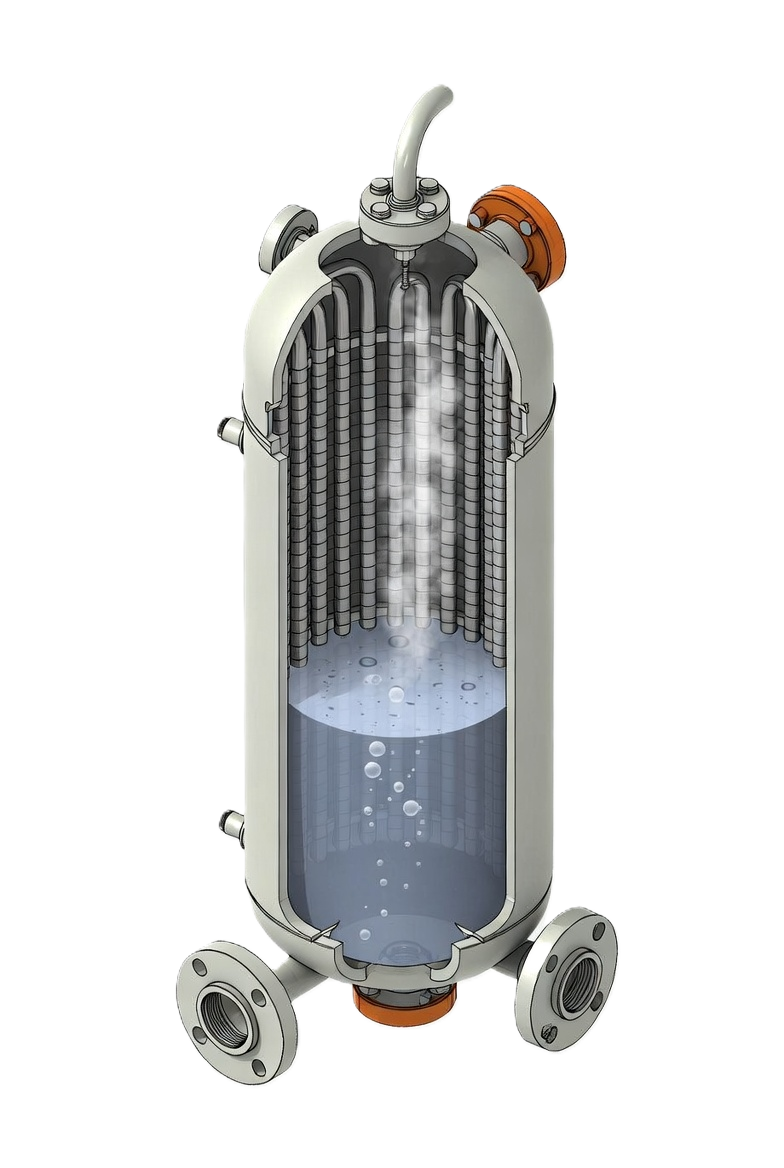
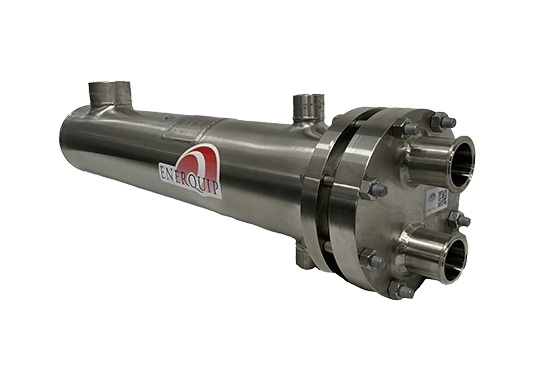
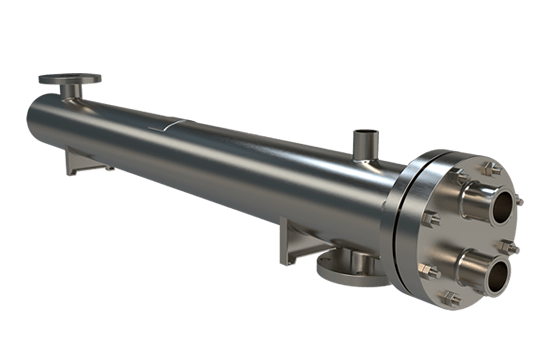
Kettle Style in Condensing and Reboiling Systems
Why Disengagement Space Is Worth Paying For
Vapor leaving a boiling liquid surface always carries entrained droplets. How much depends on the vapor velocity at the surface, which depends on the area available. A narrow shell forces high velocity and heavy carryover; a wide shell allows low velocity and lets gravity win.
The consequences of getting this wrong are specific and expensive. Carryover from a kettle reboiler puts heavy bottoms material up into the column, degrading separation and fouling trays. Carryover from a flooded chiller sends liquid refrigerant to the compressor suction, which is a mechanical failure waiting to happen. Carryover from a condensing application contaminates downstream vapor handling. In each case the oversized shell is buying a specific, identifiable protection rather than just extra volume.
The Column Energy Balance
It is worth being explicit about why a reboiler page belongs on a site about condensers. A distillation column is a closed energy system: heat in at the reboiler, heat out at the condenser, and the difference shows up as product enthalpy. Reflux ratio, internal vapor and liquid rates, and separation performance all depend on both ends operating as designed.
Practically, this means condenser problems often present as reboiler symptoms and vice versa. A condenser losing duty to noncondensable blanketing raises column pressure, which raises bottoms temperature, which changes what the reboiler is doing. A reboiler that is fouled and cannot make vapor rate leaves the condenser oversized and running at poor turndown. When we are asked to look at a condensing problem on a column, the reboiler is one of the first things we ask about.
Kettle Shells as Condensers
Using a K shell for condensing rather than boiling is less common but entirely legitimate, and the reasons are worth understanding. Pressure drop is the main one: with a large open vapor space above the bundle, vapor distributes at very low velocity and loses almost no pressure reaching the tubes. For deep vacuum service that can be decisive, and it puts the K shell in the same conversation as X shell and crossflow spiral designs.
The second reason is integrated holdup. A condenser that also acts as its own condensate receiver removes a vessel, its level instrumentation and its piping from the plot. Where the condensate needs to be held under level control — for pumping, for phase separation, for decanting two immiscible condensate phases — a kettle-style shell does two jobs in one item of equipment.
The third is noncondensable handling. Gas that separates from the condensing vapor collects in the upper vapor space where a vent can take it away cleanly, instead of accumulating in dead pockets between baffles.