1-805-484-2992
Quotes - Engineering - SalesWFI Condensers
Condensing Pure Steam to Compendial Water for Injection
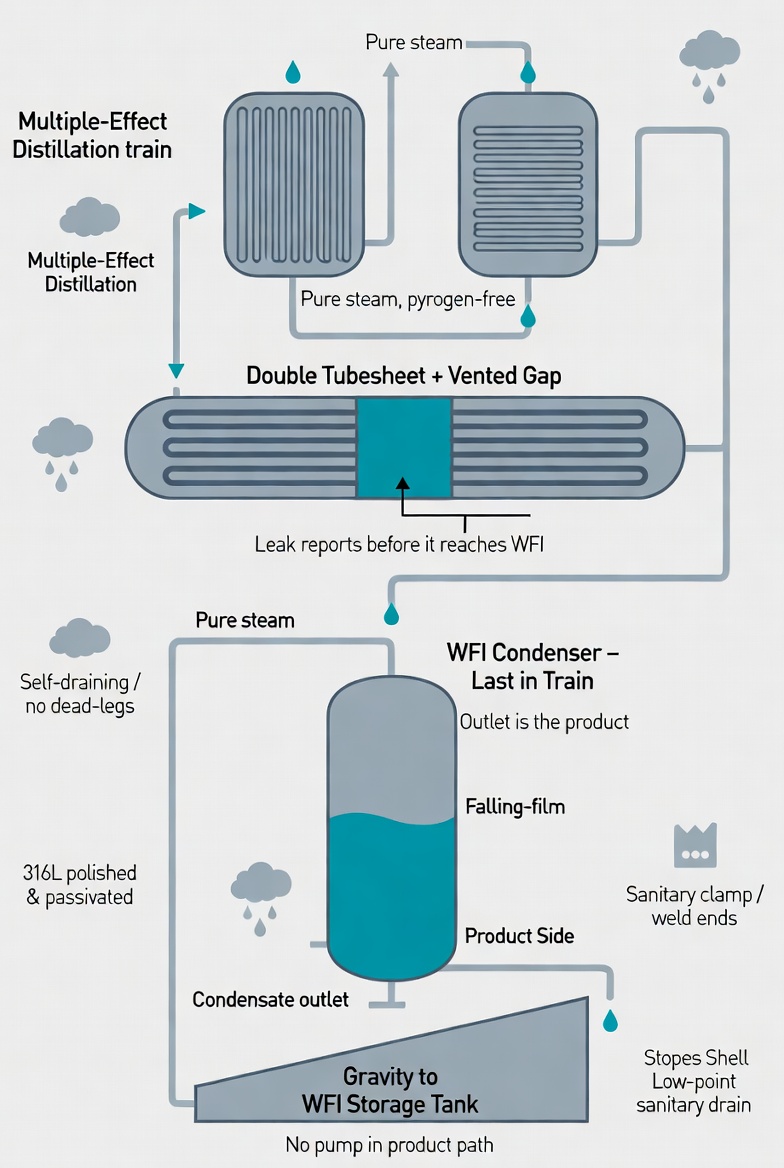
A WFI condenser occupies an unusual position: it is the last piece of equipment in the generation train, and its outlet is the product. Pure steam entering the condenser has already been separated from entrained droplets and is dry and pyrogen-free. What leaves as condensate has to meet compendial requirements for Water for Injection under the applicable pharmacopoeia. Anything the condenser contributes — a trace of cooling water through a failed joint, metal ions from an unsuitable alloy, bioburden from a pocket that did not drain — lands directly in the product.
How WFI is generated. Multiple-effect distillation is the most widely used route. Feedwater is evaporated in the first column to produce pure steam, which is condensed and re-distilled through successive columns at descending pressure, so each effect recovers the latent heat of the one before it. Adding columns improves steam and cooling water economy without changing product quality or capacity. Vapor compression distillation and dedicated pure steam generators serve the same end by different means. In all of them, heating and condensing duty is handled by double tubesheet exchangers, and condensation is commonly arranged as a thin falling film.
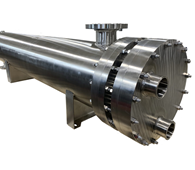
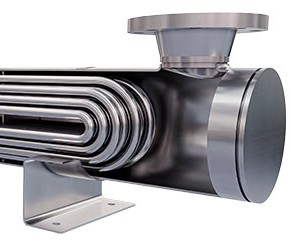
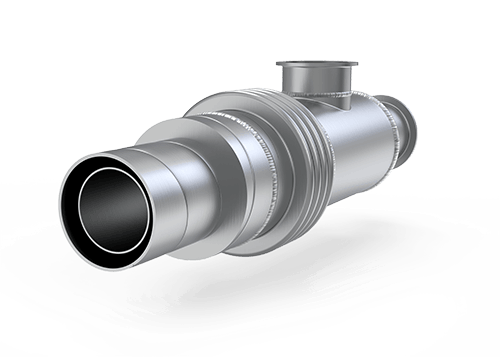
Why double tubesheets are effectively standard here. In a conventional exchanger a single tube-to-tubesheet joint separates cooling water from what will become WFI. If that joint opens, contamination is continuous and silent, and the first indication may be an out-of-specification water result days later — with every batch made since the last passing sample now in question. A double tubesheet puts two joints in series with a vented gap between them, so a leak in either reports to that gap and drains where it can be seen. Still builders apply this throughout: first effect, interstage exchangers and the condenser itself.
Drainability and hold-up. Residual water at temperature is where bioburden and endotoxin develop, and endotoxin is not removed by the fact that the system was clean at installation. Sloped shells, low-point drains, minimized dead legs and sanitary connections are what make a unit genuinely self-draining. Many stills mount the condenser high so the WFI flows to the storage tank under gravity, which removes a pump and a set of seals from the product path.
Materials and finish. 316L wetted surfaces, mechanically polished to a specified maximum roughness and passivated, are the usual baseline, with full material traceability. Surface finish is not cosmetic here: roughness governs how readily a surface can be cleaned and how easily a biofilm can establish. Connections are sanitary clamp or extended tube weld ends, never threaded.
Documentation. A WFI condenser that meets its thermal duty but arrives without material test reports, weld maps and coupons, passivation certificates, hydrotest records and slope verification is not a usable unit, because it cannot be qualified. We scope the documentation package at quotation alongside the mechanical design.
For solvent and reactor duty see API process condensers; for general hygienic process condensing see pharmaceutical condensers. Clean steam duty in food plants is covered under clean steam condensers.