1-805-484-2992
Quotes - Engineering - SalesEvaporator Condensers
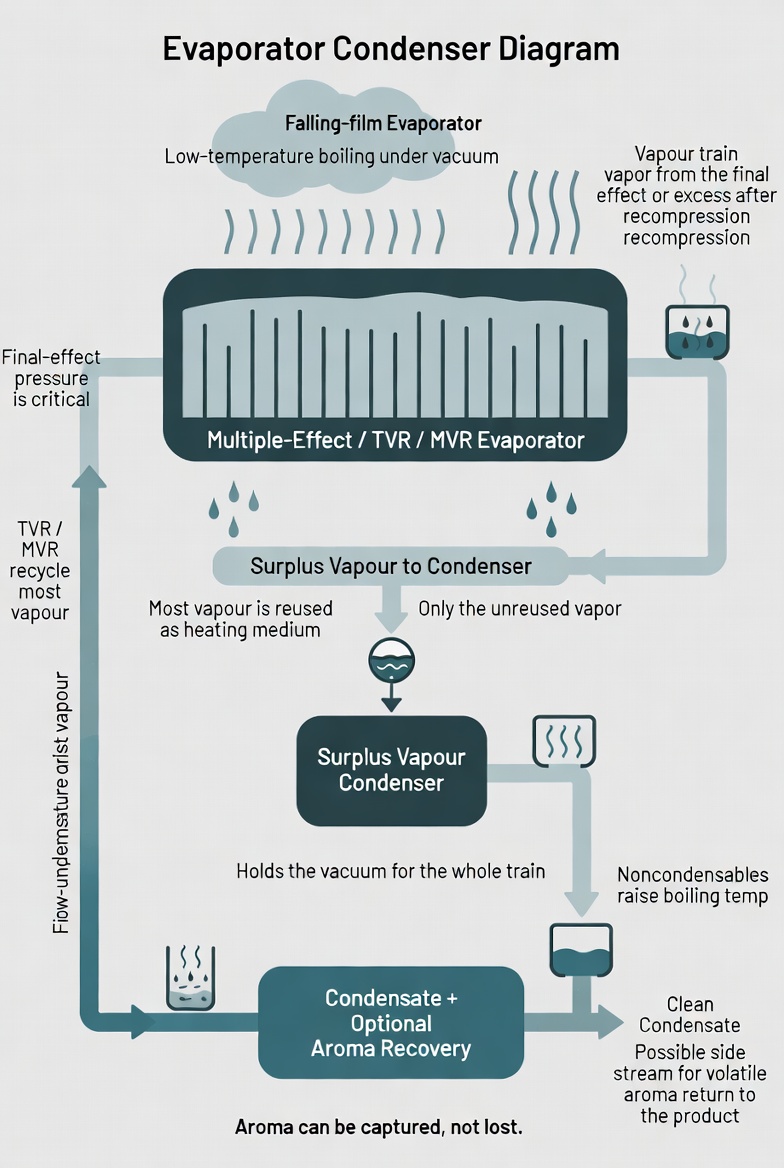
Surplus Vapor Condensing for Multiple-Effect, TVR and MVR Plant
Falling film evaporators concentrate liquids by spreading a thin film down the inside of heated tubes under vacuum. Residence time is short — often only a few minutes — and boiling temperature is low, which is what makes the technique suitable for heat-sensitive products: milk, whey, fruit and vegetable juices, coffee and tea extracts, plant proteins, pharmaceutical intermediates, stillage and process effluents. The condenser is what maintains the vacuum that makes low-temperature boiling possible, which puts it directly in the product quality path even though it never touches concentrate.
Multiple effect. Vapor from one effect becomes the heating medium for the next, which operates at lower pressure. Each additional effect improves steam economy and reduces boiler demand. Only vapor leaving the final effect needs condensing, so the surplus vapor condenser is sized against that last effect's load, at the lowest pressure in the train — where vapour-side pressure drop matters most.
Thermal vapor recompression (TVR). A steam jet thermocompressor entrains part of the vapor from an effect and lifts it to a higher pressure for reuse as heating medium. Steam consumption falls to a fraction of total evaporation capacity. The condenser then handles only the portion the thermocompressor does not recycle.
Mechanical vapor recompression (MVR). A high-pressure fan or compressor draws vapor out of the evaporator, compresses it, and returns it to the heating side. Once running, an MVR system needs little or no live steam, which is why it is now common on dairy, plant-based, beverage and pharmaceutical duty and why all-electric evaporators are built this way. Because most of the vapor is recycled, there is comparatively little left to condense — but the condenser that handles the excess is still what holds the vacuum, and MVR plant is often more sensitive to losing it than a multiple-effect train, because compressor operating point moves with suction pressure.
Condensate quality and aroma. Vapor leaving an effect carries volatiles and sometimes entrained product. Separators and demisters upstream limit carryover and protect both condenser and compressor, and cyclone-type separators generally give cleaner condensate than integrated designs. Where the volatile fraction carries aroma — as it does on juice, coffee and tea — a dedicated aroma recovery condenser captures that fraction and returns it to the product instead of losing it to drain.
Why performance drifts. Fouling on the vapor side from carryover, noncondensable accumulation from air in-leakage or gas released from the feed, and cooling water warming through the season all raise condenser pressure. That lifts boiling temperature throughout the train, which increases thermal damage to a heat-sensitive product and reduces capacity. When concentrate quality drifts across a season with no change in recipe, the condenser is a good place to look.
Related pages: vacuum condensers, sanitary condensers for product-contact duty, and dairy condensers.