
1-805-484-2992
Quotes - Engineering - Sales| PRODUCT | STYLE | SEALING | VACUUM |
| Condenser | Welded Plate | Fully welded | Capable |
Welded Plate Condensers
Plate Performance Without the Elastomer Envelope
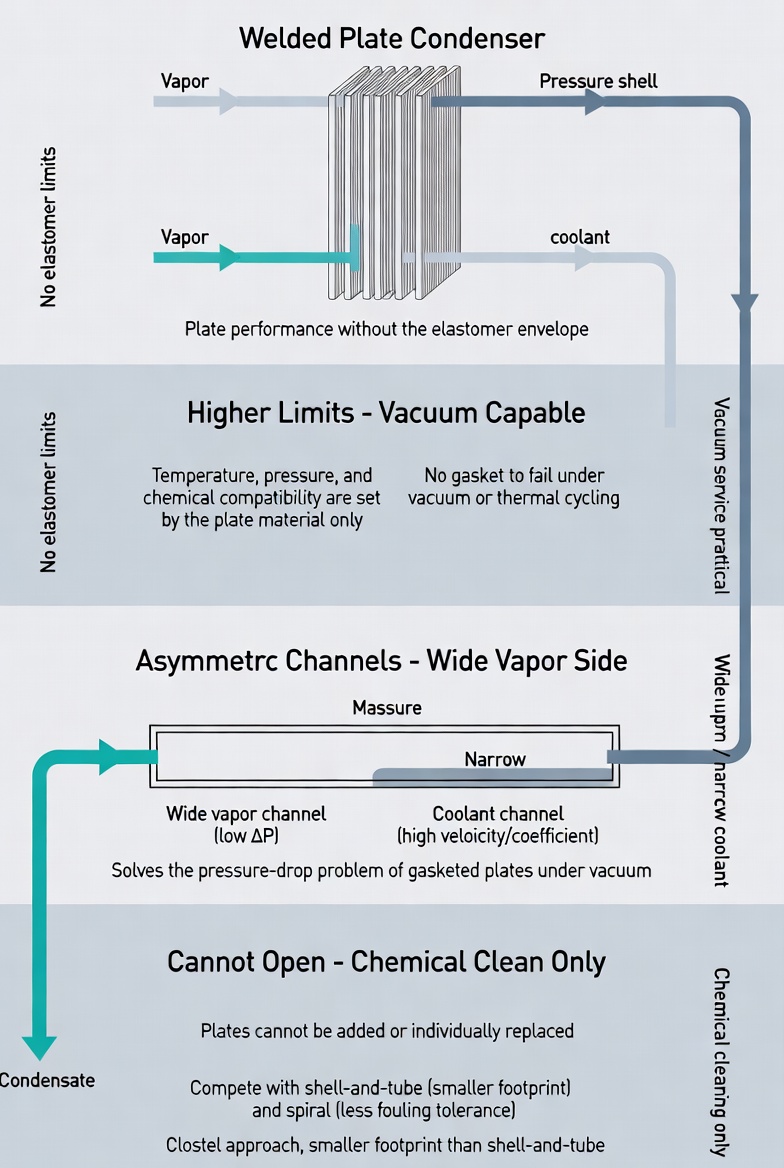
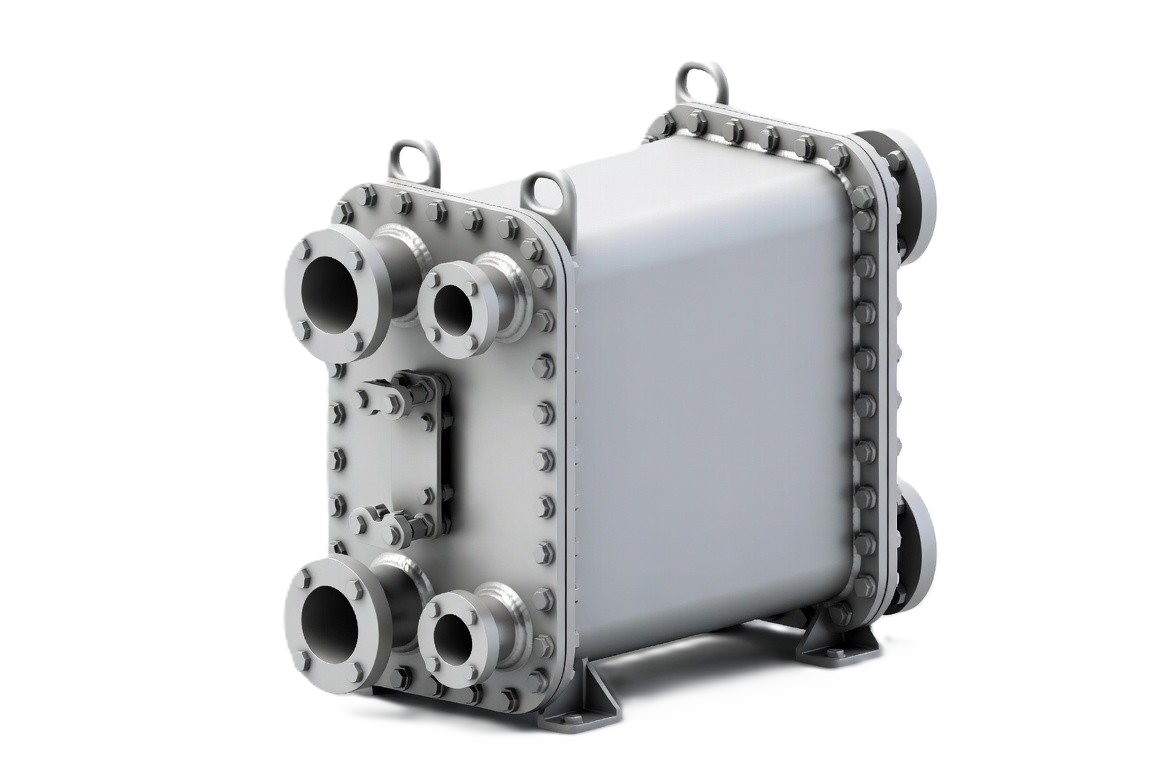
A welded plate exchanger joins the plate pack by welding rather than gaskets or braze alloy. Constructions vary — some weld plate pairs into cassettes and gasket between the cassettes, others weld the entire pack, and some enclose a welded pack inside a pressure shell — but the common purpose is the same: keep the thermal advantages of plate geometry while removing the elastomer that limits where a gasketed unit can go.
What that unlocks. Temperature limits rise to what the plate material will tolerate rather than what a gasket will. Chemical compatibility becomes a question about stainless, duplex, titanium or nickel alloy rather than about nitrile or EPDM. Pressure capability improves. And critically for this site, vacuum service becomes practical: a welded pack has no gasket that can be drawn inward or that will relax over thermal cycles, and welded constructions can be built with the wider vapor channels that vacuum condensing requires.
Vacuum condensing in a plate exchanger. Gasketed plate condensers struggle under vacuum mainly because narrow channels and enormous volumetric flow produce unacceptable pressure drop. Welded designs intended for condensing address that with asymmetric channels — a wide channel on the vapor side and a narrow one on the coolant side. The vapor gets the flow area it needs while the coolant keeps the velocity that gives a good coefficient. That asymmetry is difficult to achieve in a gasketed pack and is the main reason welded plate condensers appear on vacuum duty at all.
What you give up. The pack cannot be opened, so cleaning is chemical, and individual plates cannot be replaced. Capacity cannot be increased by adding plates. Cost is higher than a gasketed unit of the same surface. These are the same trade-offs as brazed construction, but with a far wider operating envelope in exchange.
Where it fits among the alternatives. Welded plate competes with shell and tube and with spiral exchangers on difficult condensing duty. Against shell and tube it offers a closer approach and a much smaller footprint. Against spiral it offers similar compactness but less fouling tolerance, since a spiral's single channel self-cleans and a plate pack does not.
Compare gasketed plate, brazed plate, and cross-flow spiral for vacuum duty.
Welded Plate Configuration
Channel geometry, plate material and the welding arrangement are chosen around the vapor volumetric flow, the operating pressure and the chemistry involved.
Configuration
- Construction: Welded, no gaskets
- Channels: Asymmetric available
- Plates: 316L, duplex, titanium
- Service: Vacuum to pressure
Features
- No gasket temperature limit
- Aggressive chemistry capable
- Wide vapor side channels
- Vacuum condensing capable
- Compact for the duty
Typical Condensing Duty
- Vacuum condensing duty
- Solvent recovery service
- High temperature condensing
- Aggressive chemistry
- Space constrained retrofits
Welded Plate Condensers on Difficult Duty
Asymmetric Channels and Why They Matter
The reason most plate exchangers make poor vacuum condensers is geometric rather than thermal. A conventional plate pack has channels of equal width on both sides, which is sensible when both fluids are liquids with comparable volumetric flows. In a condenser those flows are wildly unequal: the vapor may occupy hundreds of times the volume of the coolant.
Forcing that vapor through a channel sized for liquid produces high velocity and heavy pressure loss. Asymmetric welded constructions give the vapor a wide channel and the coolant a narrow one, so each gets what it needs. The vapor sees a large flow area and low pressure drop; the coolant keeps its velocity and its coefficient. It is a straightforward idea that transforms what the technology can do on condensing service.
Cleaning Without Opening
Since a welded pack cannot be opened, cleaning-in-place capability has to be designed rather than assumed. That means channel geometry that circulates cleaning solution effectively without dead zones, connections positioned to allow proper flow and complete draining, materials compatible with the cleaning chemistry at the temperature it will be used, and realistic access for the CIP equipment itself.
It also means being honest at the specification stage about what the stream will deposit. Welded plate construction suits fouling that dissolves — scale, soluble salts, light organic films. It does not suit fouling that must be scraped, and where a stream carries fibers, solids or forms hard polymer, a spiral exchanger or a shell and tube with a removable bundle is the more honest recommendation.
Choosing Between Welded Plate, Spiral and Shell and Tube
These three overlap on difficult condensing duty and it is worth separating them clearly. Welded plate gives the closest temperature approach and the smallest footprint, and handles aggressive chemistry and vacuum well — provided the stream is reasonably clean or dissolves what it deposits.
Spiral exchangers give up a little compactness and gain genuine fouling tolerance through the self-cleaning single channel, and their crossflow arrangements handle very large vapor volumes at extremely low pressure drop. They also mount directly on columns.
Shell and tube gives up compactness and approach temperature entirely, and gains the widest material range, the highest pressure capability, mechanical cleanability with a removable bundle, and the deepest pool of familiarity in almost every maintenance department. On a difficult duty it is worth pricing at least two of the three, and we are happy to do that rather than pushing whichever we happen to have quoted most recently.