
1-805-484-2992
Quotes - Engineering - Sales| PRODUCT | STYLE | PACK | LIMITED BY |
| Condenser | Gasketed Plate & Frame | Fully openable | Gasket material |
Gasketed Plate and Frame Condensers
Openable, Expandable, and Bounded by the Gasket
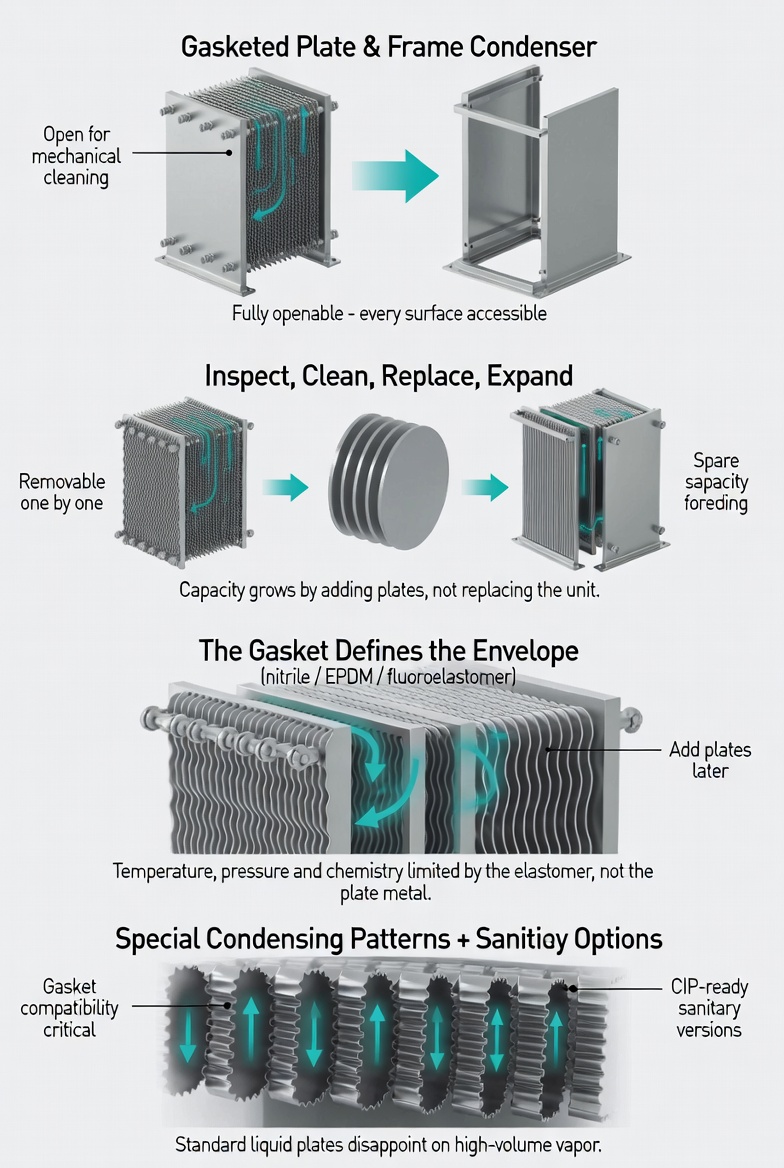
A gasketed plate and frame exchanger clamps a stack of corrugated plates between a fixed and a movable end frame, with an elastomeric gasket around each plate defining the flow channels and sealing the pack. Loosen the tie bolts and the whole pack opens.
Serviceability is the reason to choose one. Every square inch of heat transfer surface can be inspected visually, cleaned mechanically, and if necessary replaced plate by plate. Nothing else in the exchanger world offers that. On duties where fouling is expected but manageable, or where inspection is required for quality or regulatory reasons, the ability to open the unit and look is worth a great deal.
Capacity can grow. The frame is normally specified with room for additional plates. If throughput increases or the duty turns out heavier than expected, plates are added rather than the exchanger being replaced. For a plant expecting growth, that is a genuine commercial advantage over a fixed-surface unit.
The gasket sets the envelope, not the plate. This is the single most important thing to understand. Plate material — 316, titanium, alloy — may tolerate high temperatures and aggressive chemistry, but the elastomer will not. Gasket compound determines the maximum temperature, contributes to the pressure limit, and must be chemically compatible with both process streams and with every cleaning solution the unit will see. Nitrile, EPDM and fluoroelastomer compounds each have different envelopes, and specifying the plate without specifying the gasket is only half the job.
Condensing considerations. Vapor entering a plate pack must distribute across every channel, and the port and distribution area is doing that work. Under condensing conditions with high volumetric flow, the port becomes a genuine restriction, and specialized condensing plate patterns with enlarged ports and modified corrugations exist precisely for this reason. Standard liquid-duty plates used on a condensing service will disappoint.
Sanitary variants. Plate and frame units are widely used in food, dairy and beverage processing, with sanitary gaskets, appropriate surface finishes and clamp connections. The openable pack suits inspection regimes well. Gasket compatibility with CIP chemistry at temperature is the detail that most often needs checking.
See brazed plate for sealed compact duty and welded plate where gaskets cannot cope.
Gasketed Plate Configuration
Plate pattern, plate material, gasket compound and frame capacity are specified together, because the gasket usually sets the operating envelope rather than the plate.
Configuration
- Pack: Openable, expandable
- Plates: 316L, titanium, alloy
- Gaskets: Nitrile, EPDM, FKM
- Connections: Flanged or sanitary
Features
- Opens fully for cleaning
- Plates added for capacity
- Very close approach
- Individual plate change
- Sanitary versions available
Typical Condensing Duty
- Sanitary condensing duty
- Vent and flash recovery
- Evaporator surplus vapor
- Clean process condensing
- Duties expecting growth
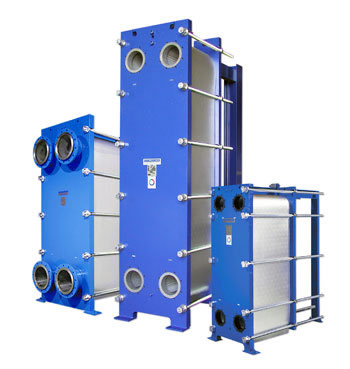
Gasketed Plate Condensers in Service
Choosing the Gasket Before the Plate
It is worth restating because it is the most common specification error on plate exchangers: the gasket, not the plate, usually defines what the unit can do. A titanium plate pack is irrelevant if the gasket compound degrades in the process stream or softens at the operating temperature.
The compatibility check has to cover both process fluids, the cleaning chemistry, and the temperature at which cleaning takes place — which is often higher than normal operation. Steam sterilization is particularly demanding, and not every compound that tolerates the process will tolerate SIP. Where the combination cannot be satisfied, that is the signal to look at welded plate construction rather than to compromise on the gasket.
Distribution and Condensing Plate Patterns
In liquid duty, getting flow into every channel of a plate pack is a solved problem. In condensing duty it is not automatic. Vapor arriving at the inlet port has a large volumetric flow, and it has to spread across the width of the pack and into every channel before it can condense usefully. If distribution is uneven, some channels do most of the work and the rest contribute little.
Condensing-specific plate patterns address this with enlarged ports, modified distribution zones and corrugation geometries chosen for two-phase flow rather than single-phase turbulence. The difference in performance between a proper condensing plate and a standard liquid plate on the same duty can be substantial, and it is not something that shows up in a simple area calculation.
Maintenance Reality
The openable pack is the selling point, and it is genuine, but it is worth being realistic about what opening one involves. Tie bolts must be released evenly, the pack separated, plates removed in order and kept in order, gaskets inspected and often replaced, and the pack reassembled to the correct clamping dimension. Over-tightening damages plates; under-tightening leaks.
None of that is difficult, but it is a procedure rather than a quick look, and gaskets are a consumable that needs stocking. Where a unit will be opened frequently, glued versus clip-on gasket attachment becomes a decision worth making deliberately, because it changes how long each service takes.