
1-805-484-2992
Quotes - Engineering - Sales| PRODUCT | STYLE | FLOW | PRESSURE |
| Condenser / Cooler | Hairpin Double Pipe | True Countercurrent | Very High Capable |
Hairpin Double Pipe Exchangers
True Countercurrent Flow in the Simplest Possible Form
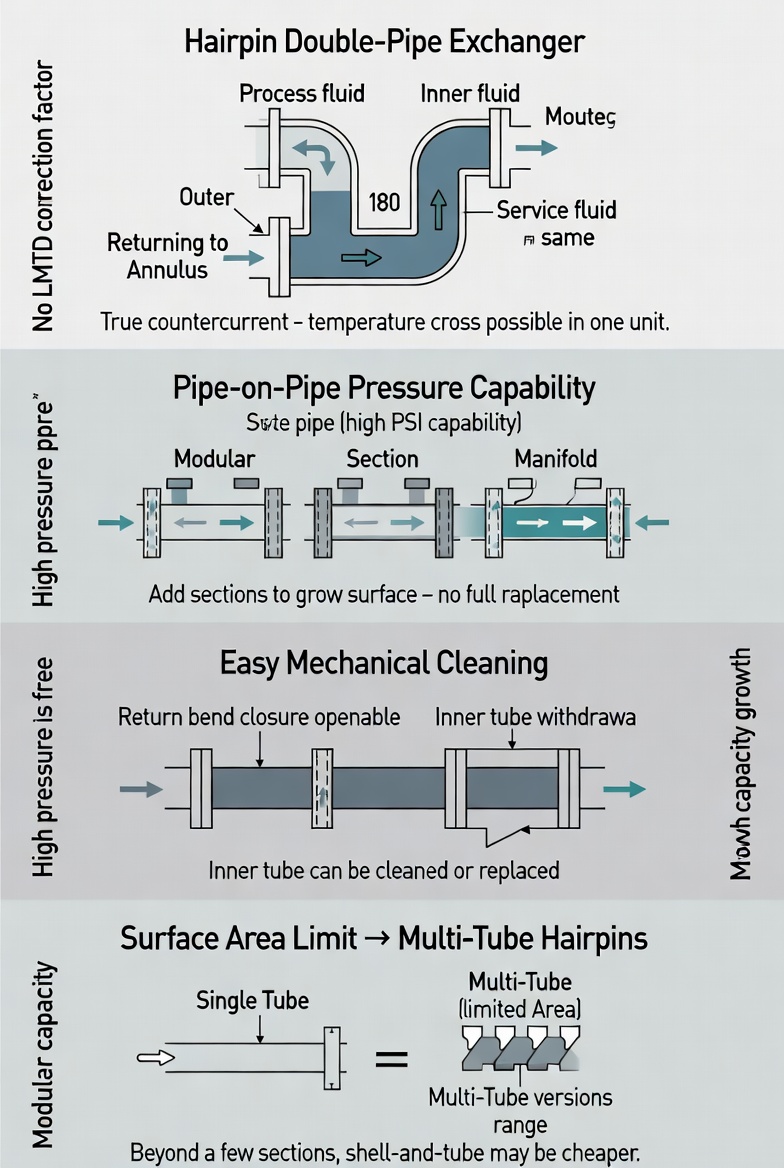
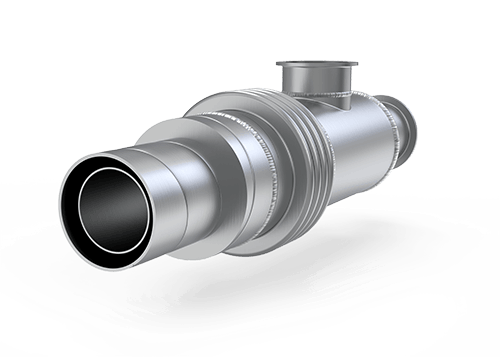
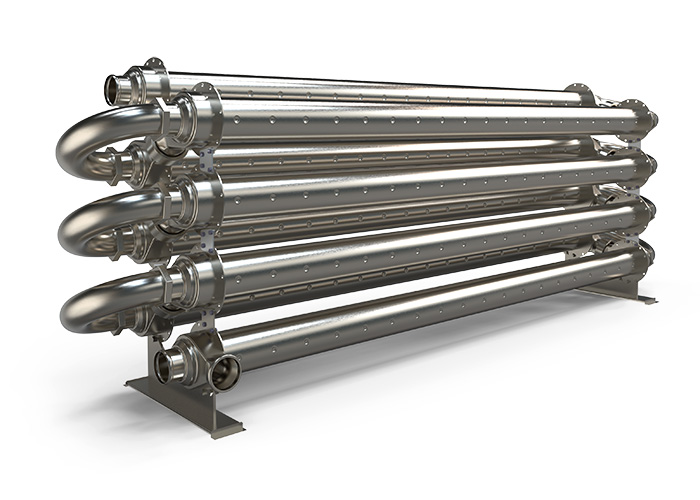
A hairpin exchanger is a pipe inside a pipe, bent through 180 degrees so both sets of connections come back to the same end. The process fluid flows in the inner tube, the service fluid in the annulus around it, and they travel in opposite directions from end to end.
Countercurrent flow is the defining property. With one channel per side there is no crossflow component and no correction factor on the log mean temperature difference. That means a hairpin can achieve a temperature cross — where the cooling fluid leaves hotter than the process fluid leaves — in a single unit, which a baffled shell and tube cannot do without multiple shells in series. On condensing duty with significant subcooling, where the condensate needs to leave well below the vapor inlet temperature, that capability is directly useful.
Pressure capability comes free. Both sides are pipe, and pipe is by far the cheapest way to contain pressure. A hairpin rated for several thousand PSI is unremarkable; an equivalent shell and tube would need a heavy forged shell and would cost a great deal more. Where vapor has to be condensed at high pressure, this alone often decides the configuration.
Surface grows in modules. Hairpins are built in standard section lengths and manifolded together. Need fifty percent more duty? Add sections. Very few exchanger types allow capacity to be increased without replacing the unit, and for pilot plants, processes still being developed, or duties where the design basis is uncertain, that flexibility has real value.
Cleaning is easy. The closure at the return bend opens, and the inner tube can be cleaned mechanically or simply withdrawn and replaced. For a small duty on a fouling stream that access is worth a great deal, and it is one reason hairpins persist in services where a more thermally efficient exchanger would be harder to maintain.
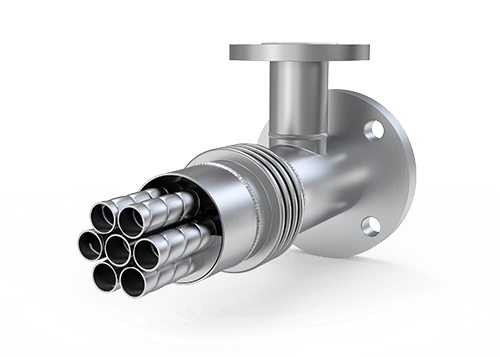
The limitation is surface area. A single inner tube provides very little, so duty grows only by adding sections, and each section brings its own connections, supports and pressure drop. Past a modest number of sections a shell and tube unit will deliver the same surface more cheaply and in less space. Where that crossover approaches, multi-tube hairpins extend the range considerably.
Hairpin Configuration
Section length, tube and shell sizes, and the number of sections in series or parallel are set by the duty, the allowable pressure drop and the space available.
Configuration
- Construction: Pipe in pipe, U-bend
- Flow: True countercurrent
- Inner Tube: Plain or finned
- Closure: Removable at bend
Features
- Temperature cross capable
- Very high pressure rating
- Modular added surface
- Low hold-up volume
- Simple mechanical cleaning
Typical Condensing Duty
- Sample and analyser cooling
- Small vent condensing
- Condensate subcooling
- High pressure condensing
- Pilot plant duty
Hairpin Exchangers on Condensing Duty
Finned Inner Tubes
When the annulus fluid has a much poorer heat transfer coefficient than the inner tube fluid — a viscous oil, a gas, or a low-flow service stream — the annulus side becomes the bottleneck and adding length is an inefficient way to fix it. Longitudinal fins welded along the outside of the inner tube address this directly by multiplying the area on the weak side.
On condensing duty this is useful when the vapor condenses inside the inner tube and the cooling medium in the annulus is air or a poor liquid coolant. Fin count, height and material are all selectable, and a finned hairpin can carry several times the duty of a bare one in the same envelope. Where both sides have good coefficients, fins add cost without much benefit.
Series, Parallel and Pressure Drop
Hairpin sections can be connected in series, in parallel, or in combinations of both, and the arrangement is a genuine design variable rather than a detail. Series connection maximizes velocity and therefore heat transfer coefficient, and preserves the countercurrent temperature profile end to end, but pressure drop accumulates through every section.
Parallel connection divides the flow, which cuts pressure drop sharply but reduces velocity and coefficient. On condensing duty this matters more than on liquid duty because vapor volumetric flow is large and falls as condensation proceeds. A common arrangement puts the vapor inlet sections in parallel to handle the high volumetric flow, then combines into series sections as the vapor condenses and the volume collapses.
Where Hairpins Beat the Alternatives
It is worth being clear about the niche. A hairpin will not compete with a shell and tube on cost per square foot at any meaningful size. What it offers is a set of specific advantages that matter on particular duties: a genuine temperature cross in one unit; pressure ratings that would make an equivalent shell prohibitive; minimal hold-up for hazardous or expensive fluids; the ability to add surface later; and easy mechanical access to the inner tube.
Sample coolers, analyser conditioning systems, small tank vent condensers, condensate subcooling sections downstream of a larger condenser, high-pressure gas condensing, and pilot plant service are where those advantages line up. If none of them applies to your duty, a shell and tube is probably the better answer and we will say so.