
1-805-484-2992
Quotes - Engineering - SalesCondensing Under cGMP
In pharmaceutical and bioprocess service the exchanger is part of a qualified system, so the deliverable is never just the hardware. ASME BPE, first published in 1997 and revised on a regular cycle, sets out what hygienic design actually means in practice: acceptable materials with full traceability, maximum surface roughness, hygienic weld procedures and inspection, dead-leg and L/D limits at every branch, and a documentation package you can hand to a validation team. A condenser that hits its thermal duty perfectly and arrives without that paperwork is not a usable unit. We scope both halves of the job at quotation, before anything gets fabricated.
- WFI and pure steam condensing on multiple-effect stills, single-effect distillers and pure steam generators, where the condensate itself is the compendial product and has to meet USP or EP limits.
- Double tubesheet construction with a vented, inspectable interspace on any duty where a tube leak could put utility fluid in contact with product or with WFI.
- API and intermediate process condensing on reactors, dryers and distillation columns, usually with solvent recovery, reflux control and containment driving the design.
- Bioreactor and fermenter off-gas condensing to knock moisture out of the exhaust ahead of filtration, protecting vent filters and holding vessel pressure steady through a run.
- Hygienic detailing as standard: 316L wetted surfaces, mechanically polished and passivated to a specified Ra, sloped for positive drainage, with sanitary clamp or extended tube weld ends.
- Documentation built for qualification — material test reports, weld maps and coupons, passivation certificates, hydrotest records, and slope and drainability verification.
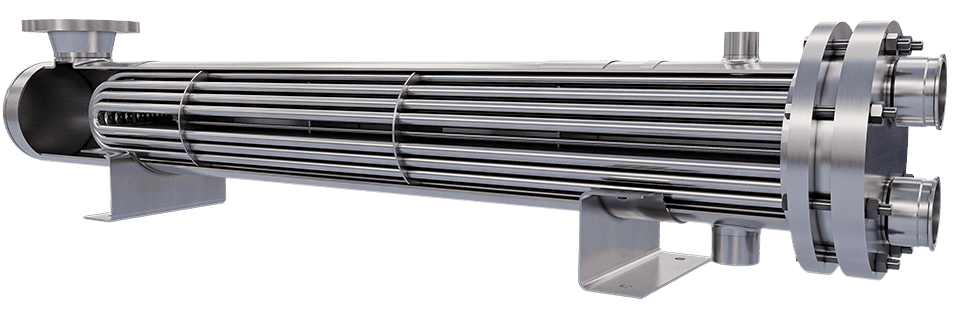
Hygienic Shell & Tube:
WFI, Pure Steam & Process
- ASME BPE practice
- Double tubesheet option
- Full traceability package
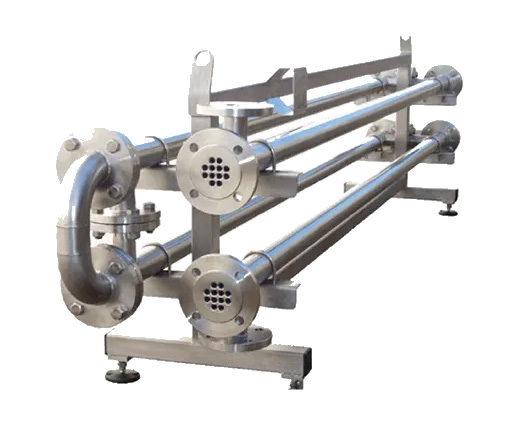
Double Pipe:
Point of Use & Small Duty
- Very low hold-up volume
- Fully drainable by design
- Sampling and POU cooling
Double Tubesheets, Drainability and the Cost of Being Wrong
The reason double tubesheet construction shows up so consistently in pharmaceutical condensers is a risk argument rather than a thermal one. In a conventional exchanger, a tube-to-tubesheet joint is the single wall between the process and the cooling utility. If it opens up, the first indication may be an out-of-specification result on water or product days later, with every batch since the last good sample now in question.
A double tubesheet puts two independent joints in series with a vented gap between them. A leak in either joint reports to that gap, where it drains and shows itself, instead of crossing into the other stream. Multiple-effect still builders apply the same logic throughout — double tubesheets on the first effect, on interstage exchangers and on the condenser itself — because on WFI duty the condensate leaving the condenser is the product.
Drainability matters for the same underlying reason it does in food service, but the tolerance is tighter. Residual condensate is a place where bioburden and endotoxin can develop between campaigns, and endotoxin does not care that the unit was clean when it was installed. Sloped shells, low-point drains, minimized dead legs and sanitary connections are what keep a unit genuinely self-draining rather than nominally so.
On the solvent side of the business the driver shifts from bioburden to containment and recovery. Many API processes run on solvents that are flammable, toxic, or expensive enough that recovery yield is a real line item, and the condenser is what decides how much of that solvent you keep.
Pharmaceutical Condensing Applications
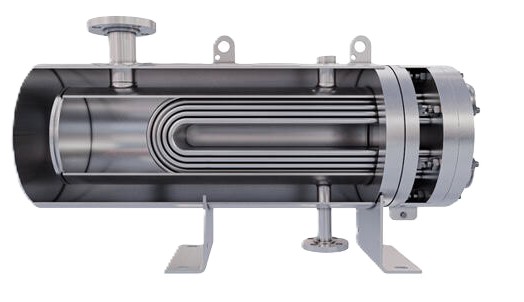
PHARMA • WATER SYSTEMS
WFI Condensers
Condensing pure steam to compendial Water for Injection on multiple-effect stills and pure steam generators.
+ Learn More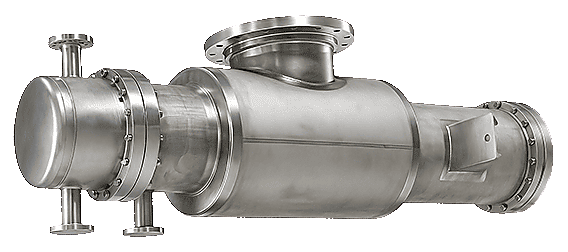
PHARMA • API PROCESS
API Solvent Recovery
Reactor, dryer and column condensing duty where solvent recovery yield and containment set the design.
+ Learn More
BIOPROCESS • OFF-GAS
Bioreactor Off-Gas
Knocking moisture out of fermenter exhaust to protect vent filters and hold vessel pressure through a run.
+ Learn More