1-805-484-2992
Quotes - Engineering - SalesVacuum Condensers
Condensing at Low Absolute Pressure Without Destroying the Vacuum
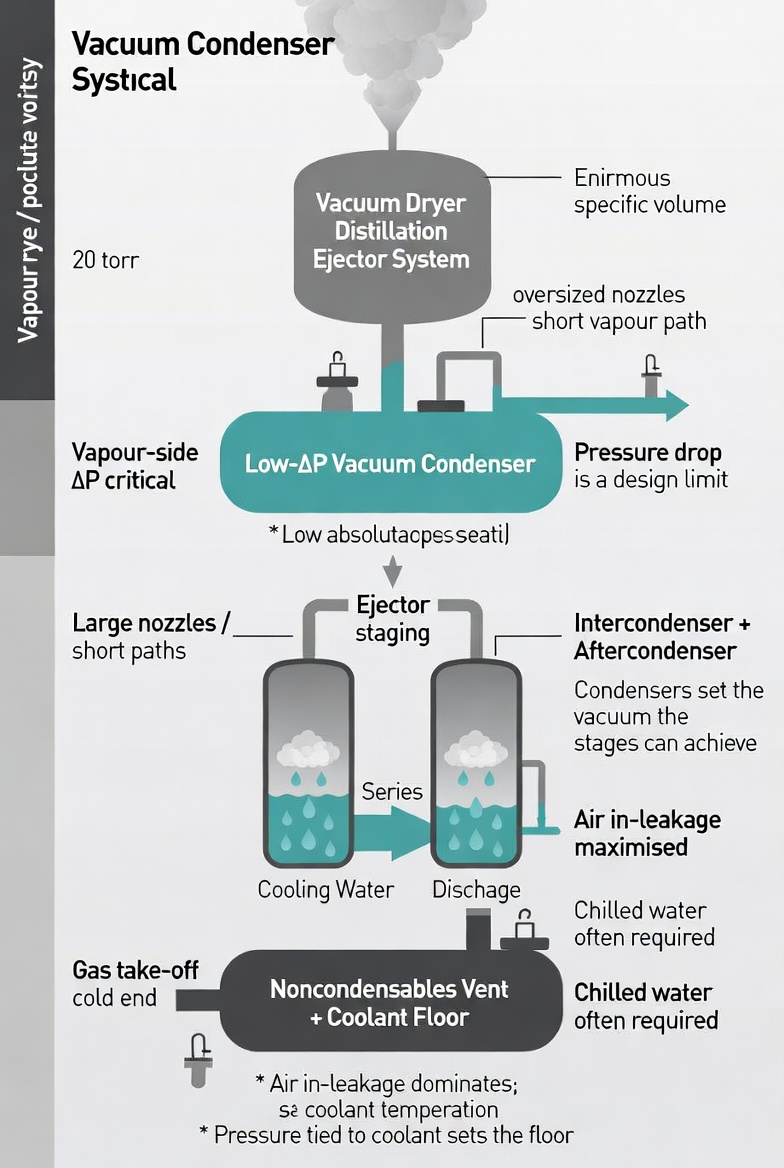
Condensing under vacuum inverts the usual design priorities. At atmospheric pressure and above, a fraction of a psi of vapour-side pressure drop is a rounding error. At 20 torr it can be the difference between a process that works and one that does not, because the pressure the process actually sees is the condenser pressure plus everything lost getting the vapor there. Specific volume is enormous at low pressure, velocities are high for very modest mass flows, and nozzle and header sizing that looks generous on a normal exchanger becomes restrictive.
What this means in practice. Vapour-side pressure drop is treated as a design specification rather than a calculated output. That drives large nozzles, short vapor paths, generous tube pitch and often a different orientation than the same duty would use at pressure. It is also why simply adding surface area to a struggling vacuum condenser can make matters worse: more tubes means more path length and more resistance.
Ejector systems and staging. Steam-jet ejector systems use condensers between stages to knock out motive steam and condensable load so the next stage handles a smaller volume. An intercondenser between stages and an aftercondenser at discharge is a standard arrangement, with cooling water flowing in series from the intercondenser inlet through to the aftercondenser discharge. Because these condensers set what each ejector stage has to move, their performance governs the achievable vacuum for the whole system. Multi-stage sets are commonly specified as thermally and mechanically guaranteed to ASME Code Section VIII Division 1 with a defined TEMA class and type, and a fouling allowance applied to both sides.
Noncondensables dominate. Under vacuum, air in-leakage matters more than anywhere else because the pressure differential driving it inward is at its maximum and the volumetric consequence of a given mass of air is at its largest. Gas accumulating in the cold end blankets surface and raises pressure, and the vacuum equipment then works harder to hold the same condition. Vent placement and gas-side rating deserve more attention here than in any other service.
Common duties. Vacuum dryers and tray dryers; edible oil and fatty acid deodorizers; vacuum crystallizers; vacuum distillation overheads; degassing and deaeration systems; steam-jet refrigeration; and the ejector or liquid ring vacuum sets serving all of them. Several of these carry a fouling or freezing risk that further constrains geometry — for instance a stream where water vapor can ice up a surface that is running cold enough to condense an organic.
Coolant temperature sets the floor. The lowest pressure achievable is bounded by the saturation pressure at the coldest surface temperature the coolant can produce. Chasing a deeper vacuum with a cooling tower loop in summer eventually becomes futile; chilled water or a refrigerated stage is the honest answer. It is better to establish that early than after installation.
Related pages: surface steam condensers, vent condensers and overhead condensers.