
1-805-484-2992
Quotes - Engineering - Sales| PRODUCT | STYLE | FLOW | SELF-CLEANING |
| Condenser / Cooler | Single Spiral | Spiral both sides | Both channels |
Single Spiral Exchangers
Spiral Flow on Both Sides, Counterflow and Self-Cleaning
The single spiral is the original and most general-purpose spiral configuration. Two long metal strips are rolled around a central core with spacer studs between them, forming two concentric spiral channels. One fluid enters at the periphery and travels inward; the other enters at the center and travels outward. The flow is genuinely counterflow along the entire path.
Self-cleaning in both channels. Because each circuit is one continuous channel, all the flow must pass through every part of it. A deposit narrowing the channel raises local velocity, and the higher shear scrubs it away. With spiral flow on both sides, both streams get that protection, which is why single spirals are used for the genuinely difficult liquids — sewage sludge, paper stock, mineral slurries, fibrous effluents, viscous emulsions — that would blind a plate pack in hours.
Crossing temperature approaches. True counterflow with no crossflow component means no correction factor and no limit on temperature cross. A single spiral will take the cold stream out hotter than the hot stream leaves, in one unit, which makes it very effective on heat recovery duty where two process streams are being interchanged.
Condensing service. Single spirals condense well at pressures at or above atmospheric, where the vapor volumetric flow is manageable within a spiral channel. Steam heating and vapor condensing are both standard duties for the configuration. The limitation is the same one that constrains plate exchangers: as pressure falls, volumetric flow rises and a spiral channel becomes restrictive. For vacuum condensing the crossflow arrangements exist instead.
Access. Removable covers on both faces give access to the heat transfer surfaces for inspection and manual cleaning when a duty genuinely requires it, which is a useful backstop even on a self-cleaning design.
For large vapor volumes and vacuum see cross-flow spiral; for column-mounted reflux duty see counterflow spiral.
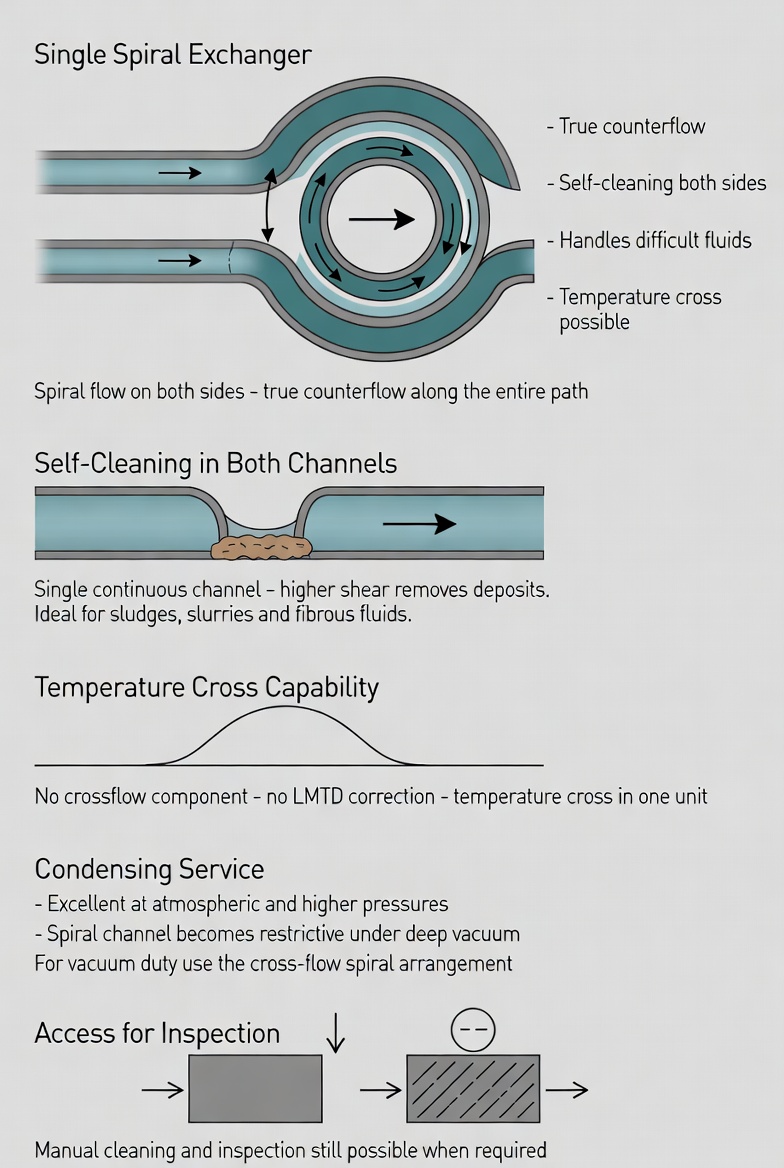
Single Spiral Configuration
Channel width, spacing and plate material are selected around the fouling character of the streams, the required approach temperature and the pressure drop available.
Configuration
- Flow: Spiral both channels
- Arrangement: Counter or co-current
- Orientation: Vertical or horizontal
- Covers: Removable both faces
Features
- Self-cleaning both sides
- Crossing approach capable
- Handles slurries and sludge
- Compact for the duty
- Removable access covers
Typical Condensing Duty
- Condensing above atmospheric
- Steam heating duty
- Fouling liquid recovery
- Slurry and sludge service
- Close approach heat recovery
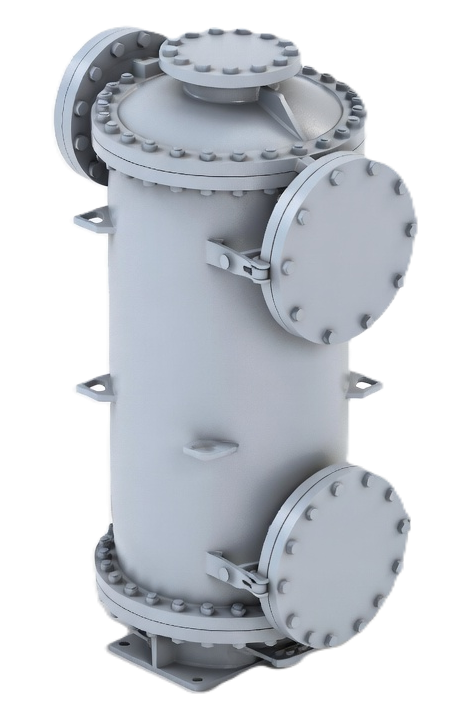
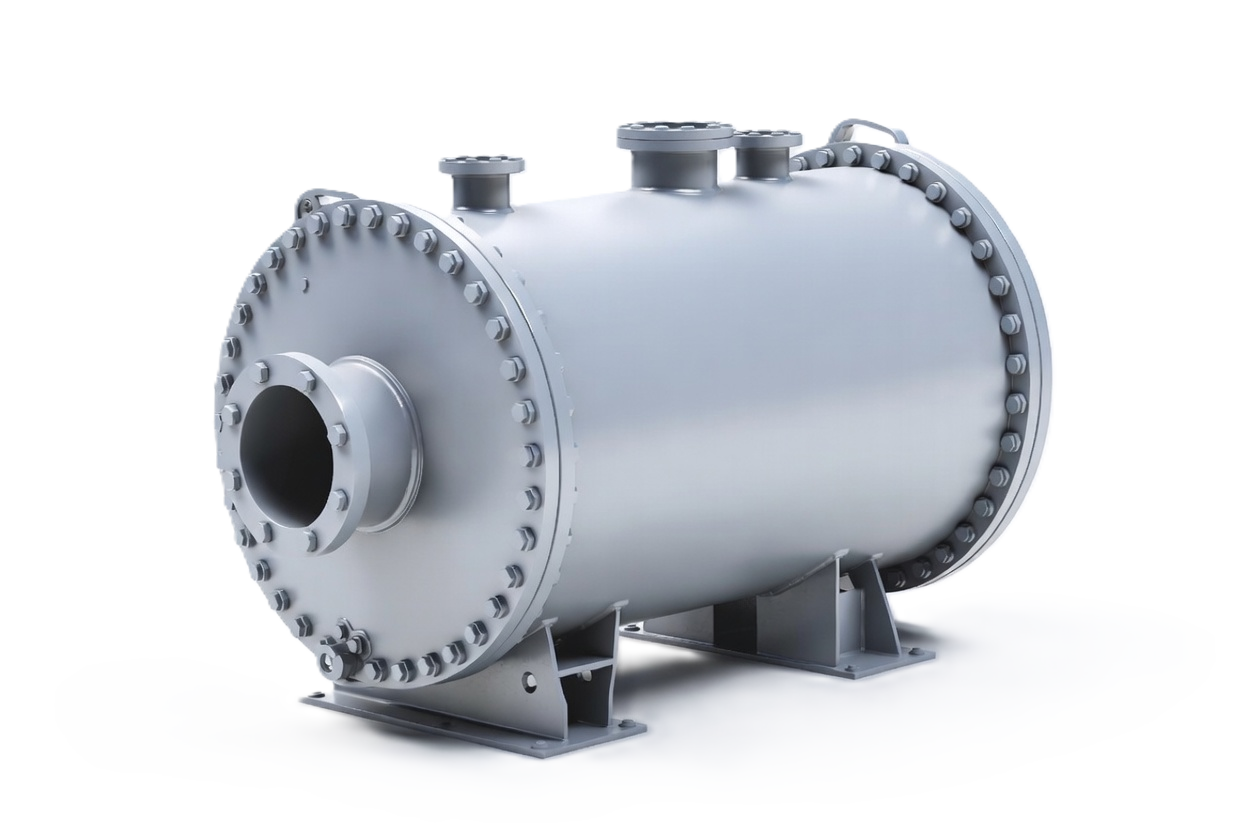
Single Spiral Selection
The Fouling Argument in Detail
It is worth understanding why the self-cleaning effect is real rather than marketing. In any exchanger with parallel flow paths — a tube bundle, a plate pack — fouling is unstable in the wrong direction. A path that starts to foul gains resistance, so flow diverts to cleaner paths, so velocity in the fouling path drops, so it fouls faster. The process runs away.
A single channel cannot behave that way. There is nowhere for flow to divert to, so a restriction raises velocity through itself, and shear stress rises with it. The fouling process is self-limiting instead of self-accelerating. That difference is why spiral exchangers survive in services that destroy other constructions, and it is worth paying for when the stream is genuinely dirty.
Orientation and Condensate
Single spirals can be installed vertically or horizontally, and on condensing duty the choice matters. Vertical installation with vapor entering at the top lets condensate drain with gravity assisting the flow, which keeps the channel clear and helps subcooling as the condensate continues along the cooler part of the path.
Horizontal installation can be appropriate where headroom is limited or where the duty is primarily liquid with modest condensing. The consideration is the same as in any condenser: liquid must be able to leave without accumulating and reducing the area available to vapor. On a duty with a large condensate load, vertical is usually the safer arrangement.
Where the Single Spiral Is Not the Answer
Being straightforward about the limits: single spirals are not the choice for deep vacuum condensing, because the spiral channel imposes too much pressure drop on a large volumetric vapor flow — the crossflow configuration exists for exactly that reason. They are not usually the cheapest option for a clean, simple, high-volume duty that a plain shell and tube would handle. And because they are a welded construction, major internal repair is not comparable to swapping a tube bundle.
Where they excel is the awkward middle ground: dirty streams, close or crossing approaches, limited plot space, and duties where a conventional exchanger would need cleaning far more often than the plant can accommodate.