
1-805-484-2992
Quotes - Engineering - Sales| PRODUCT | STYLE | SHELL TYPE | CIRCULATION |
| Reboiler | Thermosiphon | E or J divided flow | Natural |
Thermosiphon Exchangers
Natural Circulation Driven by Density Difference
A thermosiphon works on one principle: heat a fluid and it becomes less dense, and less dense fluid rises. Arrange an exchanger so that the heated leg is vertical and connects back to a reservoir, and the density difference between the two-phase mixture leaving and the liquid entering establishes a continuous circulation. No pump is involved. The circulation rate settles wherever the driving head balances the friction loss, which means the system self-regulates to a considerable degree.
Why this is attractive. A pump on a hot process duty is a maintenance item, a power consumer, a seal that can leak and a single point of failure. Removing it removes all of that. Thermosiphon reboilers are consequently very common on distillation columns, particularly where the bottoms product is hazardous, hot, or would be difficult to seal. Nothing rotates and nothing needs electricity, so the circulation continues as long as heat is being applied.
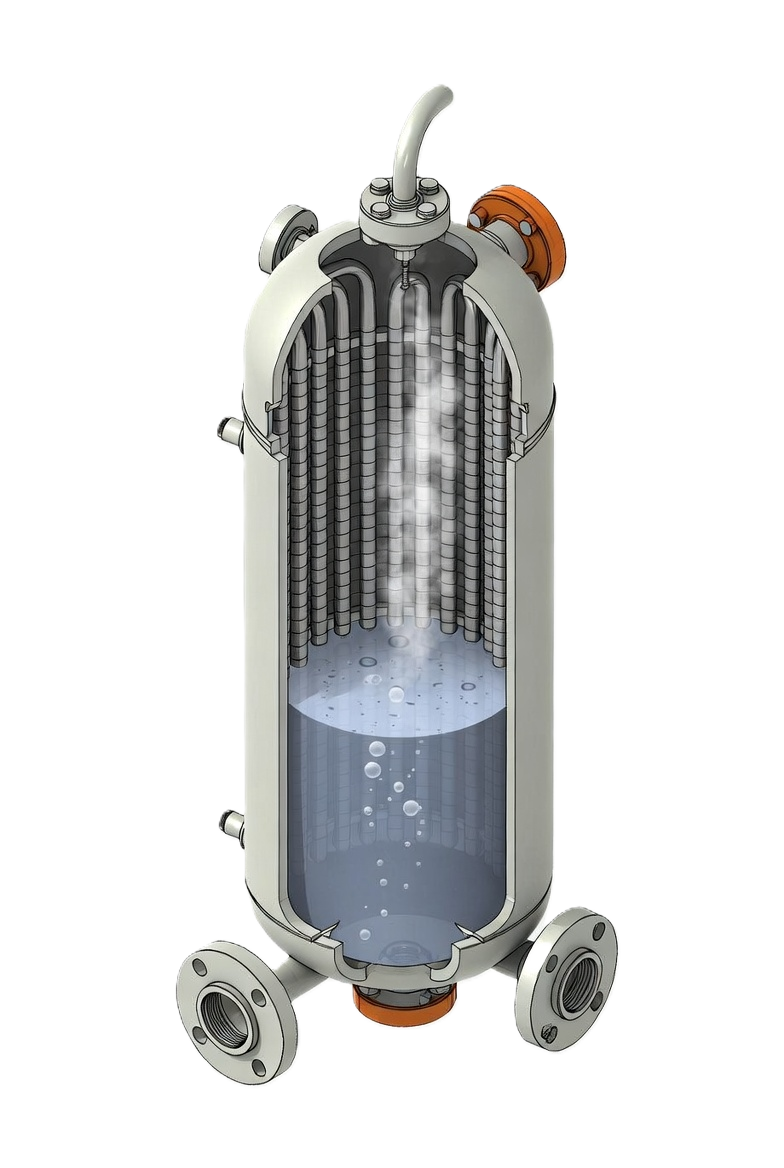
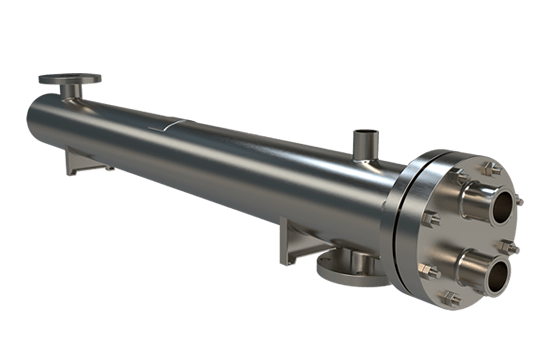
Vertical and horizontal arrangements. In a vertical thermosiphon the process fluid boils inside vertical tubes with the heating medium in the shell, and the two-phase mixture rises back to the column. This gives a compact plot footprint and short piping, and it is the more common arrangement. In a horizontal thermosiphon the process fluid boils on the shell side with the heating medium in the tubes. That suits fouling service, because the shell side of a horizontal bundle is easier to reach, and duties where the available static head is limited. For shell-side boiling, a divided flow J shell arranged with one inlet and two outlets is the conventional choice, because splitting the outgoing two-phase flow keeps pressure drop low, and pressure drop is the thing that limits circulation.
The relationship to the condenser. A thermosiphon reboiler and a column overhead condenser are coupled through the column, and thermosiphon reboilers are more sensitive to column pressure than pumped alternatives. Circulation depends on the balance between static driving head and friction, and boiling point depends on pressure. If the overhead condenser loses duty and column pressure rises, bottoms boiling temperature rises with it, the vapor fraction in the riser changes, and circulation rate shifts. Push far enough and circulation can become unstable or stall. This is a real operating failure mode and it originates at the condenser, not at the reboiler.
Thermosiphon principles in condensing service. The same density-driven circulation appears on the condensing side of processes. Gravity condensate return systems, closed-loop cooling circuits that circulate without a pump, and reflux arrangements where condensate returns to a vessel under its own head all rely on it. The design discipline is the same: account honestly for the available static head, keep friction losses low, and make sure the system still circulates at minimum load rather than only at design conditions.
Related: kettle style for the pool boiling alternative, and distillation condensers for the other end of the column.
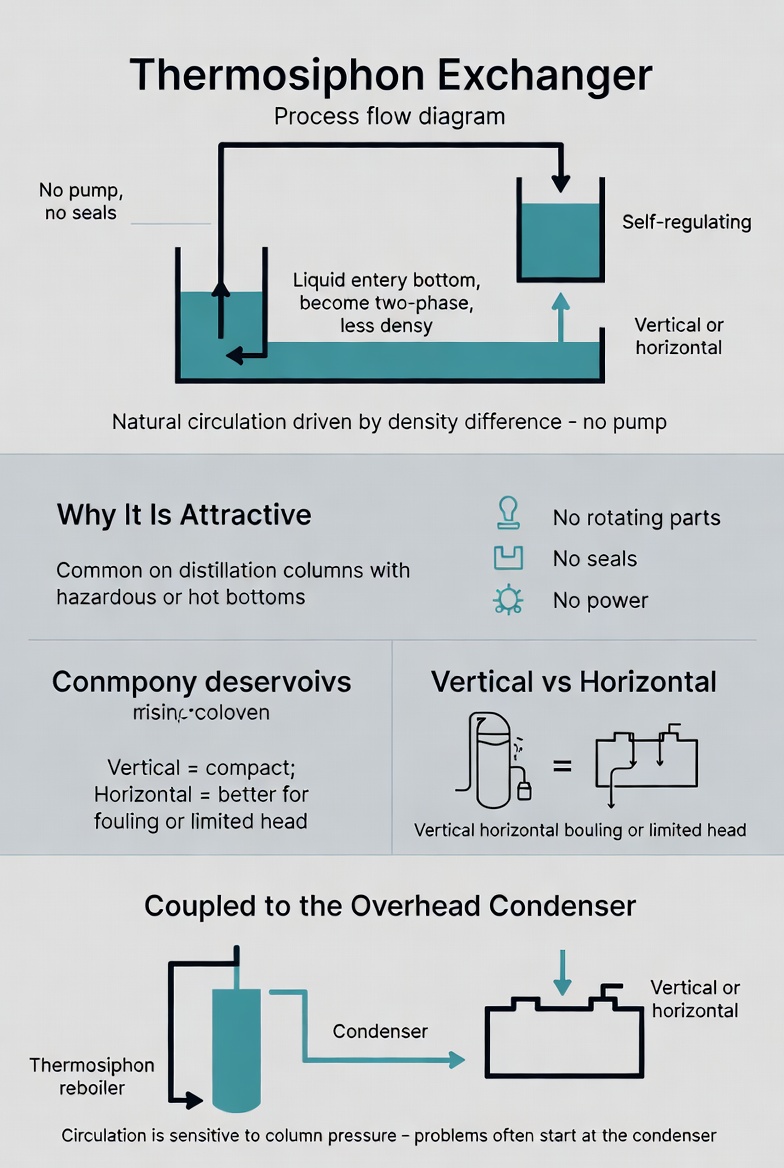
Thermosiphon Configuration
Thermosiphon design is a hydraulic problem as much as a thermal one. Elevation, riser and downcomer sizing and available static head all have to be established with the layout.
Configuration
- Orientation: Vertical or horizontal
- Shell Types: E or divided flow J
- Circulation: Natural, no pump
- Boiling Side: Tube or shell side
Features
- No pump or motor
- No seals to leak
- Self-regulating flow
- Low maintenance
- Compact plot footprint
Typical Condensing Duty
- Column reboilers
- Hazardous bottoms duty
- Gravity condensate return
- Closed loop circulation
- Solvent recovery columns
Designing for Natural Circulation
Static Head Is the Whole Design
In a pumped circuit, if the pressure drop turns out higher than expected you can usually turn the pump up. In a thermosiphon there is nothing to turn up. The driving force is fixed by geometry and fluid density, so every foot of elevation and every fitting in the riser matters. This makes thermosiphon design unusual among heat exchanger problems: the hydraulics have to be settled alongside the plot plan and the piping layout, not afterward.
Get it right and the system is beautifully robust. Get it wrong and the symptoms are unpleasant — sluggish circulation, poor heat transfer, and in bad cases flow instability or complete stall. Retrofitting a fix is difficult, because the remedy is usually elevation or larger piping and neither is easy to add later.
Turndown and Stability
A thermosiphon depends on generating vapor to create the density difference that drives flow. At reduced heat input less vapor forms, the driving head falls, circulation slows, and the exchanger moves toward the condition where it cannot sustain flow. Well-designed systems have adequate margin at minimum expected load; marginal ones work at design rate and misbehave whenever the plant turns down.
The instability worth knowing about is periodic. In some geometries the system can enter a cycle of vapor generation, flow surge, temporary loss of driving head and flow collapse, repeating at intervals. It shows up as oscillating column bottoms level or temperature and it is genuinely difficult to diagnose without knowing to look for it. Adequate static head, correctly sized risers, and avoiding excessive vaporization per pass are the standard defenses.
Vertical or Horizontal
Vertical thermosiphons boil the process fluid inside the tubes with the heating medium on the shell side. They are compact, need little plot space and use short piping runs, which helps the hydraulics. The tube side is straightforward to clean mechanically. Because the boiling happens inside relatively narrow tubes, vaporization per pass has to be kept moderate to avoid dryout at the tube exit.
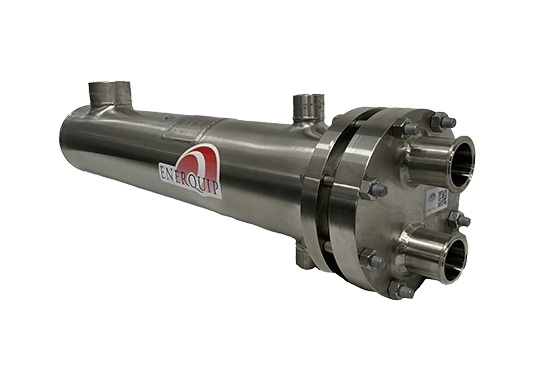
Horizontal thermosiphons boil on the shell side around a bundle carrying the heating medium. The shell side of a horizontal bundle is more accessible, so this suits fouling process fluids, and the arrangement works with less static head available. The trade is a larger plot footprint and longer connecting piping. A divided flow J shell with one inlet and two outlets is standard here, because halving the two-phase outlet path is one of the most effective ways to keep pressure drop within the available driving head.