
1-805-484-2992
Quotes - Engineering - SalesHeat Exchangers For
Condensing the Overhead of a Distillation
Every distillation ends at a condenser. Vapor leaving the top of a column or the head of a still has to be turned back into liquid, part of it returned as reflux and the rest drawn as product, and the way that split is made decides the condenser arrangement. Some plants condense everything into a drum and pump reflux back; others condense only part at the column top and finish the job downstream. Batch stills and continuous columns make different demands again, since one sees a composition that drifts through the run and the other a steady state that must hold for months.
The pages in this section follow those choices. Overhead and total condensers cover the common case where all of the vapor is condensed and reflux is metered from a drum. Partial and reflux condensers deal with arrangements that condense only a fraction at the column, either to return reflux by gravity or to send light ends forward as vapor. Product condensers handle the distillate draw and its cooling. Batch still and continuous column condensers address the two operating modes and what each does to sizing.
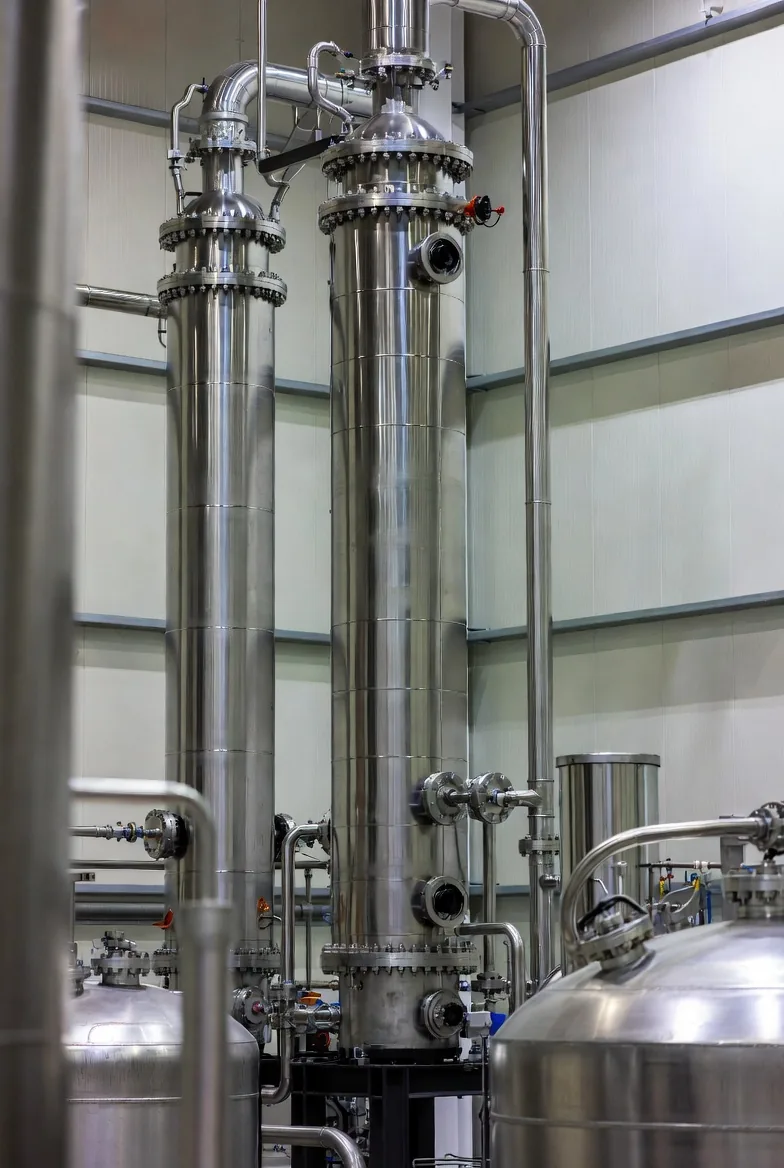
Distillation engineers usually arrive with a simulation in hand. The most useful additions are a condensing curve rather than a single temperature, the pressure drop the column can tolerate, and a clear statement of how reflux will be controlled.
Request a Quote



Total, Partial or Both
A total condenser takes all of the overhead to liquid and leaves reflux control to a drum, a pump and a valve. It is flexible, easy to control and familiar, and it suits most continuous columns. A partial condenser condenses only part of the overhead and sends the rest forward as vapor, either because light ends are the product or because column top pressure would be impossible to hold if they were condensed. Many columns use both in series.
The choice affects more than the condenser. A partial condenser counts as a theoretical stage, which can trim tray count; a total condenser with a subcooled return puts extra load on the top tray. Settling the arrangement before the condenser is rated avoids designing it twice.
Reading the Condensing Curve
Pure-component overheads condense at one temperature, but most real overheads are mixtures that condense over a range. Vapor enters at its dew point and, if fully condensed, leaves at its bubble point; the gap between them is the temperature glide. A condenser rated on an average temperature overstates its driving force near the outlet, where the coolant is warmest and the remaining vapor coldest. Rating it in zones along the curve, with the heat released at each temperature, gives an area that matches the duty. Wide-glide overheads, common with solvent mixtures and hydrocarbon cuts, also favor true countercurrent flow over cross flow.
Water-Cooled or Air-Cooled
A Fixed Tubesheet shell and tube condenser on cooling water gives a close approach, a small footprint and wide alloy choice, and it is the usual pick when water is available and clean enough. A Horizontal Fin Fan air-cooled condenser removes cooling water demand entirely, which matters at sites with scarce water or costly treatment, but it cannot condense much below ambient plus a substantial approach. Overheads that must condense cold, and many vacuum columns, end up on water, or on a water trim after an air-cooled first stage.
What a Well-Rated Condenser Gives the Column
A condenser with margin at peak boil-up holds column top pressure steady, and with it the temperature profile and the product specification. When it is short of area, pressure climbs with every increase in boil-up and operators back off throughput to stay on spec.
On the utility side, a condenser rated to the real condensing curve draws the coolant it needs and no more, leaving cooling tower or fin fan capacity for the next debottleneck.
Pressure Rating and Metallurgy
Atmospheric and pressure columns need shell and tubes rated to column design pressure with the relief case in mind; vacuum columns need full vacuum on the process side and generous vapor nozzles. Carbon steel suits dry hydrocarbons, while wet overheads carrying water, acids or chlorides go to 316L, duplex or higher. Watch the reflux drum boot and condensate outlet too, where free water collects and corrosion often starts first.
Running and Maintaining the Overhead
Watch the approach between condensate outlet and coolant inlet. When it widens at the same load, the surface is fouling or inerts are accumulating; when it closes too far, the unit is subcooling and wasting reboiler duty. Venting from the coldest point, keeping coolant velocity high enough to discourage deposits, and scheduling cleaning by trend rather than calendar keep the column running at rate.