1-805-484-2992
Quotes - Engineering - SalesVent Condensers
Flash Steam and Solvent Recovery from Vent Streams
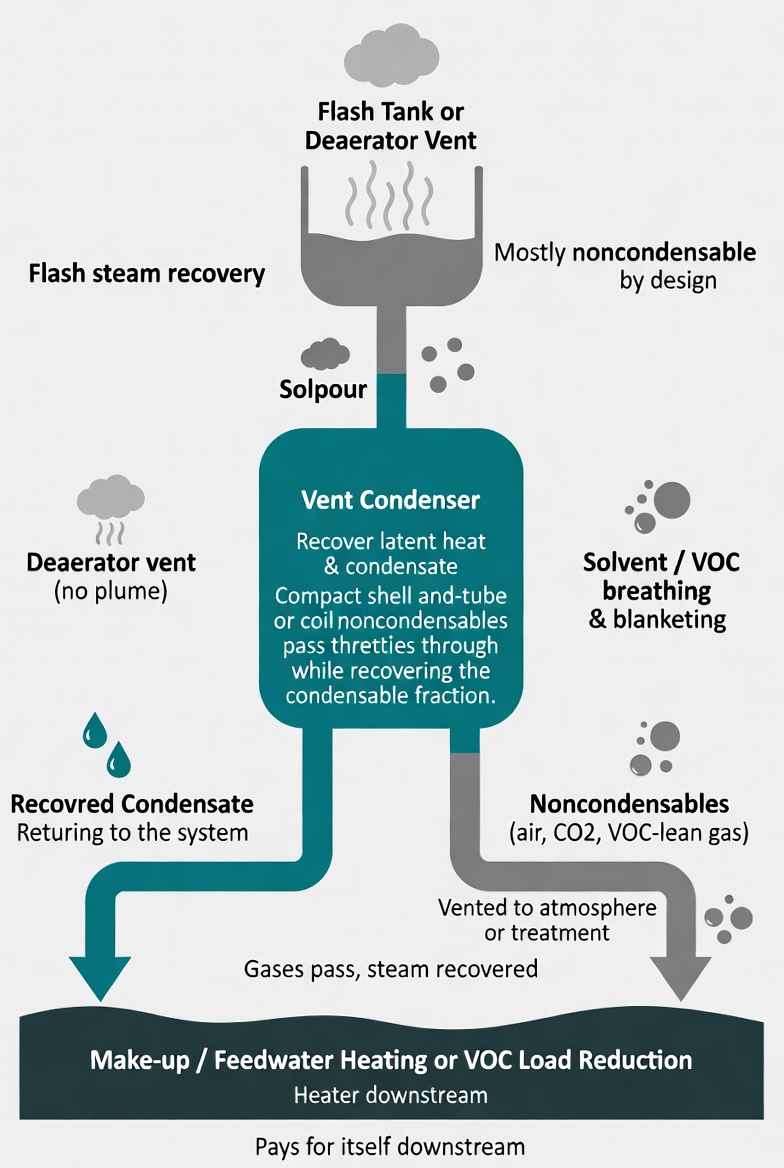
A vent condenser handles a stream that is mostly noncondensable by design, with a condensable fraction worth recovering. That makes it a genuinely different design problem from a process condenser, and it is the reason vent condensers are so often undersized: the coefficient achievable on a gas-dominated stream is a fraction of what the same geometry would give on saturated vapor, and no amount of optimism changes that. These units are always engineered for the specific application rather than selected from a table.
Flash steam recovery. When hot condensate is let down to a lower pressure in a flash tank or condensate receiver, some of it flashes to steam and, without a condenser, leaves through the vent as a visible plume. That plume is latent heat and treated water at the same time. A vent condenser recovers both, heating make-up water, boiler feedwater, process water or air with the recovered latent heat and returning the condensate to the system. As a general guide the cooling fluid needs to be below roughly 160°F to condense flash steam effectively.
One practical caution: if there is not enough cooling flow for the flash load, the coolant itself can reach saturation and start to flash, which invites water hammer. A flash steam bypass or another means of limiting the energy the coolant absorbs is the usual safeguard.
Deaerator vents. A deaerator has to vent continuously to expel the oxygen and carbon dioxide it exists to remove, and that vent carries a good deal of steam with it. A vent condenser recovers the steam while letting the dissolved gases pass, and can be arranged to reheat the leaving noncondensables so no visible plume forms at the discharge — a small detail that matters more than it sounds when the stack is visible from a public road.
Solvent and VOC recovery. Vent streams from dryers, vacuum systems, nitrogen-blanketed vessels and tank breathing carry condensable solvent in a large volume of air or nitrogen. Cooling the stream condenses the fraction whose boiling point is above the achieved temperature, recovering saleable material, reducing emissions, and cutting the load on downstream carbon adsorbers or thermal oxidisers. Because those treatment systems are expensive to run, the condenser frequently pays for itself on the reduction in downstream duty alone.
Tank breathing and blanketing. Storage tanks breathe with ambient temperature and with filling operations, and a blanketed vessel pushes gas out every time it is charged. Both produce intermittent, low-flow vent streams where the design case is often the peak during a transfer rather than a steady average.
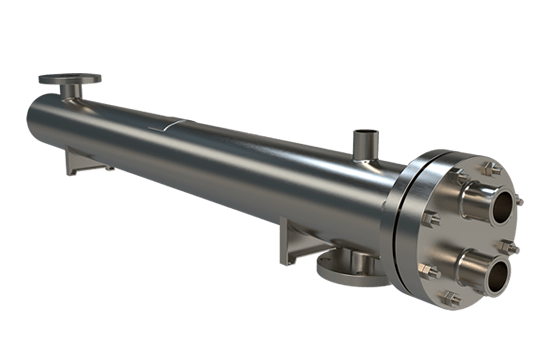
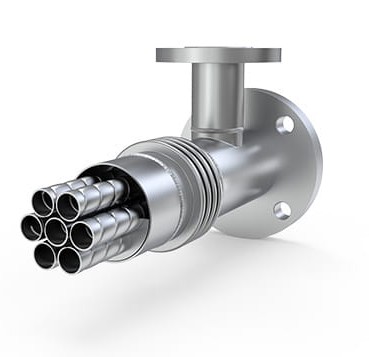
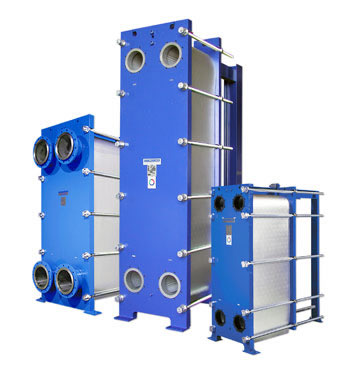
Exchanger selection. Shell and tube is the typical choice, with spiral, plate and finned coil units all appropriate depending on the stream and the heat sink. Where air or process gas is being heated rather than a liquid, a finned coil arrangement often makes the most sense.
Related pages: vacuum condensers, process condensers, and VOC recovery condensers.