1-805-484-2992
Quotes - Engineering - SalesDistillation Condensers
Total and Partial Condensing on Distillation and Fractionation Columns
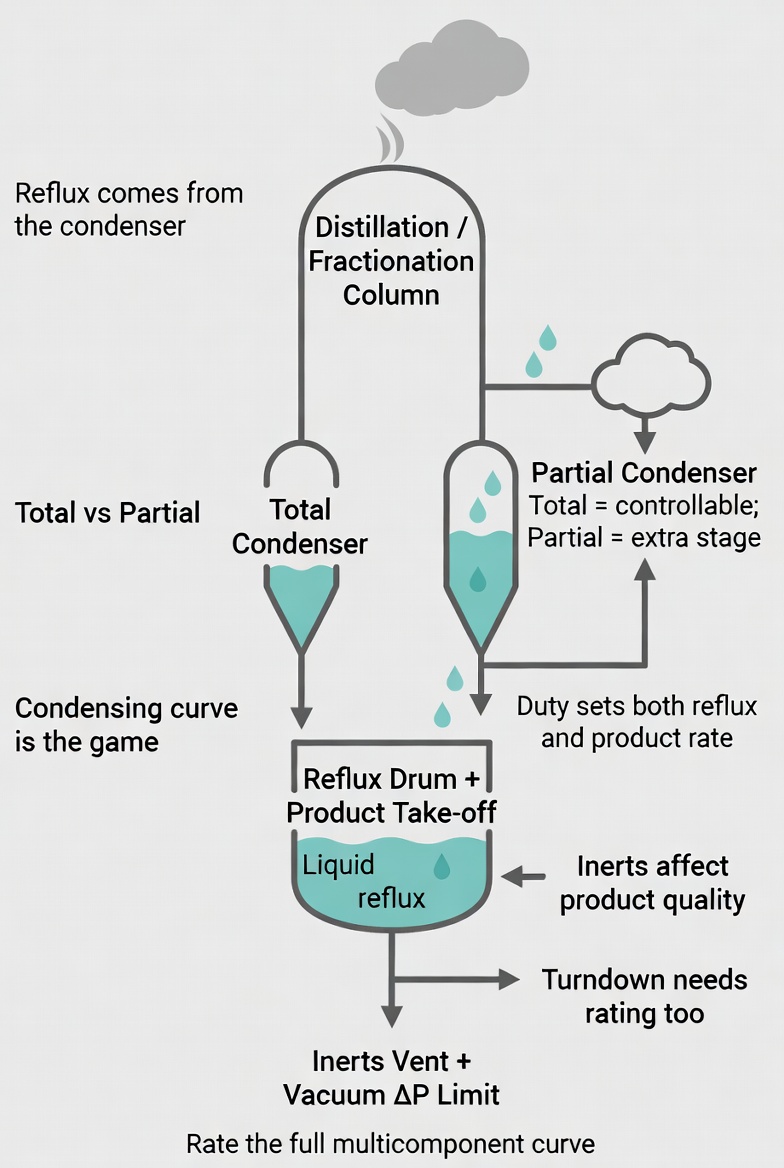
A distillation column separates because vapor rising through it contacts liquid running down it. That descending liquid is reflux, and reflux comes from the condenser. Change the condensing duty and you change the reflux ratio, which changes the separation, which changes product purity. This is why a condenser on a column cannot be specified in isolation from the column's operating envelope — it is part of the process design.
Total condensers. The entire overhead vapor is condensed, usually into a reflux drum, from which part returns to the column as reflux and part leaves as distillate. The drum is the reason this is the most controllable arrangement: it holds inventory, so reflux flow can be measured and manipulated directly, and it buffers the column against upsets in coolant temperature, vapor rate or inert loading before they reach the trays.
Partial condensers. Only part of the overhead is condensed. Liquid returns as reflux and an uncondensed vapor product leaves the top. This effectively buys an additional separation stage and suits systems with a light component you want to take as vapor. The cost is that the condenser is now coupled directly into the column's mass balance: its duty sets both reflux and vapor product rate simultaneously, so the two cannot be adjusted independently in the way a total condenser and drum allow.
The condensing curve is the whole game. A binary mixture with close-boiling components behaves almost isothermally. A wide-boiling multicomponent overhead does not: it begins condensing at its dewpoint and finishes at its bubble point, and between those the local temperature difference and the local coefficient both change substantially. Sizing on a mean temperature difference derived from terminal temperatures will mislead you, usually toward an undersized unit. Rating the curve in increments is the only reliable approach, and it is standard practice for us on any multicomponent overhead.
Inerts and light ends. Even a modest noncondensable fraction accumulates in the cold end of a condenser and blankets surface. In a column context this is worse than a simple loss of duty, because the resulting change in condensing rate propagates into reflux and shows up as a product specification excursion. A properly located vent and a design that accounts for the gas load prevents an intermittent, hard-to-diagnose quality problem.
Vacuum columns. Where the column runs under vacuum to keep bottoms temperature below a thermal degradation limit, allowable overhead pressure drop becomes the binding design constraint. Pressure lost in the condenser raises column pressure, which raises bottoms temperature, which is precisely what the vacuum was for.
Turndown. Columns run at reduced rates for all sorts of reasons. A condenser generously sized for peak duty can behave awkwardly at low load, where excess surface, condensate drainage and gas accumulation interact and reflux control becomes lively. We rate across the range rather than at the design point alone.
Related pages: overhead condensers, reflux condensers, dephlegmators, and fractionation condensers.