
1-805-484-2992
Quotes - Engineering - SalesHeat Exchangers For
Getting Solvent Back as Liquid
Solvent recovery condensers exist to put purchased solvent back in the drum. Acetone, methanol, ethanol, toluene, heptane, ethyl acetate, IPA, dichloromethane and THF are the regulars, and the economics are plain: every pound that leaves as vapor is bought a second time and then counted against an emissions limit. What unites the seven duties on this topic is a condensable solvent mixed, to some degree, with air or nitrogen, and a target stated as percent recovered or as outlet concentration.
Where the vapor originates changes everything else. A distillation column delivers nearly pure solvent vapor at a steady rate. An evaporator delivers solvent with entrained droplets and some product. A dryer or process exhaust carries a few percent solvent in a large volume of warm gas. A reactor follows a batch profile that peaks during heat-up and strip. A tank vent breathes with filling and daily temperature. A vacuum system pulls solvent at low pressure along with whatever air leaks in.
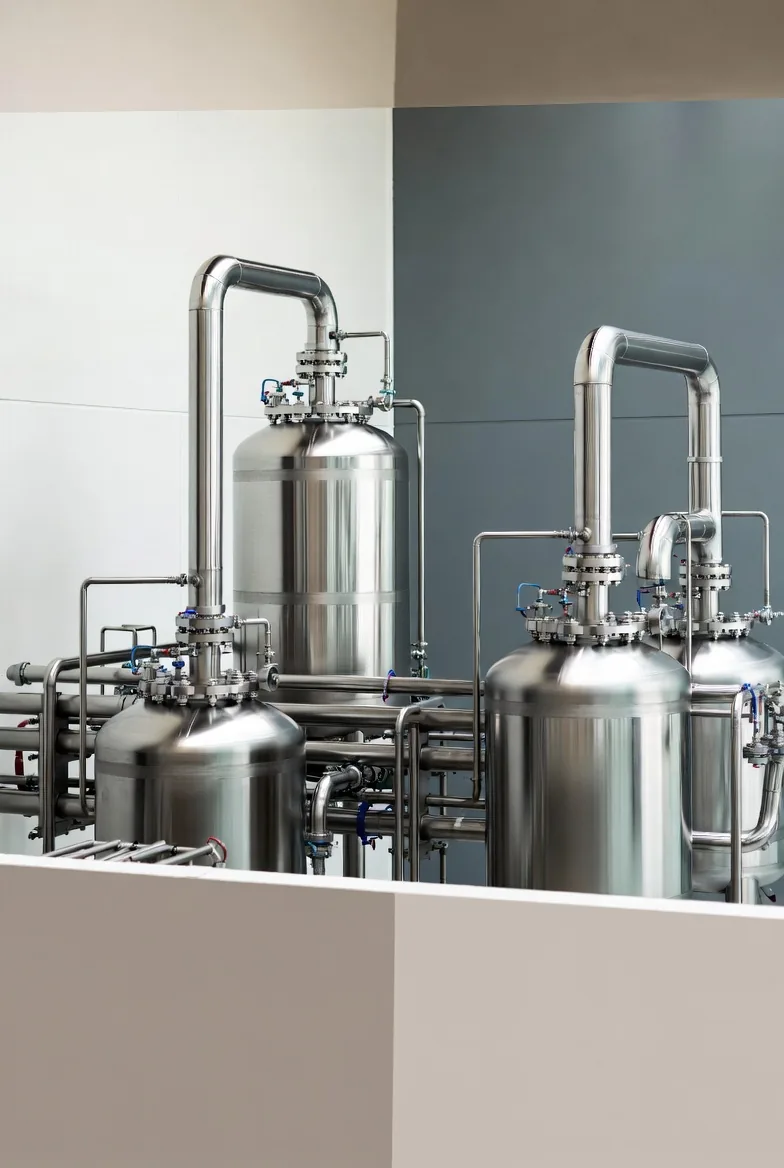
The seven pages under this topic take those sources one at a time. This page compares them and lays out what to settle before choosing among them.
Request a Quote



Rich Vapor Versus Lean Exhaust
The first split in the family is concentration. Column, evaporator and reactor vapors are rich: mostly solvent, condensing over a narrow range with high film coefficients, so the condenser is compact and the real challenge is venting the small inert fraction before it blankets the cold end. Dryer exhaust, process exhaust and tank vents are lean, perhaps one to ten percent solvent in air or nitrogen, where the gas-side coefficient controls and recovery is fixed by the solvent's vapor pressure at the outlet temperature.
Vacuum system recovery stands apart. The vapor may be rich, but at fifty torr its volume is enormous, pressure drop across the condenser subtracts directly from the vaccum the process sees, and leak air accumulates in the shell if the vent line is undersized. A unit that works well at atmospheric pressure can be close to useless at full vacuum.
Picking the Right Solvent Duty
Identify the source first, then the concentration, then the target. A ninety-nine percent recovery from lean dryer exhaust may require cooling well below freezing, bringing frost and staged cooling into the design; the same target on a column overhead is met with tower water. For reactor and tank vent duties, size on the peak rate rather than the batch average, or the condenser floods for ten minutes of every cycle and that is when most of the losses occur. For vacuum service, specify condensing pressure and leak rate, because an outlet temperature alone will not size the unit.
Fixed Tubesheet or Welded Plate for Solvent
A Fixed Tubesheet shell and tube unit with vapor on the shell side handles every source in this family, including dirty evaporator vapor and high-volume exhaust, and it can be mounted vertically for clean condensate drainage with a natural vent at the bottom. A Welded Plate unit delivers high duty in a small footprint with no gaskets touching solvents that swell elastomers, and its close approach makes good use of chilled glycol on rich vapors. It is less suited to lean, high-volume exhaust, where channel pressure drop climbs, and to vapors carrying polymer or product fines.
Payback in Recovered Liquid
Recovered solvent offsets purchase cost directly, and on many columns and reactors the condenser pays for itself within a few production campaigns.
Lower vent concentrations ease the load on any carbon bed or oxidizer that follows and keep the site inside its permitted emissions as production grows.
Choosing Metals for Solvent Service
Most nonhalogenated solvents are compatible with carbon steel shells and 304 or 316 stainless tubes. Chlorinated solvents in contact with water hydrolyze slowly to hydrochloric acid, so 316L becomes a minimum and duplex or higher alloys are common on wet DCM streams. Pharmaceutical solvent recovery may call for 316L product contact with a documented finish, because the recovered solvent returns to a GMP process. Note any water-miscible solvent that will carry dissolved acid, and any amine or ammonia that rules out copper alloys.
Sizing Inputs Every Solvent Duty Shares
For any of the seven sources, provide the solvent or mixture with composition, total flow and inert gas flow seperately, inlet temperature and pressure, the recovery target as percent or outlet concentration, and the coolant with supply temperature and available flow. For batch sources add the time profile of the vapor rate. For lean streams add the water content, because water condensing or freezing ahead of the solvent changes the duty and can plug the exchanger.