
1-805-484-2992
Quotes - Engineering - Sales| PRODUCT | STYLE | FLOW | BUNDLE |
| Condenser / Cooler | Multi-Tube Hairpin | Countercurrent | Removable |
Multi-Tube Hairpin Exchangers
Countercurrent Performance With Practical Surface Area
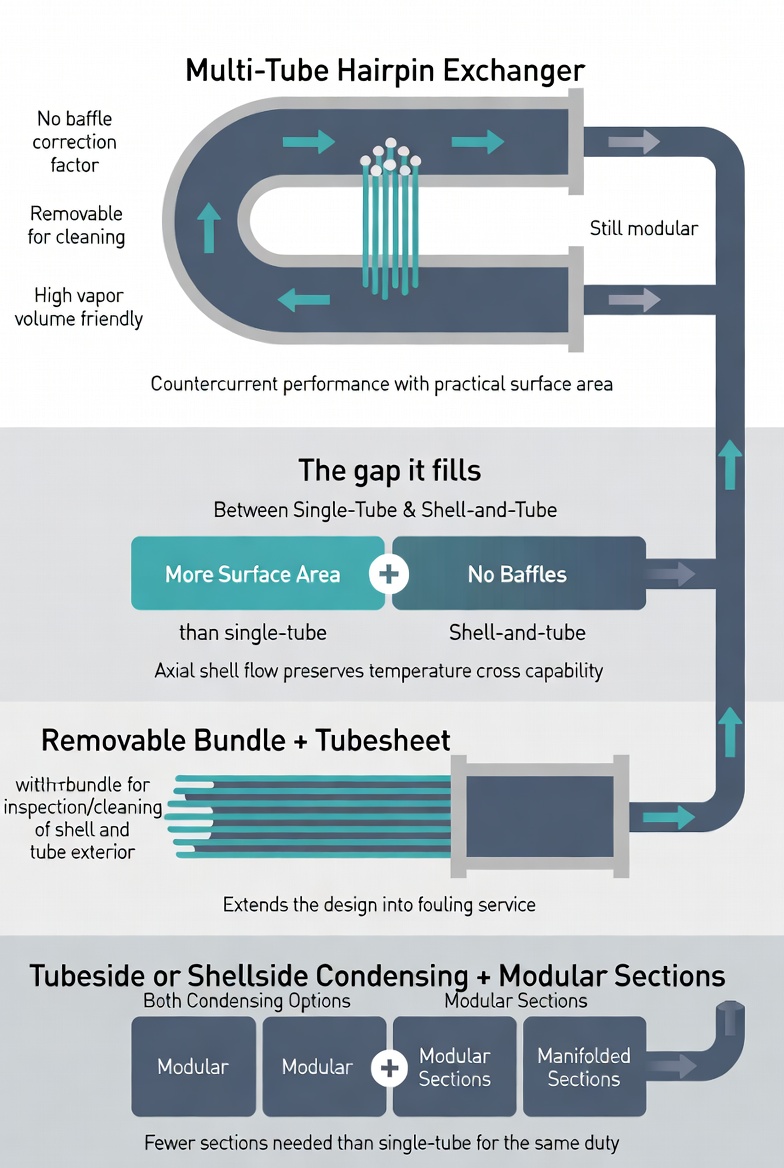
A multi-tube hairpin keeps the hairpin shell and the U-bend geometry but replaces the single inner pipe with a small bundle of tubes. The result sits deliberately between a classic double pipe unit and a shell and tube exchanger, and it exists because there is a real gap between them.
The gap it fills. A single-tube hairpin runs out of surface quickly. A shell and tube gives plenty of surface but introduces baffles, which means crossflow, which means a correction factor on the temperature difference and the loss of a true temperature cross in one unit. A multi-tube hairpin gives several times the surface of a single-tube unit while keeping flow essentially countercurrent, because the shell-side fluid travels axially along the bundle rather than being forced across it.
The bundle comes out. Unlike a single-tube hairpin where the inner pipe is simply withdrawn, a multi-tube unit generally has a removable bundle with a proper tubesheet. The shell interior and the outside of the tubes can be inspected and cleaned, which extends the construction into fouling service that a sealed unit could not handle.
Condensing behavior. For condensing duty the multi-tube arrangement offers a useful choice that a single-tube hairpin does not. Condensing inside the tubes gives multiple parallel paths and good drainage in a vertical or sloped installation, with the coolant in the shell. Condensing on the shell side around the bundle gives a much larger flow area for the vapor, which is what you want when volumetric flow is high or pressure drop is constrained. That flexibility is one of the main reasons to step up from a single-tube unit.
Modularity survives. Multi-tube hairpins are still built in sections and manifolded, so surface can still be added later. The section count needed for a given duty is simply far lower, which keeps the connection count, support requirements and installed pressure drop manageable at duties where a single-tube train would have become unwieldy.
Related: single-tube hairpins for smaller duty, and shell and tube when the duty outgrows this construction.
Multi-Tube Hairpin Configuration
Tube count, tube size, fin selection and section arrangement follow from the duty, the allowable pressure drops and which side is condensing.
Configuration
- Construction: Bundle in hairpin shell
- Flow: Essentially countercurrent
- Bundle: Removable, tubesheet
- Tubes: Plain or finned
Features
- Several times the surface
- Removable tube bundle
- Countercurrent retained
- High pressure capable
- Still modular in sections
Typical Condensing Duty
- Mid-size vent condensing
- Solvent recovery duty
- Condensate subcooling
- High pressure condensing
- Fouling small duty
Choosing a Multi-Tube Hairpin
Which Side Should Condense
This is the useful decision that opens up once there is a bundle rather than a single tube. Condensing inside the tubes gives many small parallel paths, which drains well in a sloped or vertical installation and suits hygienic duty because the wetted side is smooth and cleanable. It works best when the vapor volumetric flow is moderate.
Condensing on the shell side around the bundle gives a much larger flow area, so vapor velocity and pressure drop stay low even at high volumetric flow. That is the arrangement for vacuum or near-vacuum duty and for any service where pressure drop is the binding constraint. The trade is that shell-side condensate drainage needs attention and the shell side is the harder side to keep hygienic.
Fins and the Weak Side
Longitudinal fins can be applied to the outside of the tubes in a multi-tube bundle just as they can on a single-tube hairpin, and the logic is the same: multiply area on whichever side has the poorer coefficient. In condensing service the condensing side usually has an excellent coefficient, so if fins help at all they help on the coolant side.
It is worth checking rather than assuming. A condensing stream heavily loaded with noncondensable gas can have a far poorer coefficient than clean condensing theory suggests, sometimes poor enough to become the controlling resistance. In that case fins on the coolant side buy nothing, and the honest answer is more area or a different configuration.
Knowing When to Move to Shell and Tube
Multi-tube hairpins extend the double pipe range considerably, but they do not extend it indefinitely. As duty grows, the number of sections climbs again and the same problems return: connection count, supports, accumulated pressure drop and installed cost. At that point a shell and tube exchanger with proper baffles will do the job in one shell for less money.
The signals that it is time to change are straightforward: more than a handful of sections, a temperature cross that is no longer required, or a duty where a single large shell would fit the plot comfortably. The signals to stay are equally clear: a genuine temperature cross, a pressure rating that would burden a shell, hazardous fluid where minimal inventory matters, or a real prospect of needing more capacity later.