1-805-484-2992
Quotes - Engineering - SalesSanitary Condensers
Hygienic Vapor Condensing for Food, Dairy and Beverage Processing
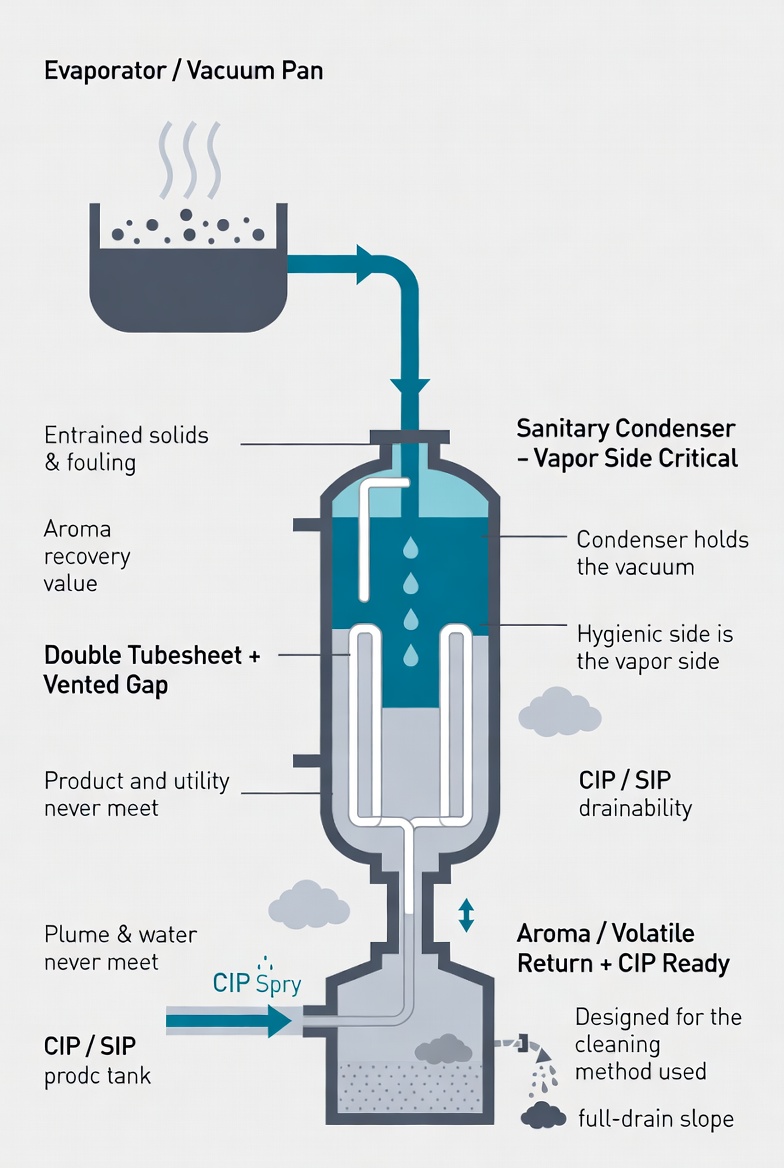
A sanitary condenser handles vapor that either is product, has been in contact with product, or produces condensate that will return to the process. That makes the vapor side the hygienically critical side, which is the opposite of most industrial condensing duty where the process fluid is dirty and the utility side is clean. Everything about the design follows from that inversion.
Vapor coming off a cooker, an evaporator effect or a vacuum pan carries entrained solids — milk and whey solids, sugars, proteins, starch, fines, fruit pulp. On the condensing surface those solids concentrate, and in the condensate film they stay warm. Residue that cannot leave the exchanger completely is a bioburden problem before the next production run starts, and it is also a fouling problem that quietly erodes the thermal performance you paid for.
Evaporator and vacuum pan vapor. Concentrating milk, whey, juice, coffee extract or plant protein happens under vacuum precisely so it can run at low temperature and avoid cooking the product. The condenser is what holds that vacuum. If it underperforms, the boiling temperature rises and product quality drops — color, flavor, nutritional value. On multiple-effect, TVR and MVR plant the surplus vapor condenser is a small item on the P&ID that quietly governs the whole concentration step.
Aroma and volatile recovery. On juice, coffee and tea concentration the light volatile fraction that leaves with the vapor is exactly the fraction that carries the aroma. Condensed and returned to the product, it is worth real money; sent to drain, it is a quality loss you can taste. That duty needs the condensing curve controlled deliberately rather than just enough surface to knock the vapor down.
Cooker, oven and blancher exhaust. Here the objectives are usually plume elimination, make-up water recovery and reducing load on downstream odor control. The stream is wet, dirty and heavily diluted with air, so the design has to tolerate a low coefficient and provide for the noncondensable fraction instead of pretending it is saturated steam.
Where product and utility must never meet. If a tube leak could put glycol, cooling water or plant steam condensate into a product stream, a double tubesheet with a vented interspace turns that failure into something visible on a walk-round rather than something discovered in a finished-goods test. It costs surface area. Against the cost of destroying product and investigating every batch since the last good sample, it is usually trivial.
Design for the cleaning method you actually use. CIP recirculation, SIP with clean steam and manual strip-down each imply different things about slope, drain placement, connection style, gasket material and surface finish. We would rather ask how the unit gets cleaned at quotation than guess and have you discover the answer during validation.
Clean steam duty is covered separately on our clean steam condensers page. For market-specific detail see dairy condensers, brewery condensers and vegetable processing condensers.