
1-805-484-2992
Quotes - Engineering - SalesShell and Tube Condenser Design
A shell and tube condenser is described by three choices, and TEMA gives each of them a letter: the front head, the shell, and the rear head. Five front head types, seven shell types and eight rear head types combine into a very large number of configurations, and the reason that matters is that condensing duty exercises the differences far more than liquid-to-liquid service does. Where the vapor goes, how the condensate leaves, where noncondensable gas collects, and whether you can clean the surface that fouls are all decided by those three letters. Get them right and the exchanger works for decades; get them wrong and no amount of extra surface area will rescue it.
- Shell side or tube side? Condensing on the shell side suits large vapor volumes and low pressure drop. Condensing inside the tubes suits hygienic duty, vertical drainage and high-pressure vapor.
- X shell — crossflow. The most common shell for vapor condensing. Vapor enters across the top of the bundle and produces very low shell-side pressure drop, which makes it the usual answer for vacuum service.
- J shell — divided flow. Two vapor inlets and a single central outlet for condensate and residual gas. Halving the flow path halves the pressure drop, which suits condensing duty that cannot afford much loss.
- E shell — single pass. The standard workhorse shell. Adequate for most condensing at or above atmospheric pressure where pressure drop is not the binding constraint and cost matters.
- Removable bundle or not? Fixed tubesheet is the least expensive per square foot but the shell side can only be cleaned chemically. U-tube and floating head bundles come out for mechanical cleaning.
- Thermal expansion. A large temperature difference between shell and tubes has to go somewhere. U-tube and floating head absorb it by design; fixed tubesheet needs an expansion joint.
Sanitary & Hygienic:
Food, Dairy & Pharma
- 316L, polished to spec
- Double tubesheet option
- Drainable and CIP-ready
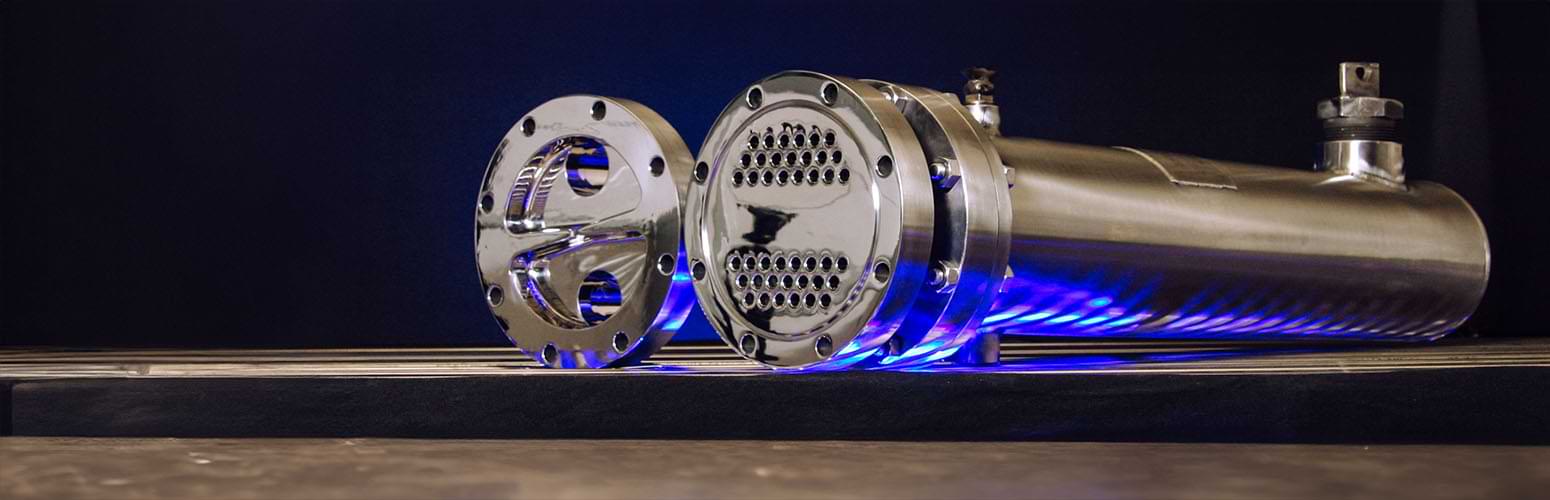
Industrial & Process:
Chemical & Utility
- Carbon steel to Hastelloy
- Vacuum or pressure duty
- TEMA B, C or R class
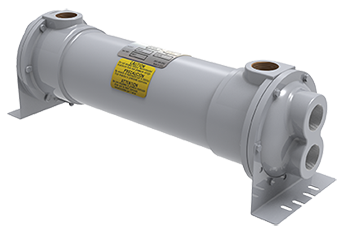
Column Service:
Reflux & Overheads
- Vertical or horizontal
- Partial or total duty
- Countercurrent capable
Selecting a Shell and Tube Condenser
Which Side Should the Vapor Be On?
This is the first question and it drives everything after it. Vapor on the shell side gives a large flow area, which is what you want when the volumetric flow is high — and under vacuum, volumetric flow is always high. It also lets you use the X or J shells that exist specifically to keep vapor-side pressure drop low. The drawback is that the shell side is the harder side to clean and the harder side to drain completely.
Vapor inside the tubes is the better answer for hygienic service, where the wetted side must be smooth, positively drained and cleanable, and for reflux and dephlegmator duty where condensate has to run back down the same passage the vapor came up. It is also the choice when the vapor is at high pressure, because containing pressure in tubes is cheaper than containing it in a large shell.
Shell Types That Exist for Condensing
The TEMA X shell, or crossflow shell, is the one most commonly used for vapor condensing. Vapor is distributed across the top of the bundle and flows down across the tubes, which produces a very low shell-side pressure drop and makes the X shell the standard answer for vacuum condensing. Proper X shell condensers reserve a tube-free lane along the top of the exchanger so vapor distributes evenly, and a clear area at the bottom of the bundle so condensate can run to the outlet nozzle without backing up into the tubes. Because the vapor path is short and the velocities are low, careful attention to noncondensable removal is essential in an X shell — there is little natural sweeping action to move gas along.
The J shell, or divided flow shell, is the other condensing-oriented design. For a condensing shell fluid it is arranged with two vapor inlets and one central outlet, so each half of the vapor travels half the length. Pressure drop falls by roughly an order of magnitude compared with the equivalent E shell. The same shell reversed, with one inlet and two outlets, is the conventional arrangement for thermosiphon reboilers.
Rear Head: The Cleaning and Expansion Decision
Fixed tubesheet construction welds the tubesheets to the shell. It is the simplest and least expensive design per square foot of surface, and the tube bores can be cleaned mechanically or chemically without difficulty. What you give up is access: the outside of the tubes can only be cleaned chemically, and there is no provision for differential thermal expansion, so a large shell-to-tube temperature difference requires an expansion joint.
U-tube construction has a single tubesheet with bent tubes, so every tube is free to expand and contract independently. That makes it the most tolerant design for thermal shock and large temperature differences, and the bundle lifts out for shell-side cleaning. The trade-off is the U-bend itself, which is awkward to clean mechanically on the inside.
Floating head designs let the rear tubesheet move axially inside the shell. They are the most flexible and the most expensive. The split-ring type is the usual choice where both thermal expansion and regular shell-side cleaning are required; the pull-through type is simpler to maintain because the whole bundle comes out as one piece, but it costs more and carries fewer tubes because of the annular dead space around the floating head. Packed and gasketed floating tubesheets are cheaper still, but the seal can leak, so they are limited to fluids that are neither toxic nor volatile.
Materials and Class
Condensate chemistry, not bulk vapor chemistry, should drive material selection. The first liquid to condense concentrates whatever acid or chloride is present into a small volume, and that film is what attacks the tube wall. 304L and 316L stainless cover a great deal of condensing duty. Duplex grades, titanium, high-nickel alloys such as Hastelloy and AL-6XN, and lined or graphite construction all exist for the services where stainless will not survive.
TEMA class sets the construction standard rather than the geometry. Class R is the most stringent, intended for refinery service, with the heaviest materials and tightest tolerances. Class B covers chemical process service. Class C is lighter construction for general commercial duty. Matching the class to the severity of the service is a straightforward way to avoid paying for robustness you do not need — or regretting the absence of it.
Shell and Tube Condensing Duty
PHARMA • HIGH PURITY
WFI & Pure Steam
Double tubesheet condensers where the condensate is the product and a tube leak cannot be allowed to go unseen.
+ Learn More
UTILITY • STEAM
Surface Condensers
Turbine exhaust condensing under vacuum, with water box, hotwell and air removal sized as one system.
+ Learn More
SEPARATION • COLUMNS
Overhead Condensers
Column and tower overhead duty where fouling, corrosion and pressure drop decide the configuration.
+ Learn More