
1-805-484-2992
Quotes - Engineering - SalesCondensing Without Cooling Water
An air cooled condenser is a finned tube bundle with fans. Vapor condenses inside the tubes, ambient air passes over the finned outside, and the latent heat leaves with the air. Because air is a far poorer heat transfer medium than water, the surface area required is much larger — which is why these units are physically big and why fins exist at all. What you buy in exchange is independence from a water supply. For plants in arid regions, sites where a cooling tower permit is difficult, or facilities where water treatment and blowdown costs have become a real operating line item, that independence is often decisive.
- No water infrastructure. No tower, no basin, no circulating pumps, no treatment chemicals, no blowdown to dispose of, and no makeup water to buy or permit.
- Ambient sets performance. The lowest condensing temperature achievable is bounded by dry bulb air temperature plus an approach. Summer conditions size the unit; winter needs control to avoid over-condensing.
- Condensate must drain. Vapor condenses inside the tubes, so tube slope and outlet arrangement decide whether condensate leaves freely or backs up and floods surface from the bottom.
- Noncondensables still matter. Air cooled condensers under vacuum need the same careful venting as any other condenser, and the long parallel tube runs make gas maldistribution easier to create.
- Fan power is the operating cost. Air cooling trades pumping and water treatment cost for fan horsepower. Variable frequency drives, two-speed motors and louvres let you spend that power only when ambient demands it.
- Freeze protection. In cold climates a condensing bundle can freeze locally where flow stagnates. Recirculation ducts, louvres and steam-side control all address it, and it has to be designed in.
A-Frame Steam:
Turbine Exhaust Duty
- Sloped for drainage
- Very large vapor volume
- Multi-cell arrangement
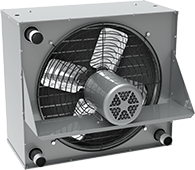
Horizontal Fin Fan:
Process Condensing
- Simple, low profile
- Easy access for cleaning
- Wide alloy selection
Draft Options:
Forced or Induced
- Forced: fan below bundle
- Induced: fan above bundle
- Recirculation control
Air Cooled Condenser Design Considerations
Sizing Against the Summer Case
A water cooled condenser sees a cooling water temperature that varies over a modest range. An air cooled condenser sees whatever the ambient dry bulb happens to be, which in many locations swings sixty degrees or more between a winter night and a summer afternoon. Because the design case has to be the hot one, an air cooled condenser is oversized for most of the year — typically substantially so.
That surplus capacity is not free performance. Under light ambient conditions the unit will over-condense and subcool, which can pull system pressure below where the process wants it, destabilize control, and in cold weather create local freezing where flow stagnates. Fan speed control, fan staging, adjustable louvres and warm air recirculation all exist to manage this, and on a condensing duty they are not optional extras.
Condensate Drainage Inside Tubes
In nearly all air cooled condensers the vapor condenses inside the tubes. That makes condensate drainage a geometric problem: liquid has to run along the tube to the outlet header without accumulating, while vapor continues to flow in the same direction. If drainage is inadequate the tube floods from the outlet end back, taking surface out of service and producing a slow, confusing loss of capacity that looks like fouling.
This is the main reason A-frame and V-bank arrangements are so common on steam condensing duty. Sloping the bundle gives condensate a gravity path to the bottom header, and the geometry also presents a very large face area to the air, which matters when the volumetric vapor flow is as large as turbine exhaust under vacuum.
Forced Draft or Induced Draft
In a forced draft arrangement the fan sits below the bundle and pushes ambient air up through it. The fan handles cool air, so fan and motor life is good and maintenance access at grade is straightforward. The downside is poor air distribution across the bundle face and a strong tendency to recirculate hot discharge air back to the inlet, which quietly raises the effective inlet temperature and derates the unit.
In an induced draft arrangement the fan sits above the bundle and pulls air through. Distribution is more even, discharge velocity is higher so recirculation is much less likely, and the bundle is shielded from sun and rain. The fan runs in hot air, which limits materials and shortens life, and everything needing service is up on the structure. Neither arrangement is universally right; the choice usually comes down to plot constraints, ambient conditions and how much recirculation risk the site presents.
Where Air Cooling Makes Sense for Condensing
Air cooling is a strong fit where cooling water is genuinely scarce or expensive, where a new tower would trigger permitting difficulty, where the condensing temperature is comfortably above summer ambient, and where plot space is available. It is a poor fit where the process needs a low condensing temperature that summer air cannot reach, where the vapor is corrosive enough to demand an expensive alloy across a very large surface, or where plot space is tight.
A common and sensible middle path is a hybrid: an air cooled condenser handling the bulk of the duty with a small water cooled or chilled trim condenser downstream to reach the final condition. That keeps water consumption low while removing the ambient dependence from the part of the duty that cannot tolerate it.
Air Cooled Condensing Duty
UTILITY • STEAM
Surface Condensing
Turbine exhaust condensing without a cooling tower, using A-frame cells sized for the summer ambient case.
+ Learn More
PROCESS • GENERAL
Process Condensing
Reactor, stripper and general process vapor condensing at sites where water treatment cost drives the decision.
+ Learn More
SEPARATION • OVERHEADS
Column Overheads
Refinery and petrochemical overhead duty, the traditional home of the air cooled condenser.
+ Learn More