
1-805-484-2992
Quotes - Engineering - SalesHeat Exchangers For
Condensers on Multi-Product Fractionators
Fractionation separates a mixture into several products along one column: light ends overhead, side draws at intermediate trays, heavies at the bottom. The condensers that serve a fractionator handle more than one stream, each with its own composition, pressure and specification. Overhead vapor is usually a wide-boiling mixture with some gas that will not condense at cooling-water temperature. Side draws are taken from inside the column and condensed or cooled for product, and solvent recovery columns split a used solvent into fractions clean enough to reuse.
The pages in this section follow the streams a fractionator produces. The column overhead page covers the main condenser and its vent gas. Reflux stream condensing deals with the liquid returned to the top tray and how its temperature affects separation. Side-draw condensers take vapor from mid-column to make an intermediate product. Recovered product vapor and solvent fraction condensers cover the cuts that are sold or reused, where product quality, not only recovery, sets the design.
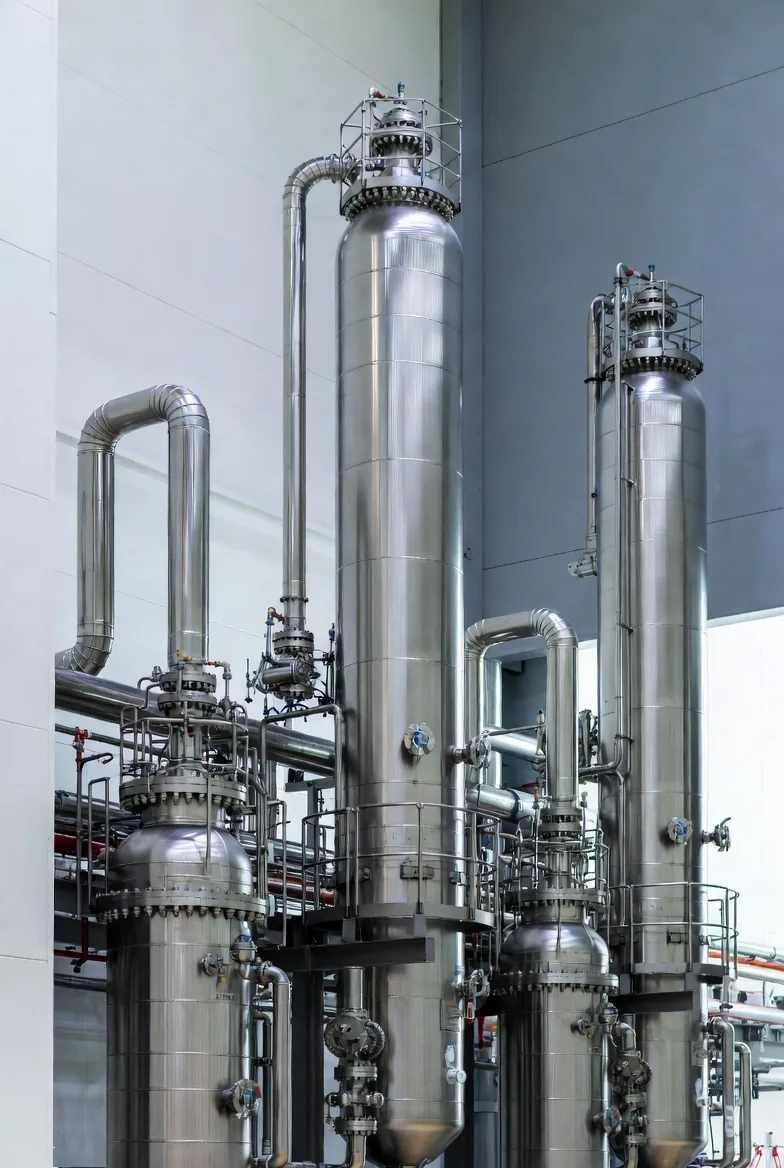
Refinery, petrochemical, gas-plant and specialty-chemical engineers run these columns and typically bring a heat and material balance. What usually needs adding is the condensing curve for each stream and the fouling and cleaning history of the existing train.
Request a Quote



Multi-Component Condensing
A fractionator overhead rarely condenses at a single temperature. With light hydrocarbons, solvents or mixed aromatics in the stream, condensation spreads across a glide that may run tens of degrees, and the lightest components condense last, at the coldest end. Any gas that will not condense at coolant temperature leaves as a vent stream and carries some condensable product with it.
Rating such a stream means stepping along the condensing curve and checking local temperature difference, heat transfer coefficient and mass-transfer resistance in each zone. A single log-mean temperature difference across the whole unit can overstate capacity badly on wide-glide duty, and that error later shows up as a column that can not hold top pressure.
Specifying Each Product Stream
Each condenser on a fractionator should be specified for its own stream: overhead, reflux, side draw or solvent cut. Give the inlet composition, the outlet state wanted (fully condensed, partially condensed, or subcooled to a storage temperature), the allowable pressure drop and the product specification the stream feeds. A side-draw condenser that subcools a light product too little can flash in the rundown line, and one that subcools too much wastes surface. Stating where each cut goes next lets the rating account for it.
Fixed Tubesheet or Floating Head
A Fixed Tubesheet condenser is the economical choice when the shell side is clean cooling water and the temperature difference between shell and tubes stays within what an expansion joint can absorb. Fractionator duties often break one of those conditions. Hydrocarbon overheads carrying corrosion products or polymer foul the tubes, and hot vapor against cold water drives large differential expansion. A Floating Head bundle can be pulled for mechanical cleaning of both sides and lets the tubes grow freely, which is why it is the long-standing choice for heavy refinery and petrochemical service.
Gains From Rating Every Stream
Condensers rated individually to their streams keep each product on specification without operators juggling coolant between them, and they hold column pressure steady when one product rate changes.
Properly sized side-draw and product condensers also recover more saleable liquid from the vent gas and the rundown, which shows up directly as yield per barrel or per batch.
Construction for Hydrocarbon Service
Carbon steel shells and tubes cover dry hydrocarbon service. Wet overheads carrying water, hydrogen sulfide, ammonium salts or chlorides need attention where water first condenses, because that is where salts deposit and corrosion concentrates; wash water injection and duplex or alloy tubes are the common answers. TEMA class R construction applies to most refinery condensers, with design pressure set by the column and its relief case.
Fouling, Cleaning and Monitoring
Fractionator condensers foul from both sides: cooling water scale and biological growth on one, salts, polymer or coke fines on the other. Trend the overall coefficient from routine temperature and flow readings and plan bundle pulls from the trend. Floating Head construction also allows a spare bundle to be swapped in during a short outage, keeping the column on stream while the dirty one is cleaned.