
1-805-484-2992
Quotes - Engineering - SalesPlate Condensers and Their Envelope
A plate exchanger builds its heat transfer surface from a stack of thin corrugated plates rather than a bundle of tubes. The corrugations force turbulence at low velocity, which produces heat transfer coefficients several times higher than a comparable shell and tube, and the resulting unit is dramatically smaller for the same duty. For condensing service the appeal is real: a very close temperature approach, a small footprint and low hold-up volume. The limitation is equally real. The channels between plates are narrow, and narrow channels and high-volume vapor are fundamentally in tension. Under vacuum, where specific volume is enormous, that tension usually decides the answer.
- Close approach. Genuine countercurrent flow across the plate pack allows approach temperatures a shell and tube would need far more surface to reach, which matters when coolant is only slightly colder than the vapor.
- Compact and light. A plate condenser occupies a small fraction of the space and weight of an equivalent shell and tube, which is decisive on mezzanines, skids and inside existing buildings.
- Pressure drop is the limit. Narrow channels mean vapor-side pressure drop rises quickly with volumetric flow. This is what rules plate condensers out of most deep vacuum duty regardless of their thermal advantage.
- Vapor distribution. Getting vapor evenly into every channel of a plate pack is harder than distributing it across a tube bundle, and maldistribution shows up as capacity you paid for but cannot use.
- Gaskets set the envelope. On gasketed units the elastomer, not the plate, limits temperature, pressure and chemical compatibility. Welded and brazed constructions remove that limit at the cost of openability.
- Fouling tolerance is low. Narrow channels block. Plate condensers suit clean vapor; streams carrying solids, polymer or heavy fouling belong in a spiral or a shell and tube with a removable bundle.
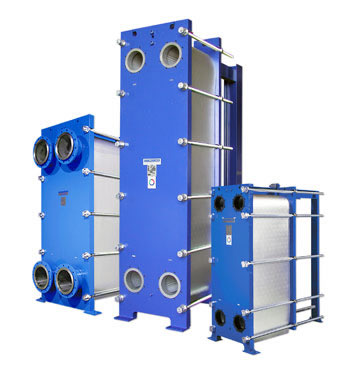
Gasketed Plate:
Openable & Serviceable
- Fully openable pack
- Plates can be added
- Gasket sets the limits
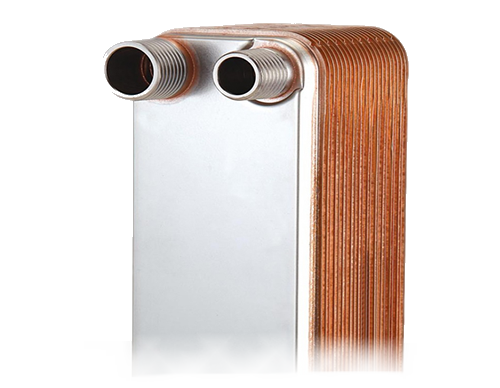
Brazed Plate:
Compact & Sealed
- No gaskets at all
- Very compact and cheap
- Clean duty only
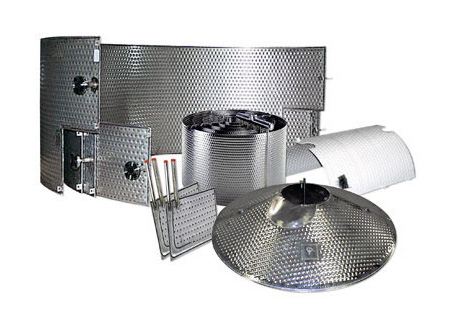
Welded Plate:
Aggressive Service
- No gasket limitation
- Higher temp and pressure
- Vacuum capable
Where Plate Condensers Fit
The Pressure Drop Conversation
Everything about plate condenser selection comes back to vapor-side pressure drop. A plate pack achieves its high coefficient by forcing flow through narrow, tortuous channels. For a liquid that is an excellent bargain. For a vapor it depends entirely on the volumetric flow, because pressure drop scales with velocity squared and velocity scales with volume.
At or above atmospheric pressure, where a given mass flow of vapor occupies a manageable volume, plate condensers work well and their compactness is a genuine advantage. As pressure falls the same mass flow expands, velocities climb, and pressure drop rises until it exceeds what the process can tolerate. Since pressure lost in the condenser directly raises the pressure the process sees, a plate condenser can reach the point where it defeats the vacuum it is meant to serve. Deep vacuum condensing generally belongs to X shell, spiral or crossflow designs instead.
Gasketed, Brazed or Welded
Gasketed plate and frame units clamp the plate pack between end frames with an elastomeric gasket around every plate. The pack opens completely for inspection and cleaning, individual plates can be replaced, and capacity can be increased later by adding plates to the same frame. Those are significant practical advantages. The gasket, however, sets the operating envelope: it limits temperature, it limits pressure, and it must be chemically compatible with both streams and with any cleaning solution.
Brazed plate units replace gaskets with a brazing alloy, usually copper, fusing the pack into a single sealed block. They are compact, inexpensive and well suited to clean duties such as refrigerant condensing. They cannot be opened, so they cannot be mechanically cleaned, and the braze alloy has its own chemical compatibility limits.
Fully welded plate units eliminate both gaskets and braze. They tolerate higher temperatures and pressures, handle aggressive chemistry, and are capable of vacuum service that gasketed units cannot approach. They cannot be opened either, so cleaning is chemical, and they cost more.
Condensate and Noncondensables in a Plate Pack
Two practical issues deserve attention on any plate condensing application. The first is condensate removal: liquid forming inside a narrow channel has to leave without restricting the vapor still flowing through it, which puts real weight on plate pattern selection, orientation and port sizing. The second is noncondensable gas. In a tube bundle, gas accumulation is at least predictable — it collects in the coldest, most stagnant region and can be vented from there. In a plate pack with many parallel channels, gas can preferentially load some channels and not others, and the affected channels stop contributing. That failure mode is difficult to diagnose from outside the unit, which is a good reason to treat noncondensable loading as a design input rather than an operating surprise.
A Reasonable Rule of Thumb
Plate condensers are worth serious consideration when the vapor is clean, the operating pressure is at or above atmospheric, the duty needs a close temperature approach, and space or weight is constrained. They are worth ruling out early when the service is under meaningful vacuum, when the vapor carries solids or fouls readily, when the chemistry or temperature exceeds what gaskets or braze will tolerate, or when a very large vapor volume has to be handled.
None of that is a criticism of the technology — it is simply a narrower envelope than shell and tube. Within it, a plate condenser is frequently the most cost-effective answer available.
Plate Condensing Duty
SANITARY • FOOD
Sanitary Duty
Food, dairy and beverage condensing where a close approach in a small footprint is worth more than fouling tolerance.
+ Learn More
UTILITY • RECOVERY
Vent Condensers
Flash steam and vent recovery duty where the heat sink is a liquid and the stream is clean.
+ Learn More
PROCESS • EVAPORATION
Evaporator Duty
Surplus vapor condensing on evaporation plant where footprint is tight and the vapor is clean.
+ Learn More