
1-805-484-2992
Quotes - Engineering - SalesHeat Exchangers For
Interstage Coolers and Knock-Out Condensers for Process Gas
Every time a compressor raises gas pressure it raises temperature, and a multistage machine needs the gas cooled between stages to save power and protect the next stage. When that gas carries water or heavier components, cooling also condenses liquid, and the interstage cooler becomes a condenser feeding a knock-out drum. The same pattern runs through recycle gas loops, cracked gas, CO2 compression and air separation trains: cool, condense, separate and send dry gas forward.
Fixed Tubesheet shell and tube coolers suit most interstage duties, with gas in the tubes when it is dirty or corrosive and on the shell when pressure drop must be minimal. Horizontal Fin Fan coolers reject heat directly to air on large gas plants and remote stations, where water is costly or absent, and often take the first stage of cooling ahead of a water trim.
The failure that matters most here is liquid reaching the next stage. Condensate slugs damage impellers, valves and pistons far faster than any thermal shortfall costs in power.
Final aftercoolers follow the same rules with a different goal. After the last stage, gas is cooled for the downstream process or pipeline, and the condensate that drops out there can be the largest share of water the train removes. Treat the aftercooler and its separator as seriously as the interstage units.
Request a Quote




Cooling Between Stages
Compression power rises with suction temperature, so every degree a cooler fails to remove is paid for in the next stage. A common target is gas within 15 to 20 F of coolant temperature. Pressure drop costs power too, and an allowance of 1 to 2 percent of stage pressure is a typical budget.
Send the compressor stage pressures and temperatures with the inquiry; they define the duty far better than nameplate horsepower.
Knocking Out the Condensate
Cooling gas below its dew point produces liquid that has to be removed before the next stage. A cooler discharging into a properly sized separator with a mesh pad or vane pack removes droplets down to a few microns. When the gas arrives at the separator as fine mist, a condenser with excessive tube velocity has usually sheared the liquid film into droplets the separator can not catch.
Water-Cooled or Air-Cooled
Fixed Tubesheet shell and tube coolers give a closer approach and a smaller footprint where cooling water exists, and they contain high pressure economically with gas in the tubes. Horizontal Fin Fan coolers avoid cooling water entirely and suit large flows, but they are limited by the hottest day and need freeze protection when condensing water in winter. Many trains run both in series.
Startup and low load deserve a look too. At reduced flow, gas leaves the cooler colder than design, more liquid condenses and, on some gases, hydrates or freezing become possible. A bypass or coolant control holds the outlet within a band rather than letting it run as cold as the cooler can make it.
Gas-Side Fouling
Polymer-forming gases, lube oil carryover, salts and dust all deposit inside interstage coolers, and the deposit raises discharge temperature and pressure drop at the same time.
Gas in the tubes makes cleaning straightforward, since straight tubes can be hydroblasted with the channel covers off. Where gas must run on the shell side and deposits are expected, consider a removable bundle.
Where Water First Condenses
The first point of condensation is where corrosion concentrates. CO2, H2S, chlorides or ammonia dissolve into that first film, and carbon steel can thin quickly there while dry sections look new. Stainless tubes, or stainless in the condensing section only, are common upgrades. Provide gas composition including trace contaminants so condensing-zone chemistry can be judged.
Instruments That Protect the Machine
A high-level switch in the knock-out drum, an outlet gas temperature transmitter and a differential pressure gauge across the cooler give operators early warning. Rising outlet temperature at steady load signals fouling; rising drum level at steady temperature signals a drain or trap problem. Both are cheaper to catch on a trend than in a compressor teardown.
Coolant side matters as well. Cooling water returning above about 120 F scales quickly on the tube wall, so where gas inlet temperatures are high, a higher water flow or a split between an air-cooled first stage and a water-cooled trim keeps the water-side wall temperature in a safe range.
Related
GAS PROCESSING • MARKET
Natural Gas
Meeting pipeline dew point and condensing glycol or amine regenerator overheads are two different duties. Condensers for both in gas plants.
+ Learn More
GAS PROCESSING • MARKET
Hydrogen
Electrolyzer and reformer hydrogen leaves wet. Cool it and knock out water before dryers, PSA or compression with a properly sized condenser.
+ Learn More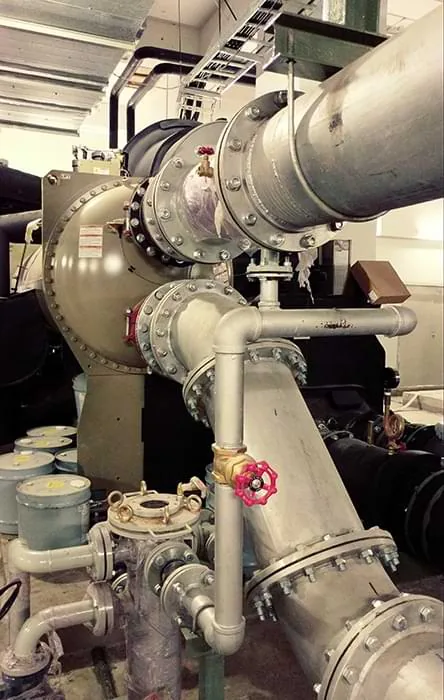
GAS PROCESSING • MARKET
Gas-to-Liquid
Fischer-Tropsch overhead holds syngas, naphtha, diesel, reaction water and wax. Condensers that recover each across a broad condensing curve.
+ Learn More