
1-805-484-2992
Quotes - Engineering - SalesDouble Pipe and Hairpin Condensers
A double pipe exchanger puts one fluid in an inner tube and the other in the annulus around it. Because there is only one channel per side, the flow is genuinely countercurrent end to end — not approximately countercurrent as in a baffled shell, but actually so. That gives double pipe units a thermal characteristic no shell and tube can match: they handle a temperature cross, where the cold outlet leaves hotter than the hot outlet, without needing multiple shells in series. Folded into a U to save space, the same exchanger is called a hairpin, and hairpins can be stacked and manifolded to build surface in modular increments.
- True countercurrent flow. One channel per side means genuine end-to-end counterflow, so a temperature cross is achievable in a single unit and the log mean driving force is the best available.
- Very high pressure capability. Both sides are pipe, and pipe is the cheapest way to contain pressure. Double pipe units handle pressures that would make an equivalent shell prohibitively heavy.
- Modular surface. Need more area? Add another hairpin section to the manifold. Few other constructions let you increase duty incrementally without replacing the exchanger.
- Low hold-up volume. Very little liquid inventory, which matters for hazardous fluids, for expensive product, and for hygienic duty where residual condensate is a contamination risk.
- Surface area per unit cost. Double pipe gives the least surface per dollar and per square foot of plot of any construction, so it stops making sense above a modest duty.
- Small duty is the niche. These are the right answer for sample coolers, small vent condensers, point-of-use duty and pilot plant service — not for a column overhead or a surface condenser.
Hairpin:
Single Inner Tube
- Simplest construction
- True countercurrent
- Very high pressure
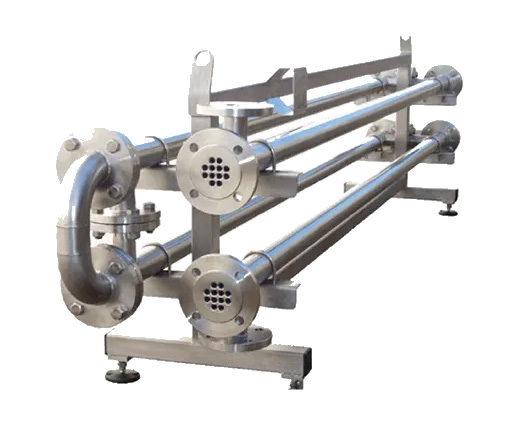
Multi-Tube:
More Surface, Same Shell
- Several inner tubes
- Better area per unit
- Removable bundle
Double Pipe Condensing Applications
Why Countercurrent Flow Matters
In a baffled shell and tube exchanger the shell-side fluid crosses the bundle repeatedly, so the flow is a mixture of crossflow and counterflow. The consequence is a correction factor applied to the log mean temperature difference, and that factor gets worse as the temperature approach gets closer. Push far enough and a single shell simply cannot do the duty; you need two or three in series.
A double pipe exchanger has no such penalty. One channel per side, flowing in opposite directions, gives the full countercurrent driving force. On a condensing duty with subcooling — where you want the condensate to leave meaningfully colder than the vapor entered — that capability is genuinely useful, and it is why double pipe sections often appear as subcooling stages downstream of a larger primary condenser.
Where Double Pipe Wins on Condensing Duty
The honest answer is: on small duties, and on duties with awkward requirements. Sample and analyser coolers, where a small vapor or hot liquid stream must be brought to a controlled temperature reliably. Small vent condensers on tanks and receivers. Point-of-use cooling on hygienic water systems, where the very low hold-up and easy slope-to-drain are exactly what the hygienic design requires. Pilot plant and laboratory duty, where the process may change and modular surface is worth more than optimized cost. High-pressure condensing, where pipe construction is far cheaper than an equivalent pressure-rated shell.
They also suit services where fouling is severe but the duty is small, because a hairpin can be opened and the inner tube cleaned or replaced without much ceremony.
Single Tube or Multi-Tube
A classic hairpin has one inner tube in one outer pipe. It is as simple as heat transfer equipment gets, tolerates very high pressures and very high temperature differences, and is easy to clean. Its weakness is surface area: one tube gives very little, so duty scales only by adding sections, and at some point the manifolding, supports and pressure drop stop being worth it.
A multi-tube hairpin puts a small bundle of inner tubes inside the outer shell instead. The unit retains the countercurrent flow characteristic and the hairpin geometry, but delivers several times the surface in the same envelope. The bundle is generally removable for cleaning. This is the natural step when a single-tube hairpin train would need too many sections, and it extends the practical range of the construction considerably before shell and tube becomes the better answer.
Knowing When to Stop
Double pipe exchangers become uneconomic as duty grows, and the crossover is not especially high. Once a duty needs more than a modest number of hairpin sections, a shell and tube unit will deliver the same surface in less space, with less piping, fewer joints and lower installed cost. We would rather tell you that at quotation than sell you a manifold of sections that a single shell would have handled better.
The exception worth noting is pressure. If the vapor is at a pressure that would require an unusually heavy shell, double pipe construction can remain the economic answer well past the surface area where it would otherwise have been displaced.
Double Pipe Condensing Duty
UTILITY • VENTS
Vent Condensers
Small tank and receiver vent duty where a compact countercurrent unit beats a small shell and tube.
+ Learn More
PHARMA • POINT OF USE
Hygienic Duty
Point-of-use and sampling duty where minimal hold-up and full drainability are the requirement.
+ Learn More
SEPARATION • REFLUX
Small Still Duty
Reflux and knock-back service on small batch stills and pilot plant reactors.
+ Learn More