
1-805-484-2992
Quotes - Engineering - Sales| PRODUCT | STYLE | TEMA TYPE | BUNDLE |
| Vapor Condenser | Floating Head | AES / AET / BES | Removable |
Floating Head Condensers
Straight Tubes, Removable Bundle, Free Expansion
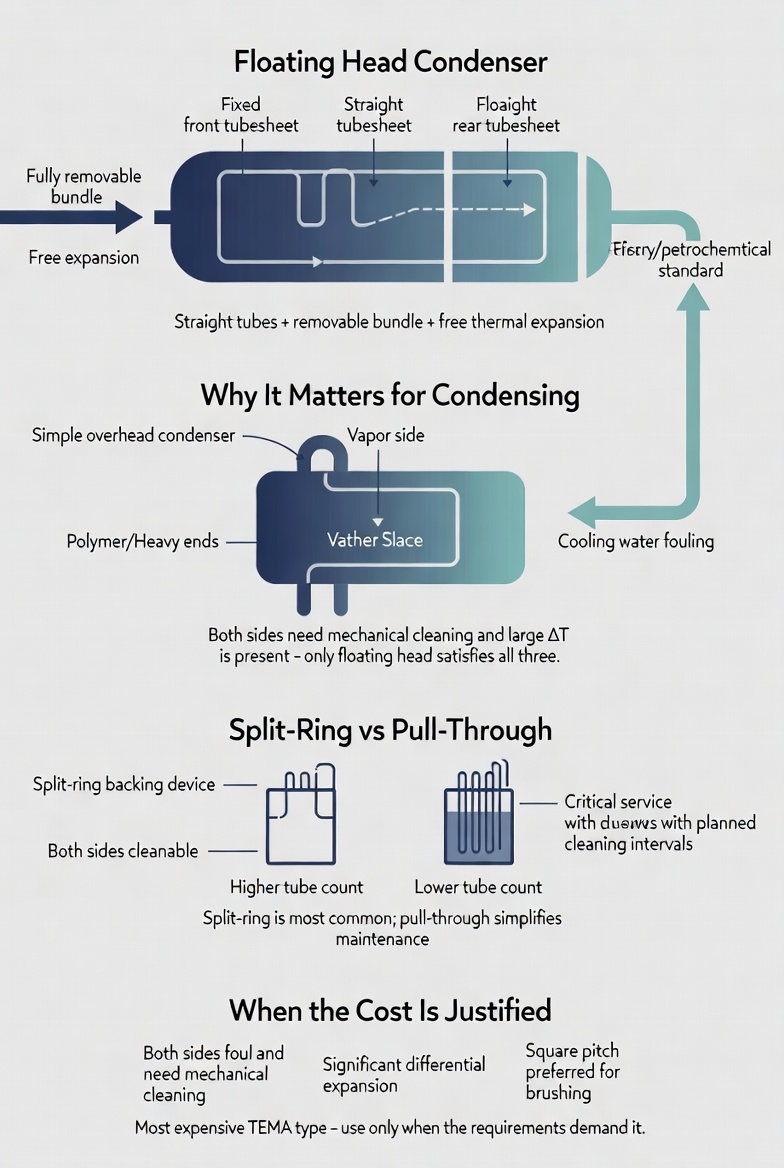
A floating head exchanger has two tubesheets like a fixed tubesheet unit, but the rear one is not welded to the shell. It floats — free to move axially as the tubes expand and contract independently of the shell. Straight tubes run between the two tubesheets, and the whole bundle can be withdrawn for cleaning. That combination is what makes the configuration valuable: it is the only standard design that gives you free thermal expansion and straight, fully cleanable tubes and a removable bundle, all at once.
Why it matters on condensing duty. Consider an overhead condenser on a fractionation tower. The vapor side deposits polymer and heavy ends and needs mechanical cleaning. The cooling water side is river or tower water and fouls biologically, so it also needs mechanical cleaning. The temperature difference is large enough to cause real differential expansion. A fixed tubesheet cannot be cleaned on the shell side. A U-tube cannot be properly cleaned on the tube side. Only a floating head satisfies all three requirements, which is why it is standard in refinery and petrochemical service.
Split-ring versus pull-through. The split-ring type is the most common. A backing device clamps around the floating tubesheet, and the floating head cover bolts to it. The head diameter can approach the shell diameter, so tube count is good, but the backing ring has to be removed before the bundle will come out. The pull-through type bolts the head directly to the floating tubesheet, so the entire bundle withdraws as a single piece with no disassembly inside the shell. Maintenance is simpler, but the head must fit through the shell, which leaves an annular dead space and reduces tube count for a given shell diameter — so it costs more per square foot.
Packed and gasketed alternatives. The floating tubesheet can also be sealed with packing or a gasket rather than an internal head. These are cheaper and allow the shell side to be inspected and steam cleaned, and only the shell fluid contacts the packing. The seal can leak, however, so these types are restricted to fluids that are neither toxic nor volatile. On a condenser handling solvent, hydrocarbon or anything hazardous, that generally rules them out.
Where the cost is justified. Floating head units are the most expensive configuration and they should not be the default. They earn their price when both sides foul, when thermal expansion is significant, when the service is critical enough that cleaning intervals are planned rather than hoped for, and when a square tube pitch is wanted so brushes can pass between tube rows.
See also U-tube where only shell-side access is needed, and overhead condensers for the classic application.
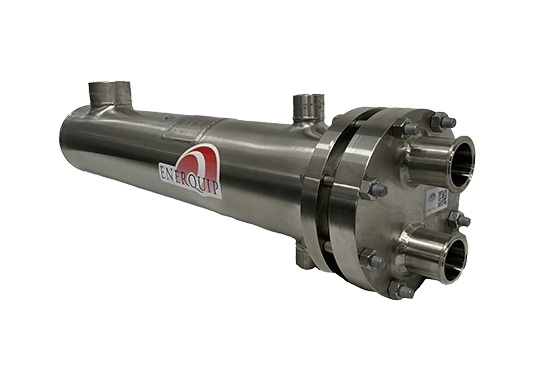
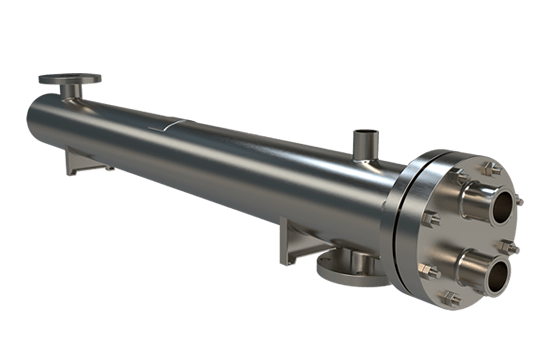
Floating Head Condenser Configuration
Typical arrangement for fouling condensing duty. Head style, pitch and baffle selection all follow from the cleaning method and the fouling character of both streams.
Configuration
- TEMA Types: AES, AET, BES, BET
- Rear Head: S, T, P or W
- Bundle: Fully removable
- Tube Pitch: Square for cleaning
Features
- Straight cleanable tubes
- Free thermal expansion
- Shell side steam cleanable
- Large bundle entrance area
- Multi-pass tube circuits
Typical Condensing Duty
- Refinery overheads
- Petrochemical condensers
- Fouling both sides
- Heavy hydrocarbon service
- Critical cleaning intervals
Floating Head Selection for Condensers
Split-Ring or Pull-Through
The practical difference is what has to happen before the bundle comes out. On a split-ring design, someone must enter the shell, remove the backing ring and unbolt the floating head cover before the bundle will move. That is routine but it takes time and it requires access. On a pull-through design the head is bolted straight to the floating tubesheet and the whole assembly slides out in one operation.
The cost of that convenience is tube count. A pull-through head has to pass through the shell bore, so its diameter is smaller than the shell, leaving an annular gap around it that carries no tubes. For the same shell diameter you get less surface, which means a larger shell for the same duty. Where maintenance frequency is high, that trade is often worth making; where cleaning is annual, split-ring usually wins on cost.
Tube Pitch and Cleaning Access
A removable bundle is only as cleanable as its layout allows. On a triangular pitch, tubes are packed as densely as possible — good for surface area per shell diameter, but there is no straight lane between tube rows, so mechanical brushing of the outside surface is not practical and cleaning is limited to hydroblasting or chemical methods.
A square or rotated square pitch opens straight lanes between rows. Brushes and lances can pass through, and the shell side becomes genuinely mechanically cleanable. The cost is fewer tubes in the same shell. On a fouling condenser this is one of the most consequential decisions in the specification, and it is worth settling deliberately rather than accepting whatever the thermal design software proposes.
Packed and Gasketed Types
Externally packed and outside-packed lantern ring designs seal the floating tubesheet against the shell with packing or a gasket instead of an internal head. They are less expensive, they allow shell-side inspection and steam cleaning, and only the shell-side fluid contacts the packing, so the tube-side fluid stays contained.
The limitation is straightforward: packing and gaskets can leak, particularly after thermal cycling. That confines these designs to services where a small shell-side leak would be a nuisance rather than a hazard. Water, glycol, and benign process liquids are candidates. Solvent, hydrocarbon, toxic or volatile condensing service is not, and on those duties the extra cost of an internal floating head is not really optional.