1-805-484-2992
Quotes - Engineering - SalesReflux Condensers
Knock-Back and Reflux Condensing on Reactors and Batch Stills
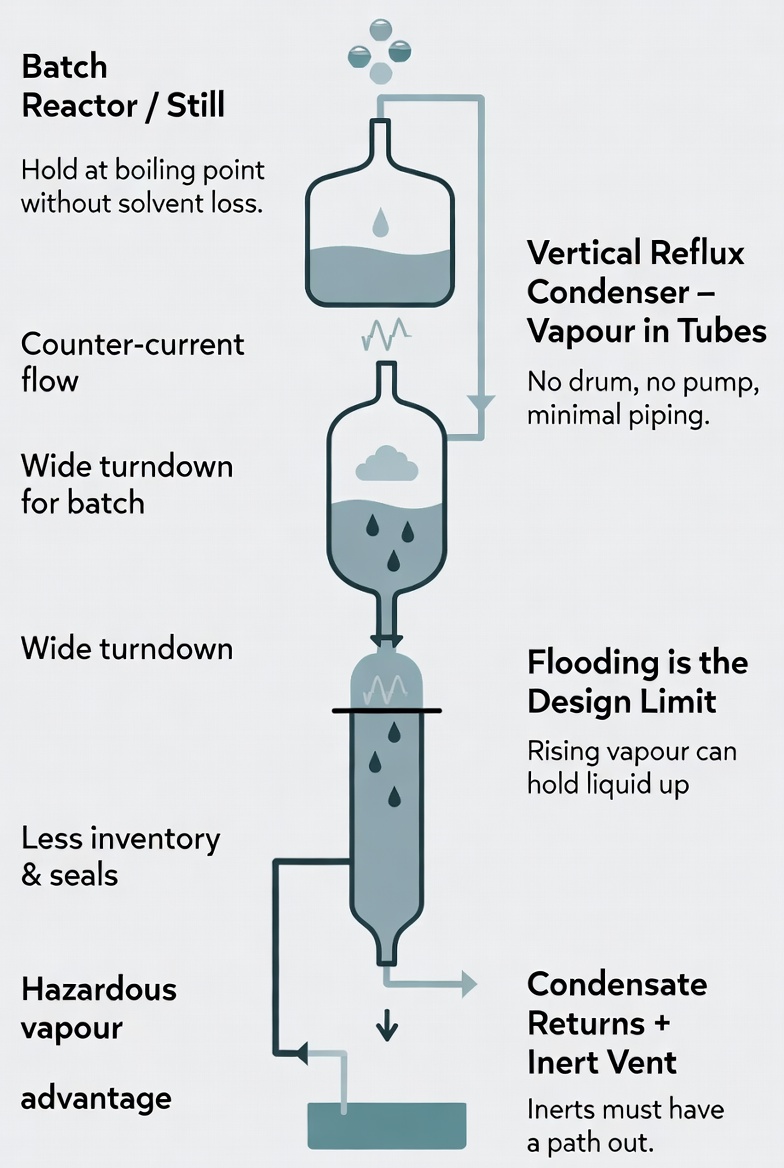
A reflux condenser condenses vapor and returns the condensate directly to the vessel that produced it, with no reflux drum and no pump in the path. On a batch reactor it lets you hold a reaction at the solvent's boiling point indefinitely without losing solvent inventory — a knock-back condenser in the usual shorthand. On a batch still or a column it generates reflux internally. On a solvent recovery system it returns heavy material while letting light ends and inerts pass on to vent treatment.
Why vertical, and why vapor in the tubes. Nearly all reflux condensers are vertical with the vapor rising inside the tubes and coolant on the shell side. Condensate then runs back down the same tubes it condensed in, against the rising vapor, and falls out of the bottom head into the vessel. It is a compact arrangement that needs no pump, no drum and very little piping.
Flooding is the real design limit. Because vapor flows up and condensate flows down in the same tube, the two interact. Above a certain vapor velocity the rising gas holds the liquid film up instead of letting it drain, liquid accumulates, and the tube floods. Once that starts, condensing surface is lost, the pressure in the vessel climbs, and behavior can become unstable in a way that is unpleasant on a reacting system. Flooding — not the heat transfer coefficient — is what sets the maximum diameter, tube size and vapor load for the unit, and it is why most vertical units in this service are designed for downflow condensation with a deliberate margin. Checking that margin is a specific calculation, not a rule of thumb.
Inerts have to be able to leave. A reflux condenser on a closed reactor is a dead end unless there is a vent path. Nitrogen from a blanket, air from a charge, or gas generated by the reaction will otherwise collect at the top of the tubes, blanket the coldest and most effective surface, and progressively strangle the condensing duty. Reflux condensers that lose performance during a batch and recover after being opened up are almost always suffering from this.
Batch duty means wide turndown. Vapor rate through a batch varies enormously: high while a solvent boils off, much lower at the tail. A unit sized for peak load has surplus surface at the end, which is not harmless — it changes where condensation completes in the tubes and can cause subcooling and unstable behavior. Rating across the range is what keeps operation predictable.
Where the vapor is hazardous, a reflux arrangement is attractive for reasons beyond cost: no drum and no pump means less inventory, fewer seals and fewer flanged joints that can leak. On toxic or highly flammable service that argument frequently decides the layout on its own.
Related pages: dephlegmators for column-mounted reflux generation, distillation condensers, API process condensers, and knock-back condensers.