
1-805-484-2992
Quotes - Engineering - Sales| PRODUCT | STYLE | SEALING | SERVICE |
| Condenser | Brazed Plate | Vacuum brazed | Clean duty only |
Brazed Plate Condensers
Sealed, Compact and Inexpensive for Clean Service
A brazed plate exchanger is a stack of corrugated plates joined in a vacuum furnace with a brazing alloy — copper in most units, nickel where copper is chemically unacceptable. The braze fuses every plate contact point, so the pack becomes a single rigid block with no gaskets, no frame and no tie bolts.
What that buys. Density and price. Because every contact point is bonded, the pack resists pressure far better than a clamped one, so plates can be thinner and channels narrower. The result is a very high surface area per unit volume and a physically tiny exchanger for its duty. Removing the frame, gaskets and tie bolts removes most of the cost and most of the weight. A brazed plate condenser will typically be a fraction of the size, weight and price of an equivalent shell and tube.
What it costs you. The unit cannot be opened, ever. There is no mechanical cleaning, no inspection, no plate replacement and no adding capacity later. If it fouls it must be cleaned chemically in place, and if that fails it is replaced. That single fact defines the application envelope: brazed plate units belong on clean, well-filtered, predictable duties and nowhere else.
The braze alloy is a material in the process. Copper braze means copper is wetted, whatever the plate material is. Ammonia attacks copper, so ammonia refrigeration requires nickel-brazed or stainless-brazed construction. Some process chemistries and some water treatments are equally unfriendly to copper. Checking compatibility with the braze alloy as well as the plate is an easy step to overlook and an expensive one to get wrong.
Refrigerant condensing is the classic application. The refrigerant circuit is closed, clean and filtered by design, the duty suits the close approach a plate pack gives, and compactness is valuable in packaged equipment. Brazed plate condensers are consequently standard in chillers, heat pumps and packaged refrigeration, and the same reasoning extends to clean closed-loop process condensing.
Compare with gasketed plate where access matters and welded plate for aggressive or high-temperature service.
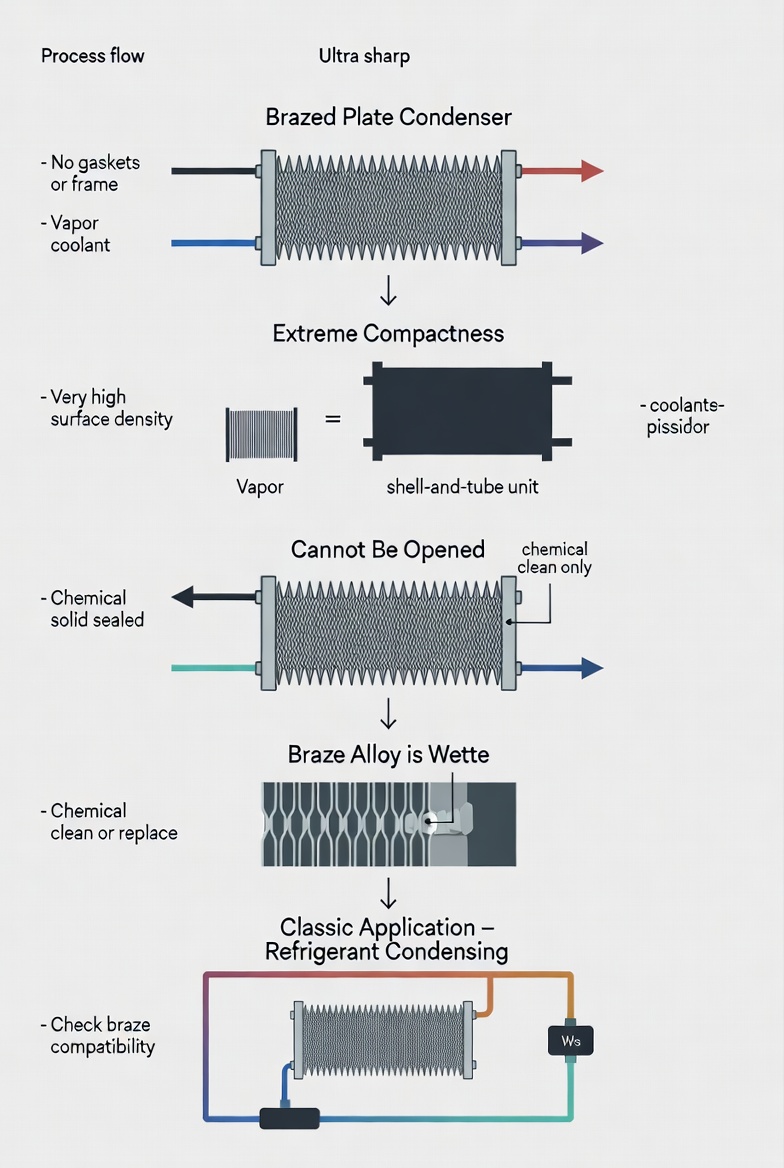
Brazed Plate Configuration
Plate count, port size and braze alloy are the main variables. Because the unit cannot be opened, cleanliness of both streams is part of the specification rather than an operating detail.
Configuration
- Construction: Vacuum brazed block
- Braze Alloy: Copper or nickel
- Plates: 316L stainless
- Service: Clean, filtered only
Features
- No gaskets or frame
- Very high area density
- Low cost and weight
- High pressure capable
- Compact packaged units
Typical Condensing Duty
- Refrigerant condensing
- Chiller and heat pump duty
- Clean closed loop systems
- Small vent condensing
- Packaged skid equipment
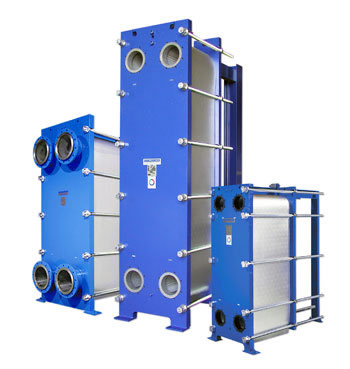
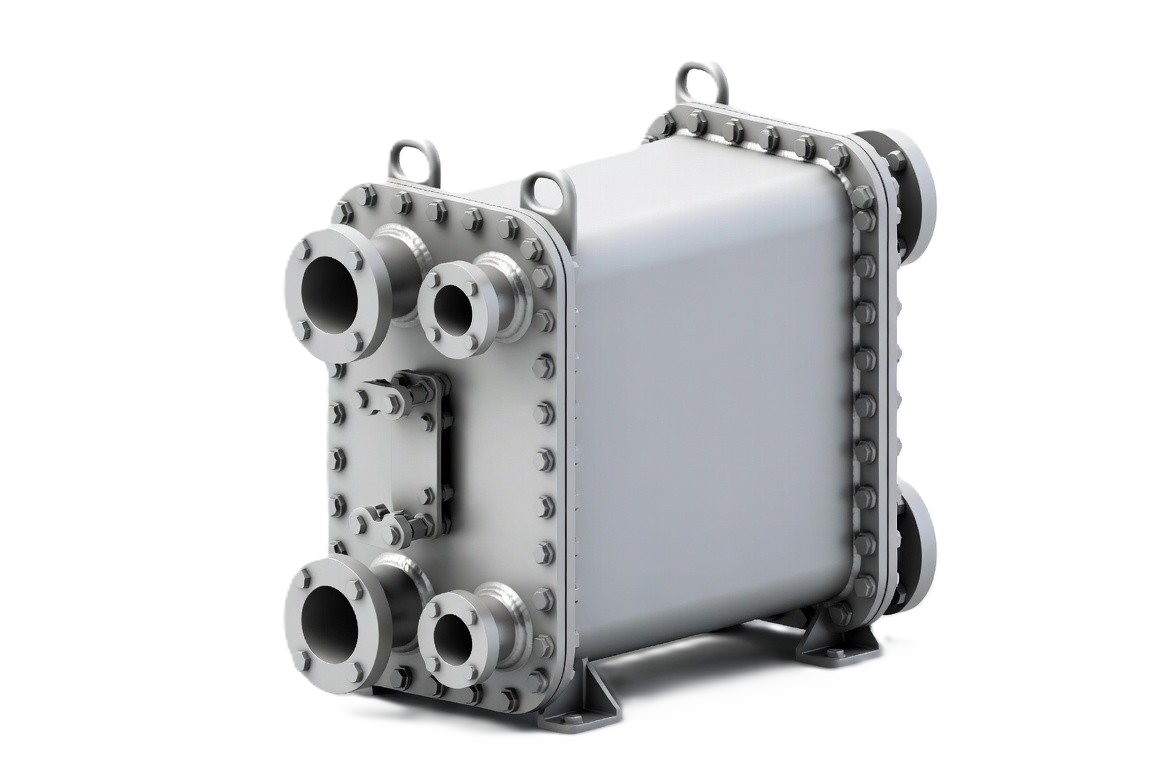
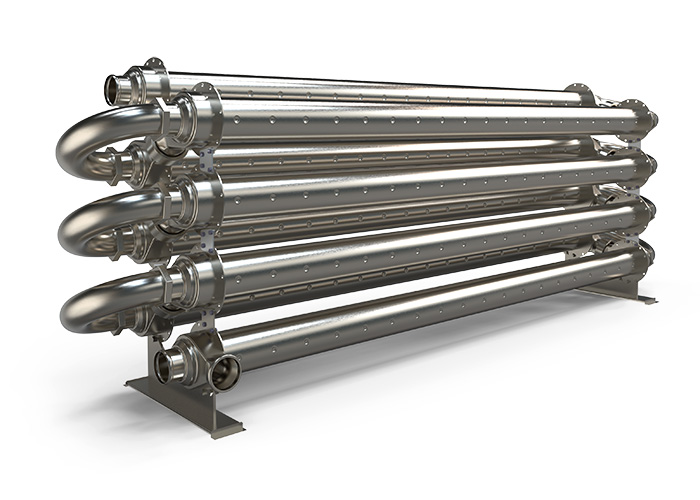
Applying Brazed Plate Condensers
Clean Service Is Not Advice, It Is a Requirement
With most exchangers, fouling is a maintenance question — how often will it need cleaning and how difficult will that be. With a brazed plate unit it is an end-of-life question, because the only available intervention is chemical cleaning in place. If a deposit will not dissolve, the exchanger is finished.
That makes upstream protection part of the design rather than an accessory. Filtration or strainers on both streams, treated water on the coolant side, and honest assessment of what the condensing stream might carry are all necessary. Where there is genuine uncertainty about cleanliness, the low purchase price of a brazed unit is a poor bargain against a gasketed or tubular alternative that can be opened.
Braze Alloy Compatibility
The braze alloy is wetted by both fluids and is therefore a material of construction, not an assembly detail. Copper is standard because it brazes well and conducts heat, but it has real chemical limitations. Ammonia attacks copper, which rules copper-brazed units out of ammonia refrigeration entirely. Some cooling water treatments, some process chemistries and certain sulfur-bearing streams are similarly aggressive.
Nickel-brazed construction addresses most of these cases at higher cost, and all-stainless brazing exists for the most demanding. The check is straightforward and takes a moment: confirm both streams are compatible with the braze alloy as well as with the plate material.
Where the Compactness Really Pays
Brazed plate condensers dominate packaged equipment for a reason that goes beyond the exchanger price. In a chiller, heat pump or skid-mounted system, the space the exchanger occupies has a cost of its own: it drives frame size, enclosure size, shipping dimensions and installed footprint. An exchanger that is a fraction of the volume of the alternative saves money throughout the package, not just on its own line item.
The same logic applies to retrofits into constrained spaces, to mezzanine installations where structural loading matters, and to any application where the equipment has to fit through an existing door. Where those constraints are absent and the duty is not perfectly clean, the argument for brazed construction is much weaker.