
1-805-484-2992
Quotes - Engineering - SalesPrecondensing Ahead of Activated Carbon
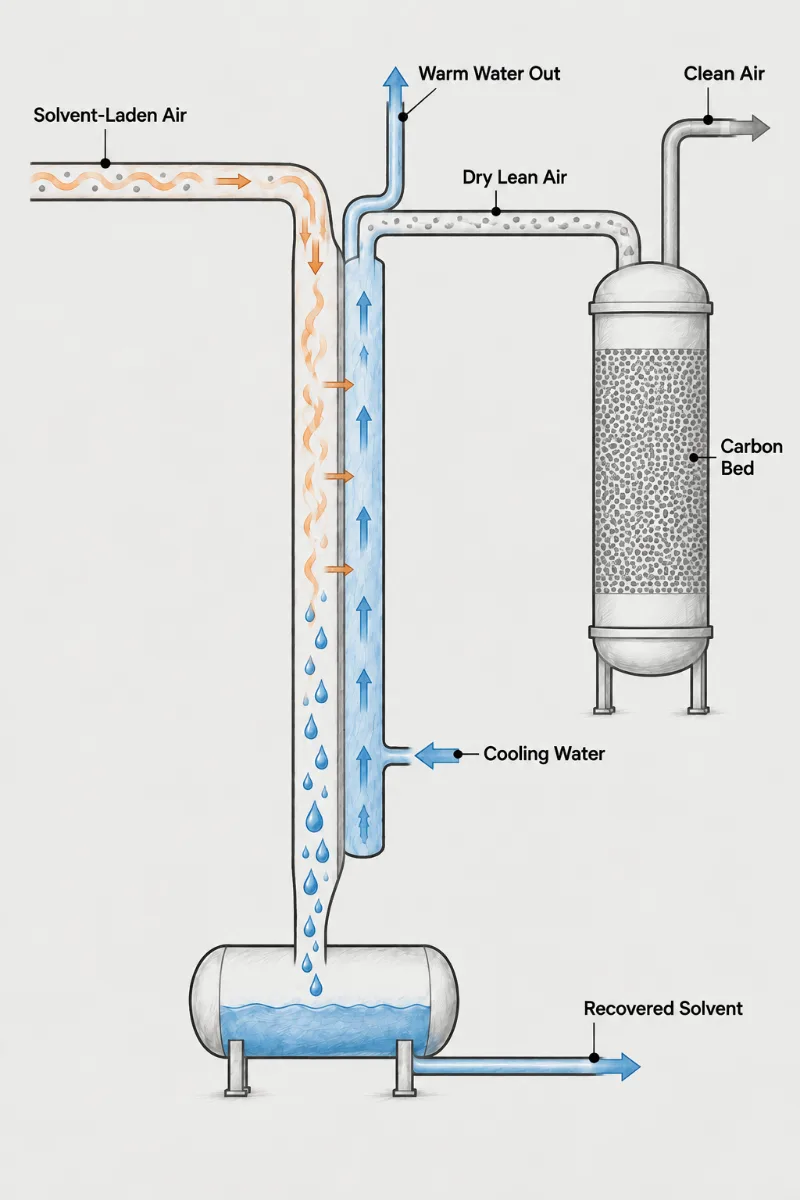
Activated carbon adsorbs organics best when the gas reaching it is cool and dry. A vent from a dryer, reactor or tank farm often arrives warm and close to saturation with solvent and water, which loads the bed quickly, raises its temperature through heat of adsorption, and shortens the time between regenerations. A precondenser in front of the bed knocks out the bulk of the condensables as recoverable liquid and drops the gas temperature, so the carbon only polishes the residual concentration. The design target here is an outlet dew point and humidity, not simply a condensing load.
- Outlet Dew Point: Size to a stated exit temperature, because each degree of cooling lowers the solvent partial pressure the carbon still has to adsorb.
- Relative Humidity: Gas leaving at saturation carries water into the pores; a small reheat after condensing brings humidity down to where water stops competing for capacity.
- Bed Temperature: Stripping heavy organics upstream cuts the heat released on adsorption, which lowers hot-spot risk, especially with ketones on carbon.
- Coolant Reach: Chilled water or glycol lets gas leave within ten to fifteen degrees of coolant inlet; ambient air cannot get much below summer dry bulb.
- Ice Formation: Glycol below freezing will ice water onto the tube walls, so either stay above freezing or design for a defrost cycle.
- Regeneration Peak: If desorbed steam and solvent pass through the same condenser, rate it for that rich, steam-heavy case as well as the lean vent.
Sizing a Condenser to Protect the Carbon
The usual complaint is a carbon system that breaks through in hours instead of days. The beds were sized for a dilute stream, but the vent arrives warm and saturated, and the precondenser that was supposed to strip it was rated at average flow rather than at the surge when a dryer starts or a tank is filled.
Most of this stream is air or nitrogen, so the duty behaves like a gas cooler that happens to drop liquid. Solvent molecules have to diffuse through a stagnant gas film to reach the cold wall, which keeps the coefficient low and makes surface area a function of gas-side mass transfer. What leaves with the gas is set by the solvent's vapor pressure at the exit temperature: for many solvents the saturated concentration roughly halves with every 20 to 25 F of cooling, so the coolant choice largely decides how much work the carbon is left with.
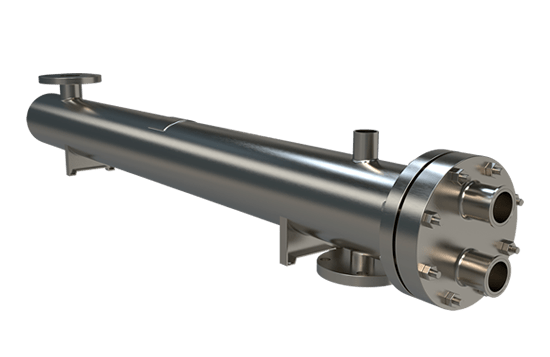
A Fixed Tubesheet exchanger, mounted vertically with gas flowing down the tubes and chilled water or glycol on the shell, is the normal answer. Condensate drains in the same direction as the gas, tubes can be rodded, and the shell stays in carbon steel while the tubes go to 304 or 316 where water and chlorinated solvents might form acid. A Horizontal Fin Fan has a narrower role: a first stage on a hot inlet, say above 150 F, taking out heavy organics and water with ambient air before a water-cooled trim condenser. On its own it cannot reach the dew point a carbon bed needs.
Bring the carrier gas flow, solvent species and concentration including water, the inlet temperature at peak, the carbon system's maximum allowable inlet temperature and humidity, and the coolant you can supply.
Gas and solvent load
Carrier gas flow, solvent species, concentration and water content
Bed inlet limits
Highest temperature and humidity the carbon system will accept
Cooling available
Chilled water or glycol supply temperature and spare flow
Cycle pattern
Surge events, regeneration steam routing and operating hours
Lighter Load
for the Carbon Bed Downstream
1.
Longer Bed Life
Every pound of solvent condensed upstream is a pound the carbon never has to hold. Cutting inlet loading stretches regeneration intervals and slows the gradual capacity loss from heels that never fully desorb.
2.
Cooler Adsorption Zone
Adsorption gives off heat. Leaner, cooler gas keeps the mass-transfer zone narrow and bed temperture down, which is the main defense against hot spots when ketones or aldehydes are in the stream.
3.
Liquid Worth Keeping
Condensate drawn off ahead of the bed is often clean enough to return to a solvent tank or still, instead of ending up mixed into steam-regeneration condensate that needs decanting.
Dew point and humidity questions
Start from the loading the carbon can hold per cycle, convert that to an allowable solvent concentration at the bed inlet, and read the required outlet temperature off the solvent's vapor pressure curve. Toluene at 100 F has a vapor pressure of about 1 psia; at 50 F it is near 0.2 psia, so a 50 F outlet leaves the carbon with roughly a quarter of the load. Methyl ethyl ketone needs a colder outlet to reach the same ratio. Heavy aromatics and glycol ethers can be handled on cooling-tower water, but light ketones and chlorinated solvents usually need chilled glycol before the bed notices the difference.
Reheating the gas by 10 to 20 F after the precondenser is usually worth it, because carbon loses organic capacity once relative humidity climbs above about 50 percent and gas leaving a condenser is at 100 percent. Gas leaving at 45 F and warmed to 60 F drops to about 58 percent relative humidity while the solvent content stays unchanged. The reheat can use the warm inlet gas in a small gas-to-gas exchanger, or a steam or electric coil. Without it, water fills the pores first, breakthrough comes early, and the beds appear undersized. The sign is beds that last well in winter and fail in humid summer months.
One unit can serve both, but the two cases are rated separately and the condenser is built for the harsher one. The process vent is lean, mostly air, and gas-film limited; regeneration discharge is mostly steam with solvent, condenses at high coefficients, and arrives at a much higher rate for a short time. A unit sized for the vent will be overwhelmed during a steam-out, which shows up as solvent reaching the second bed during regeneration. Rate for the steam case, confirm the vent case still reaches its outlet temperature, and route regeneration condensate to a decanter since it is a water-solvent mix.
On its own, an air-cooled condenser rarely does enough ahead of carbon, because it cannot bring the gas below ambient dry bulb plus a 15 to 20 F approach. On a 95 F afternoon that means an outlet near 110 F, which still passes most of a light solvent. Where it pays is a dryer exhaust at 250 F that is mostly water: ambient air takes out the bulk of that latent load for nothing, and the chilled trim stage is sized only for the solvent that remains. Fan speed control lets it track ambient, but it will never reach the 40 to 50 F outlet a ketone or chlorinated solvent needs before carbon.