
1-805-484-2992
Quotes - Engineering - SalesProtecting the Vacuum Pump with a Precondenser
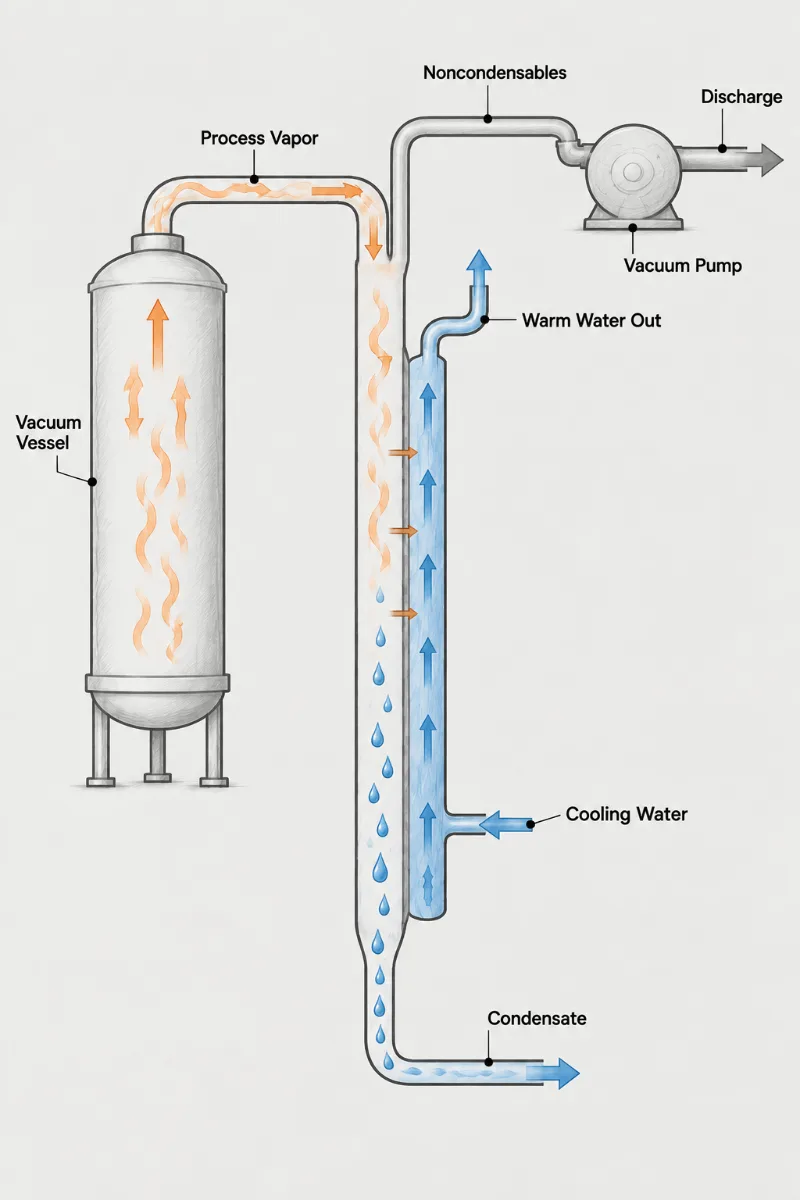
Under vacuum, a pound of vapor fills an enormous volume, and the pump has to move all of it. A precondenser between process and pump turns most of that vapor into liquid, so the pump handles only air leakage, inert sweep and whatever condensables remain at the condenser outlet. That shrinks the pump needed, but the stronger reason is protection: solvent dissolving in the oil of a rotary vane pump, water condensing inside a dry screw, or warm vapor heating the seal liquid of a liquid ring all erode capacity and service life. Unlike most condensing duties, pressure drop here costs vacuum directly.
- Suction Pressure: Each torr lost across the condenser raises vessel pressure or forces a deeper pull; budget drop as a fraction of absolute pressure.
- Seal Liquid: Liquid ring capacity falls as seal temperature nears the vapor pressure of the pumped gas; condensing upstream keeps the ring cool.
- Oil Dilution: Solvent reaching a lubricated pump thins the oil, worsens ultimate vacuum and forces frequent oil changes.
- Air Inleakage: Leakage sets the noncondensable load, and a vent that is mostly air limits how far vapor content can be driven down.
- Vapor Volume: Specific volume at low pressure is huge, so tube count and nozzle size follow velocity limits as much as area.
- Draining Against Vacuum: Condensate leaves through a barometric leg, a receiver pumped out on alternation, or a seal pot.
Rating a Condenser That Works Under Vacuum
The symptoms are familiar: the process cannot reach design vacuum, the pump runs hot, and the oil turns milky within days. Usually the pump is fine. The precondenser in front of it was rated with atmospheric-pressure velocities, or with a pressure drop that consumed a third of the available vacuum, and the condensables slipping through finish the job.
At 50 torr absolute, vapor occupies roughly fifteen times the volume it would at atmospheric pressure, and pressure drop rises with the square of velocity. Good vacuum designs therefore put the vapor on the shell side with a large inlet nozzle, an impingement plate and an open vapor lane, then cool the remaining gas in a final zone so the vent leaves well below the condensing temperature. As vapor condenses, the noncondensable fraction rises toward the outlet; that last section is where the leanest possible gas is made for the pump.
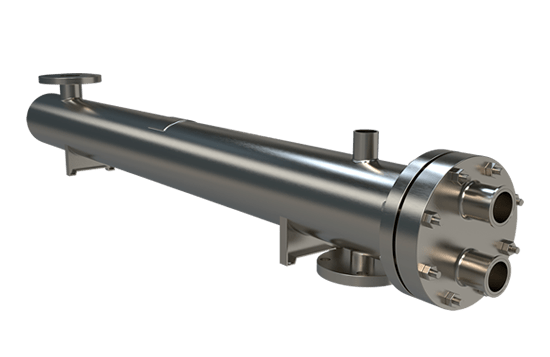
A Fixed Tubesheet unit with cooling water in the tubes and condensing on the shell is the standard arrangement, and its vent connection should sit at the cold end, never near the inlet. A Horizontal Fin Fan works only where the condensing temperature stays well above ambient, as on a steam ejector intercondenser or a moderate vacuum; at deep vacuum the saturation temperature falls close to ambient and air cooling has nothing left to work with.
For sizing, bring the pump type and capacity curve, operating absolute pressure, vapor rate and composition, measured or estimated air leakage, and coolant temperature.
Absolute pressure
Operating vacuum and the drop the process can spare
Pump details
Pump type, seal liquid or oil, and rated capacity
Vapor and leakage
Condensable rate plus measured or estimated air inleakage
Drain method
Barometric leg, receiver or seal pot arrangement planned
Deeper Vacuum
with a Smaller, Cleaner Pump
1.
Lighter Pump Duty
Condensing vapor before the pump means it moves leakage air and residual vapor only. On a solvent-heavy duty that can cut the actual volumetric load at suction several times over.
2.
Longer Oil Life
Lubricated pumps stay out of the solvent-dilution cycle. Oil holds its viscosity, ultimate vaccum stays where it was commissioned, and oil changes move back to the maintenence schedule from the emergency list.
3.
Solvent Recovered
Liquid collected at the precondenser is concentrated and free of seal water or oil, so it can often return to process. Downstream of the pump the same solvent would be mixed into seal liquid or exhaust.
Vacuum rating questions
Budget the drop as a percentage of absolute pressure, with 5 percent a comfortable target and 10 percent the most a process will usually tolerate. At 100 torr that allows 5 torr; at 10 torr it allows half a torr, which forces shell-side condensing with a large inlet nozzle and a short vapor path. Losing more than that pushes the vessel pressure up and raises the boiling temperature of a heat-sensitive product. In the plant the sign is a vessel gauge reading well above the pump suction gauge with no valve between them. Ask for the rating at minimum operating pressure, where velocity is highest and the drop is worst.
A liquid ring pump does condense vapor, but every BTU it absorbs warms the seal liquid, and capacity falls sharply as the seal temperature approaches the saturation temperature of the vapor at suction. A ring running on 85 F seal water pulling 50 torr water vapor, which saturates near 100 F, has little margin left and loses capacity on a warm day. A precondenser keeps that heat out of the ring and keeps solvent out of the seal water, which otherwise becomes contaminated wastewater. The pump can then be sized for leakage air and residual vapor only, which often means a smaller frame.
The coolant must sit well below the saturation temperature of the vapor at the operating absolute pressure, and that temperature falls fast as vacuum deepens. Water at 50 torr condenses near 100 F, so 85 F tower water barely works; at 20 torr it condenses near 72 F and chilled water is needed. A light solvent at 50 torr may saturate below 32 F and need refrigerated glycol. Allow a 15 F approach between coolant inlet and condensing temperature, and a further margin for the final gas-cooling zone where the noncondensables are stripped lean. The vapor's pressure-temperature curve, not the pump, chooses the coolant.
Put the vent at the coldest point of the shell, past the last of the surface, so the pump draws the gas with the lowest vapor partial pressure the condenser can make. In a horizontal shell-side unit that means a nozzle beneath a baffled cold zone near the coolant inlet, not on top of the shell where vapor enters. A vent near the inlet short-circuits fresh vapor straight to the pump, which is why a condenser that looks big enough on paper underperforms. If an existing unit is piped that way, relocating the vent nozzle alone can cut the vapor reaching the pump by a wide margin.