
1-805-484-2992
Quotes - Engineering - SalesCooling the Gas Before a Wet Scrubber
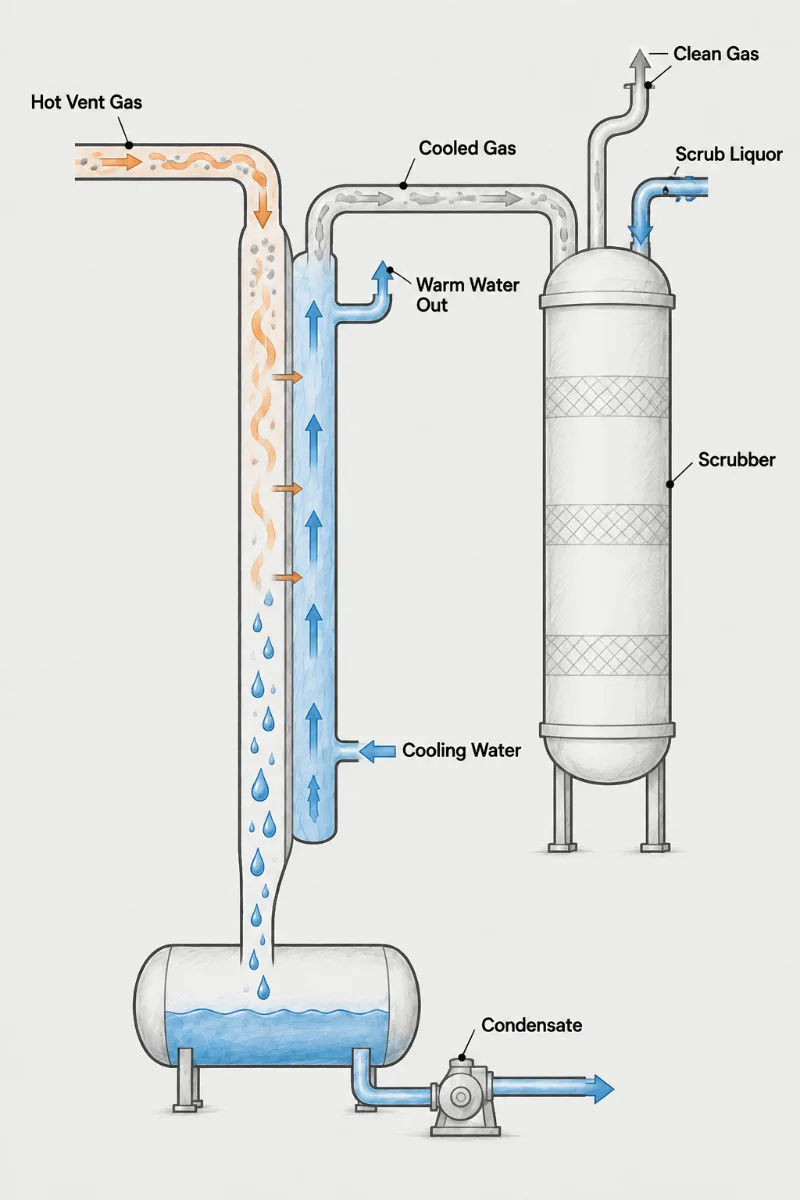
Packed towers and venturi scrubbers absorb best when their liquor is cool. Send them a hot, saturated vent and the gas hands its heat and water to the recirculating liquor: temperature climbs, solubility of the target gas falls, the sump dilutes and blowdown rises. A precondenser removes that heat and moisture first, along with organics that would otherwise emulsify, foam or ride through the packing as aerosol. What sets this duty apart is the condensate: soluble acid or alkaline gases dissolve in the first water that forms, so the liquid leaving the condenser can be harsher than anything in the tower.
- Liquor Temperature: Absorption of SO2, HCl or ammonia falls as recirculating liquor warms; removing gas heat upstream holds the liquor near design.
- Sump Dilution: Water condensed ahead of the tower no longer thins the reagent, so caustic or acid makeup and blowdown stay near design rates.
- First Condensate: Soluble acid gases concentrate in the first water to form, giving a liquid more aggressive than the scrubber liquor.
- Organic Carryover: Oils and solvents that reach the liquor cause foaming, emulsions and fouled packing; condensing them first leaves a separable liquid.
- Fan Budget: The induced-draft fan was sized for the tower; the precondenser must fit inside the few inches of water column left.
- Fog Control: Rapid chilling of hot humid gas forms fine mist; a mesh pad or vane pack after the condenser keeps it off the packing.
Precondenser Design for Scrubber Service
Every Btu the gas carries into a wet scrubber ends up in the liquor. When a vent arrives at 180 F and saturated, much of the packed height is spent quenching rather than absorbing, and the liquor cooler or cooling tower on the recirculation loop works harder than anyone planned. Moving that cooling into an indirect condenser gives the tower back its height.
The gas cools along its condensing curve while a large noncondensable fraction slows vapor transport to the wall. With chilled coolant and high inlet humidity, the bulk gas can cool faster than vapor diffuses out of it, leaving a supersaturated fog that a condenser cannot catch by surface area alone. Moderate approach temperatures and a mist eliminator downstream deal with it.
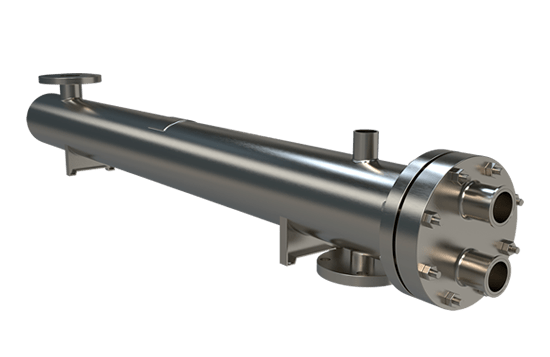
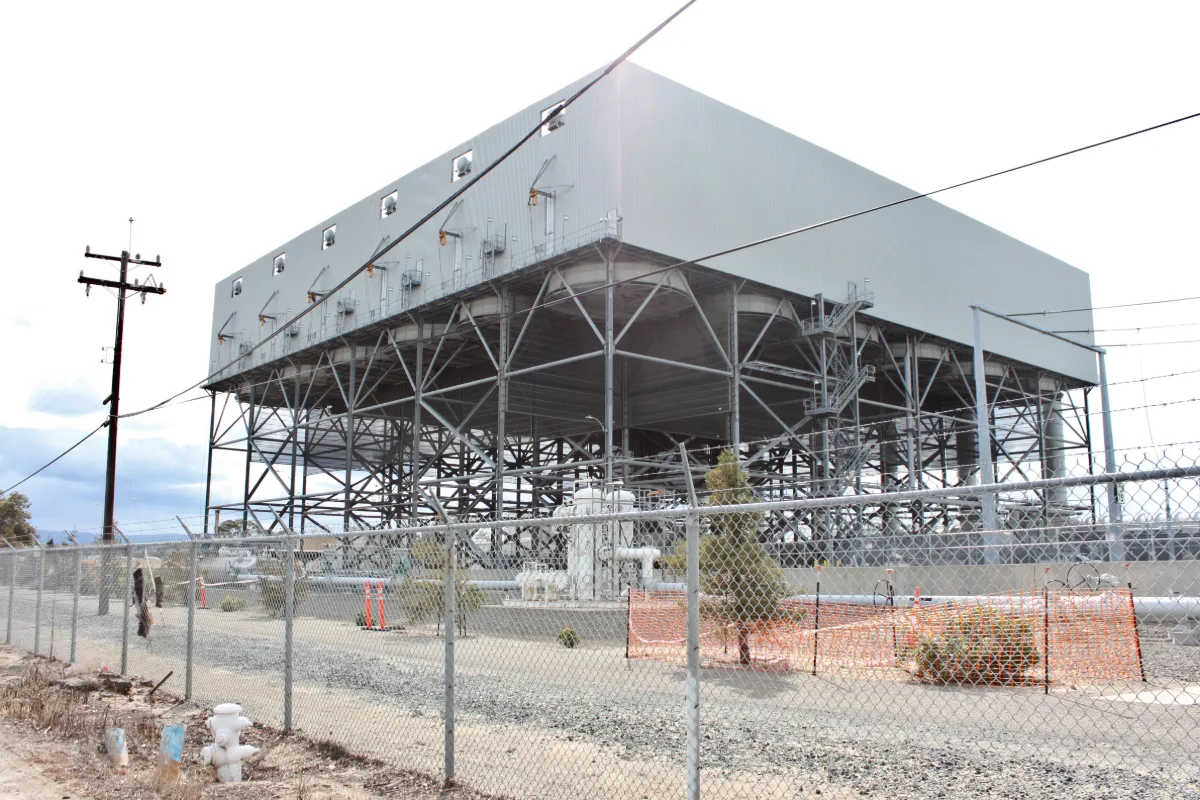
Materials follow the condensate, not the gas. A Fixed Tubesheet unit with the gas in alloy tubes, from 316L for mild duty through duplex, titanium or Hastelloy where HCl and chlorides are present, keeps the expensive metal on the wetted surface while cooling water runs through a carbon steel shell. A Horizontal Fin Fan is an option where water is scarce, but finned alloy tube is costly, and in winter the coldest rows can run below the acid dew point. Louvers and warm-air recirculation are then part of the design, not an accessory.
Bring the gas flow, temperature, moisture and soluble gas content, the scrubber's design liquor temperature, the fan's spare static pressure, and where condensate can be drained.
Gas to scrubber
Flow, temperature, moisture and soluble gas content
Liquor targets
Design liquor temperature and allowable sump dilution
Condensate chemistry
Expected pH, chlorides and the drain destination
Fan margin
Pressure drop the existing fan can still absorb
Cooler Liquor
Better Absorption in the Tower
1.
Absorption Restored
Lower inlet temperature lets packed height work on absorption instead of quenching. Removal of temperature-sensitive gases such as SO2 and ammonia recovers without adding packing or raising liquor circulation.
2.
Less Reagent Makeup
Water condensed upstream no longer dilutes the sump, so reagent strength holds and blowdown volume falls. On caustic scrubbers the change appears directly in chemical purchases and wastewater charges.
3.
Packing Kept Clean
Taking oils and organic aerosols out before the tower slows packing fouling and foaming, which otherwise surface as climbing pressure drop and liquor carried out of the stack.
Liquor and condensate questions
The first condensate forms from a small amount of water that has absorbed soluble acid gas out of a very large volume of gas, so the acid is concentrated in to a thin film instead of diluted in a sump. A vent carrying 500 ppm HCl and 10 percent water can produce an initial condensate near 3 percent hydrochloric acid, with chloride near 30,000 ppm, while the scrubber liquor runs neutral at a few hundred ppm. Pick the tube alloy from a calculation of that first film at its warmest, and ask for the condensate pH to be measured at start-up to confirm the choice.
A direct-contact quench cools the gas just as well, but it turns every pound of condensed water and organic into quench liquid that must be treated, where an indirect condenser produces a small, separable liquid stream. On a vent carrying 200 lb/hr of recoverable solvent and 1,500 lb/hr of water, the quench produces a dilute emulsion that goes to the wastewater plant; the condenser produces a liquid that can be decanted and returned. A quench wins where the gas is dusty or sticky, since there are no tubes to foul. Where recovery value or disposal cost is significant, the indirect route is usually cheaper over the life of the system.
Fog forms when the bulk gas cools faster than water vapor can diffuse to the tube wall, leaving a supersaturated mist that no amount of extra surface will catch. It is most likely with chilled coolant on a hot, humid inlet, say 180 F gas against 45 F glycol. Keep the approach gentler, cooling in two stages with tower water first, or accept the fog and remove it with a mesh pad or vane pack sized for droplets under 10 microns between the condenser and the scrubber. A visible plume at the scrubber stack appearing after the precondenser was added is the usual symptom.