
1-805-484-2992
Quotes - Engineering - SalesCondensing Flammable Vapors Safely
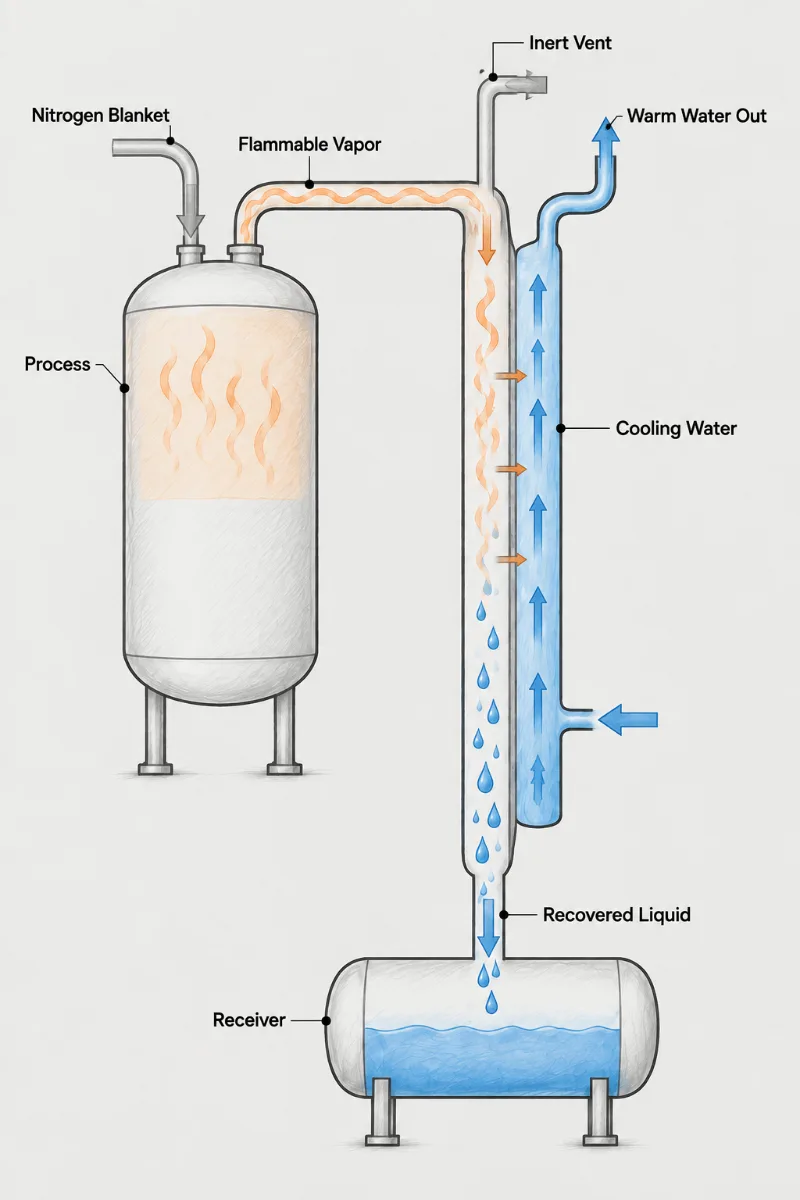
Recovering flammable solvent from a vent turns a fire hazard at the stack into liquid in a tank, but for part of the condenser's length the stream may pass through its flammable range. A rich vent that enters above the upper explosive limit grows leaner as solvent drops out, and near the cold end the residual mixture can cross into the explosive envelope if oxygen is present. That is what separates this duty from ordinary vapor recovery: the thermal design and the safety design are one calculation, and both depend on whether the system is inerted.
- Flammable Envelope: Track concentration along the condenser, not only at inlet and outlet; a rich vent can fall through the UEL as solvent condenses.
- Nitrogen Inerting: Holding oxygen below the limiting concentration keeps the vent non-flammable at every solvent level, whatever the condenser does.
- Static Bonding: Low-conductivity solvents build charge flowing through tubes and drains; bond shell, channels, piping and receivers together.
- Area Classification: Motors, instruments and any fan drives near the condenser must suit the hazardous-area class where it is installed.
- Arrestor Losses: Detonation or deflagration arrestors in the vent add pressure drop the condenser and blower must allow for when fouled.
- Coolant Leaks: Solvent entering cooling water can reach a cooling tower; pressure hierarchy and welded tube joints keep it out.
Thermal Design Inside the Safety Case
Where in your condenser does the vent mixture become flammable? If nobody on the project can answer that, the hazard analysis is incomplete. Concentration changes continuously from inlet to outlet, and the point at which the mixture crosses the UEL depends on coolant temperature, flow and how much air leaks in. Rating the full condensing profile answers the question and tells the safety team whether inerting is required or just prudent.
Inerting has a thermal cost. Nitrogen dilutes the vapor, lowering its partial pressure and dew point, and the extra gas slows diffusion to the cold wall. For the same recovery the condenser needs more surface or colder coolant, and the design case is the maximum sweep rate, not the normal one. An oxygen analyzer on the vent header, interlocked with the nitrogen supply, closes the loop.
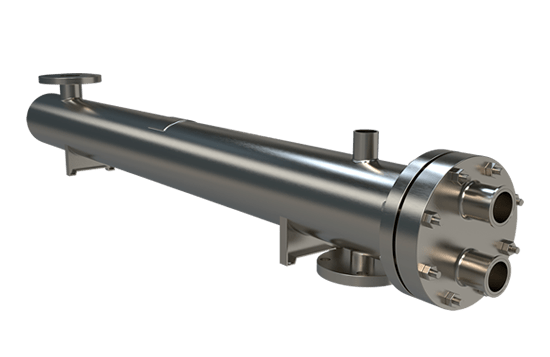
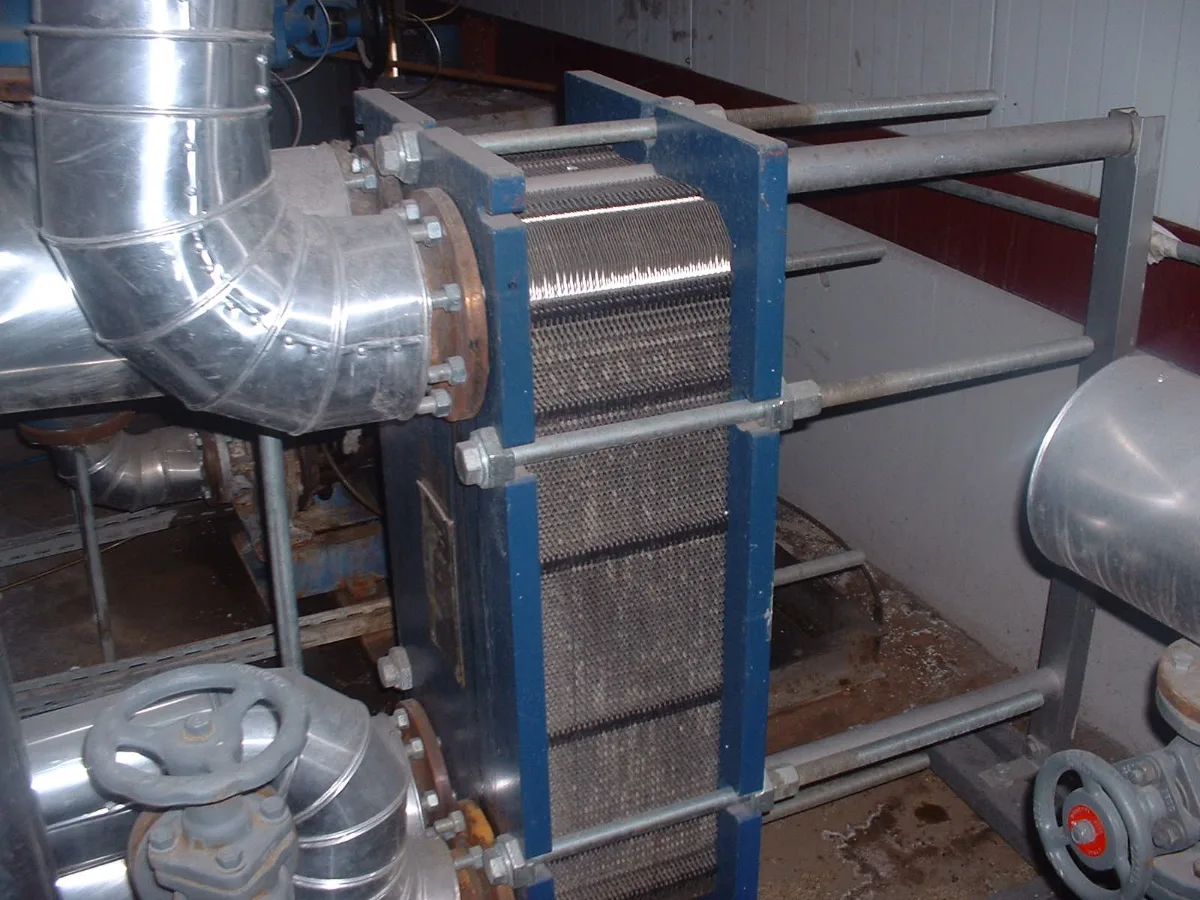
A Fixed Tubesheet exchanger with all-welded process-side construction keeps solvent in the tubes and cooling water on the shell, and its design pressure can be raised to contain a deflagration where the hazard review calls for it. A Welded Plate exchanger offers very low liquid holdup and no gaskets in solvent service, which shrinks the flammable inventory; confirm its pressure rating against the relief case. Gasketed Plate & Frame units are a poor fit, because a gasket failure sprays solvent outward.
Have the solvent list with flash points and flammable limits, the inerting method, the area classification, and the relief basis ready when you ask for a price.
Solvent identity
Each flammable component with flash point and explosive limits
Oxygen control
Inert gas, oxygen setpoint and how it is monitored
Area class
Hazardous-area rating at the installed location
Relief basis
Design pressure, relief scenario and any arrestors in line
Safer Recovery
of Flammable Solvent Vapor
1.
Fewer Leak Points
Welded process-side construction and no gasketed joints in solvent service remove the commonest source of fugitive leaks, which matters most where a small drip near a hot surface becomes an ignition event.
2.
Small Liquid Inventory
A drainable design with modest holdup keeps the volume of flammable liquid inside the condenser small, which lowers the fire load and simplifies the emergency case in the hazard review.
3.
Known Vent Composition
Rating the full condensing curve fixes residual solvent at the outlet, so the downstream oxidizer, arrestor or atmospheric discharge sees a defined concentration rather than an estimate.
Inerting and ignition questions
Yes, usually by a meaningful margin, because the nitrogen added to keep the vent safe is noncondensable gas the condenser must cool and that blankets the tube wall. Take a vent carrying 500 lb/hr of acetone with 500 scfm of nitrogen sweep. Double the sweep to 1,000 scfm and the acetone partial pressure at the inlet roughly halves, its dew point drops by 20 F or more, and the same coolant now reaches a smaller fraction of the load.
The rating has to run at the maximum sweep, including any emergency purge rate, because that case fixes how much acetone leaves at saturation. A common mistake is to size on the normal purge and then find the outlet gas rich enough to overload the downstream oxidizer whenever an operator opens the nitrogen valve wider. State the sweep in scfm at a reference temperature so the gas mass is not ambiguous.
Because a flanged joint is a mechanical connection, not a dependable electrical one, and in flammable service you need a path to ground you can measure. Gaskets, paint, thread sealant and corrosion products can leave a flange reading hundreds of ohms, and the shell, channels and receiver each sit on their own set of bolts.
Toluene, hexane and heptane have conductivities low enough to hold charge as they run down a tube and splash into a receiver, and a spark across an isolated channel cover is enough to ignite a mixture that has drifted into its flammable range at the cold end. A bonding jumper across each flanged joint, from channel to shell and from the drain to the receiver, with resistance checked at commissioning and after every bundle pull, closes those gaps. Put the test points on the inspection list.
It can be, if every piece of powered equiptment on it, including fan motors, vibration switches, louver actuators and heat tracing, carries a rating for the division or zone where it sits. Belts must be static-conductive and the fan ring bonded, and a fin-tube bundle in a Class I, Division 2 area usually needs a hot-surface review as well.
The thermal side is a separate problem. An air cooler cannot bring a rich solvent vent much below ambient, so on a summer afternoon it may not pull the stream far enough below its dew point to recover much, and the leaner outlet is exactly where the mixture passes through its flammable range. Most plants in flammable service choose a water-cooled Fixed Tubesheet unit with the pump and motor outside the classified boundary, and keep the condenser itself passive.