
1-805-484-2992
Quotes - Engineering - SalesCondensing Solvent Fractions and Azeotropes
Solvent recovery columns separate spent solvent blends into fractions that can be reused, and the condenser at each cut has to handle mixtures that rarely behave like a single compound. Many solvents form azeotropes with water or with each other, so a fraction may condense at a constant temperature yet still be a mixture. Some condensates split into two liquid phases once cooled. Others carry chlorides or acids that attack ordinary stainless. Solvent-fraction condensers are specified around those behaviors as much as around the heat load.
- Azeotrope Behavior: A minimum-boiling azeotrope condenses at a single temperature like a pure compound, which simplifies rating but fixes the fraction's composition at column pressure.
- Two Liquid Phases: Water-solvent condensates such as toluene-water separate on cooling; drainage must keep both phases moving to a decanter without holding one in the shell.
- Condensing Glide: Non-azeotropic blends condense over a temperature range, so the coolant must stay well below the bubble point of the final, heaviest portion.
- Chloride Attack: Chlorinated solvents can hydrolyze with water to hydrochloric acid, which pits 304 and 316 stainless; duplex, Hastelloy or titanium may be required.
- Purity for Reuse: Recovered solvent must meet the specification of the process it returns to, so trace contamination from the condenser itself matters.
- Vent Losses: Volatile solvents leave the vent at their vapor pressure; a colder trim stage or lower outlet temperature reduces both losses and emissions.
When the Fraction Is a Mixture That Acts Like One Compound
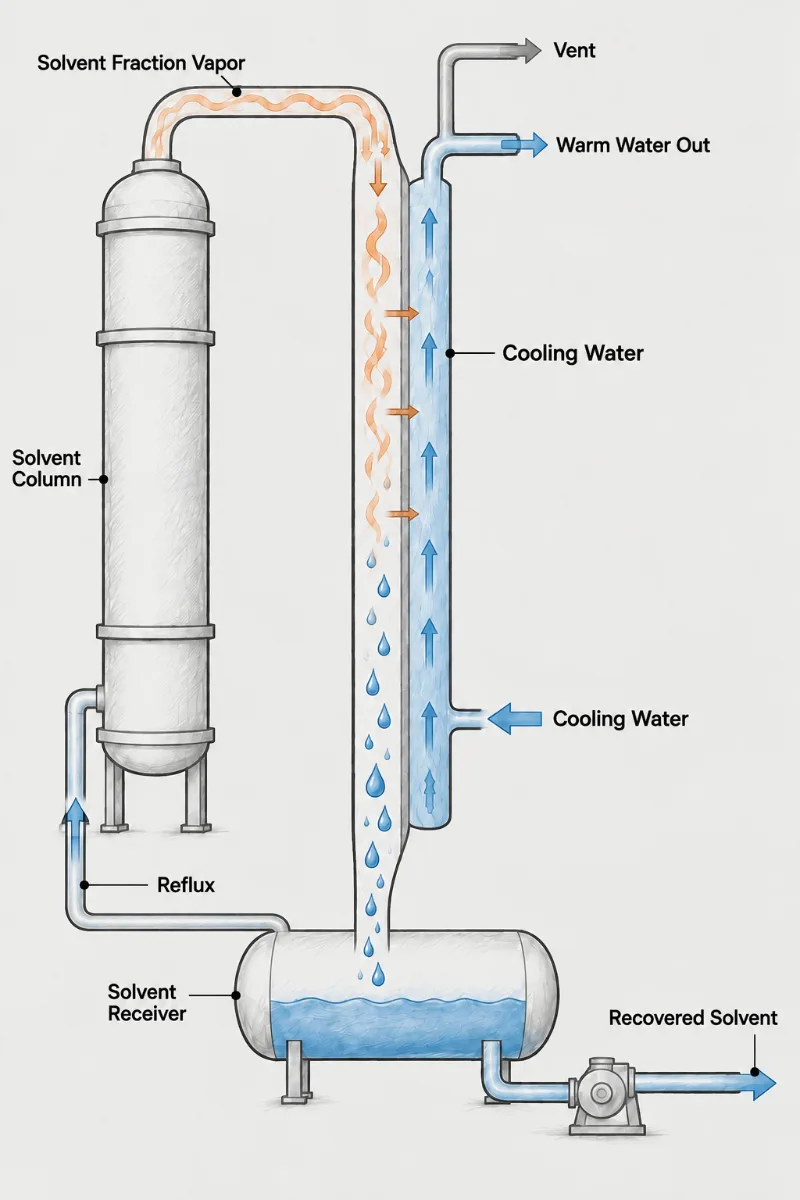
A solvent fraction that refuses to get any purer, however much reflux is applied, has usually reached an azeotrope. An azeotrope is a mixture whose vapor and liquid share the same composition at a given pressure, so ordinary distillation cannot pass through it. Ethanol-water, isopropanol-water and many solvent-water pairs form minimum-boiling azeotropes that come overhead together and condense at one temperature. For the condenser this simplifies the rating, but it means the fraction's water content is fixed by the column, not by the condenser.
Heterogeneous azeotropes behave differently in the condenser. A toluene-water or butanol-water overhead condenses as one vapor but separates into an organic layer and an aqueous layer once liquid forms. Plants exploit this with a decanter that returns one phase as reflux and draws off the other, breaking the azeotrope. The condenser has to drain both phases freely to that decanter, and subcooling the condensate improves the split because mutual solubility falls as temperature drops.
Where the fraction is not azeotropic it condenses over a temperature range, and the rating must follow that glide all the way to the bubble point.
Materials are the other solvent-specific decision. Chlorinated solvents such as methylene chloride or trichloroethylene release hydrochloric acid when wet, and chloride pitting and stress corrosion cracking can take out a 316L bundle quickly. Duplex stainless, Hastelloy or titanium are the common upgrades, depending on chloride level and temperature.
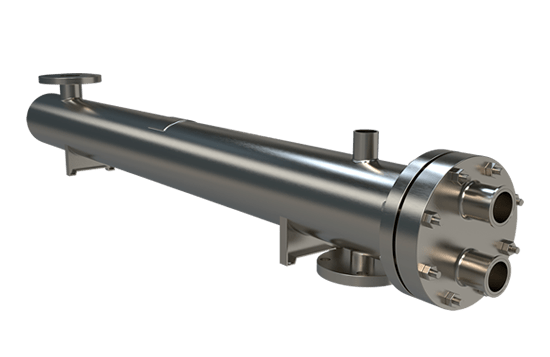
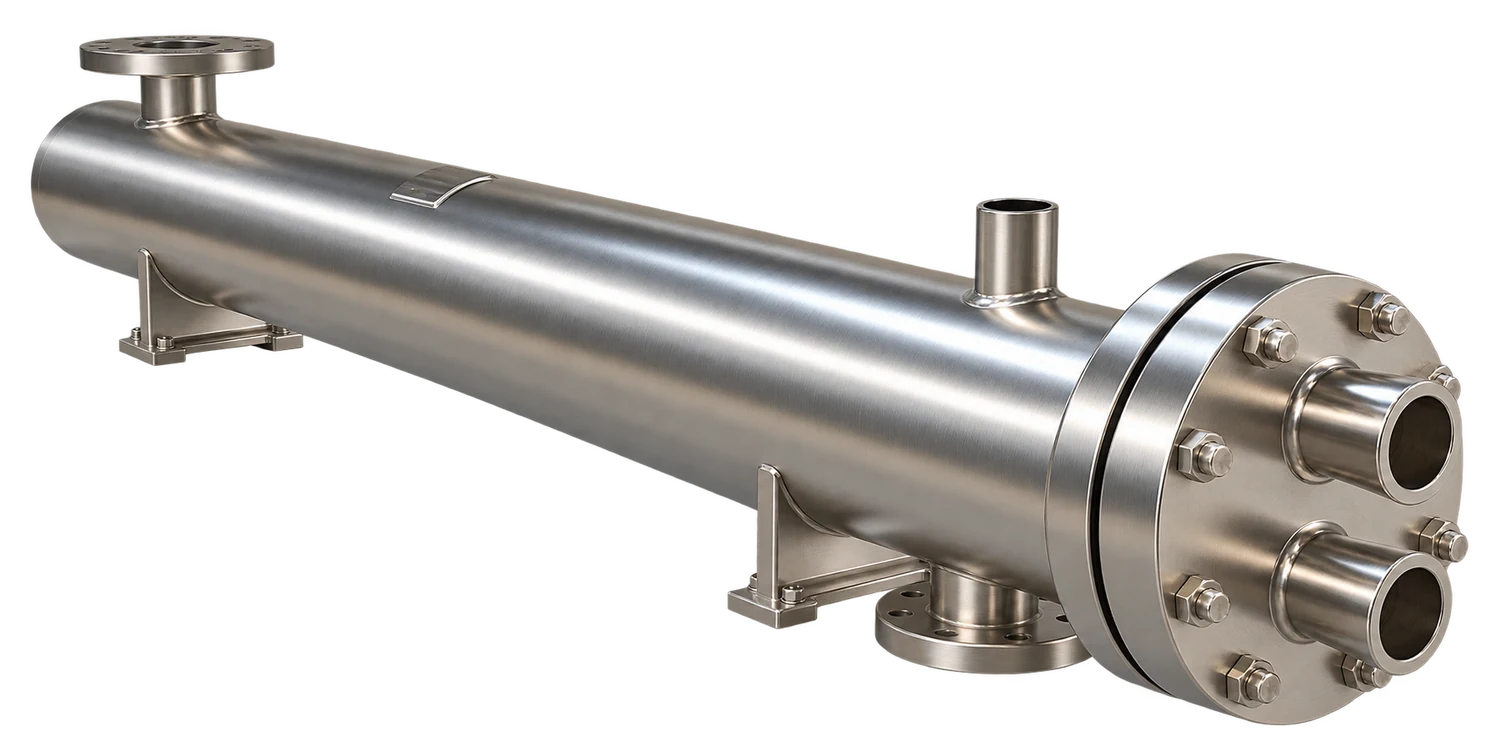
A Fixed Tubesheet exchanger in the right alloy, with condensing on the shell side and water in straight tubes, covers most solvent fractions; mounting it vertically with vapor in the tubes helps when two liquid phases must drain together. A U-Tube bundle fits when the bundle must be pulled to check for corrosion, accepting that the inside of the bends is hard to inspect.
For a quote, bring the fraction composition including water, whether it forms an azeotrope or splits into two phases, chloride and acid content, the purity required for reuse, and coolant data.
Fraction makeup
Solvent blend with water and any chlorinated species
Phase behavior
Azeotrope present, or two liquid layers on cooling
Reuse spec
Purity the recovered solvent must meet
Decanter plans
How layers separate and which returns as reflux
Solvents Back
Into Service at Specification
1.
Phase-Aware Drainage
Outlet geometry and orientation keep organic and aqueous layers moving together to the decanter, so neither phase accumulates in the shell and upsets the azeotrope-breaking split.
2.
Alloys for Wet Chlorides
Wetted materials are matched to chloride and acid content, preventing the pitting and cracking that would otherwise contaminate recovered solvent with metal salts and shorten condenser life to a few campaigns.
3.
Lower Solvent Losses
Condensing to a lower outlet temperture, with a chilled trim stage where justified, cuts the solvent lost at the vent and the emissions the plant must report.
Azeotrope and alloy questions
A condenser cannot break a homogeneous azeotrope, but it can set up the split of a heterogeneous one by bringing the condensate cold enough to seperate into two liquid layers. The practical lever is subcooling. A butanol-water condensate held at 150 F splits poorly because mutual solubility is still high; the same liquid at 90 F gives a sharper interface and an organic layer with less water in it. Size the condenser to reach that subcooled temperature at full rate, not just to condense, and give the decanter enough residence time to settle the heavy phase. If you later see the organic reflux carrying extra water back up the column, the first thing to check is whether coolant inlet temperature crept up over the summer.
The water content of a recovered solvent fraction is usually fixed by the azeotrope, so running the condenser colder or hotter will not move it. Isopropanol, for example, comes overhead at about 12 percent water at atmospheric pressure no matter how the condenser is tuned. Where the plant decants, extra water points to a decanter running warmer than its design temperature or being pushed past its residence time. A quick plant check is to sample condensate at the condenser outlet and at the decanter organic draw: if both read high, the azeotrope sets it and a drying step is needed; if only the draw reads high, the decanter is the problem.
316L is a sound choice for alcohols, ketones, esters, glycol ethers and hydrocarbons, and a poor choice once chlorinated solvents and water share the same condenser. Methylene chloride with a few hundred ppm of water can produce enough hydrochloric acid at the condensing surface to pit 316L tubes in a single campaign. Before accepting 316L, confirm the chloride content of every blend the column will run, including off-spec feeds and cleaning solvents. If any of them carry chlorinated species, price duplex tubes or a nickel alloy at the outset. The upgrade costs less than one bundle replacement plus a batch of recovered solvent contaminated with iron and chromium salts.
Both phases should leave together through one bottom outlet with no low point or baffle pocket where the heavier liquid can settle. A toluene-water condensate separates fast, and in a horizontal shell the water layer tends to collect at the far end and stay there for hours. The visible sign is a decanter interface that wanders even though column feed is steady. Vertical in-tube condensing avoids the problem because gravity pulls both layers down the same tube. If a horizontal unit is unavoidable, specify a bottom outlet at the low end, a slope of about a quarter inch per foot toward it, and a drain line sized for the heavier phase at full rate.
Cold enough that the solvent's vapor pressure at the vent temperature keeps losses within the permit and the economic target, which for light solvents often means well below cooling water temperature. Acetone at 90 F has a vapor pressure near 6 psia, so a vent at that temperature carries about 40 percent acetone by volume; at 40 F the loss drops by close to 90 percent. That is the case for a chilled trim stage after the main condenser. Run the trim stage only as cold as the permit needs, since colder glycol costs refrigeration and can freeze dissolved water onto the tubes.
A condenser rated for one blend rarely suits the next without checking three things: the condensing temperature, whether the new pair forms two liquid phases, and what the new chloride level does to the alloy. Switching from ethyl acetate recovery to methylene chloride recovery, for example, lowers the condensing temperature by about 70 F, raises vent loss sharply, and introduces a chloride attack risk that 316L tubes were never chosen for. Ask for a rating sheet on every blend the column is expected to see over the next several years, and pick the tube alloy for the harshest one. The small premium paid up front avoids a condenser that works for one product and corrodes on the next.