
1-805-484-2992
Quotes - Engineering - SalesReflux Cooling for Batch and Semi-Batch Reactors
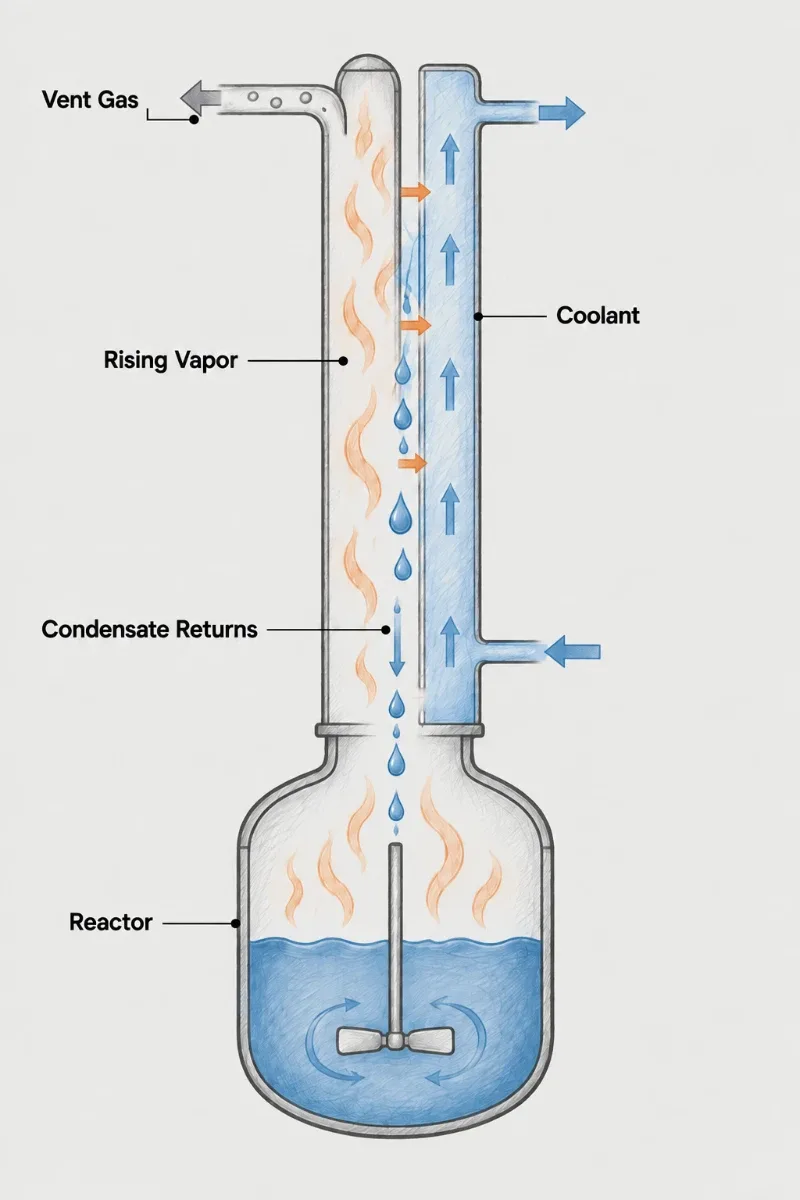
On a jacketed reactor the knock-back condenser is frequently the main heat-removal path, not an accessory. Once the batch reaches the solvent's boiling point, reaction heat goes into boiling solvent, the vapor rises into the condenser, and the condensate falls back to cool the mass. As long as the condenser keeps up, batch temperature is pinned at the boiling point and the solvent stays in the batch. Sized for the peak exotherm, the gases the reaction gives off and the vacuum the vessel may be pulled to, it becomes part of the reactor's safety case.
- Peak Exotherm: Design load is the highest heat release during dosing or initiation, converted to boil-up through the solvent's latent heat, not the average batch duty.
- Solvent Hold: Vapor escaping the top is solvent the recipe loses; a cold trim stage or brine coolant keeps vent losses within batch-record limits.
- Evolved Gas: A nitrogen sweep or gas released by the reaction carries solvent out and blankets tube surface, cutting condensing capacity sharply.
- Vacuum Rating: Reactors that strip under vacuum need the condenser shell and tubes rated for full vacuum and a vapor path sized for low-pressure volumes.
- Relief Path: The condenser sits between the reactor and its vent, so its pressure drop at relief flow has to be included in the relief sizing.
- Shared Utilities: Coolant often comes from the same tempered system as the jacket, so its temperature during cooling steps sets condenser capacity.
When the Condenser Holds the Batch Temperature
A reflux-cooled reactor is only as safe as its condenser on the worst minute of the batch. Jacket area grows roughly with the square of vessel diameter while batch volume grows with its cube, so on larger reactors the jacket cannot remove a fast exotherm by itself. Boiling solvent can, provided the vapor it generates is condensed and returned. If the condenser falls behind, vapor builds pressure in the headspace, batch temperature rises above the intended boiling point, and reaction rate climbs with it.
Sizing therefore starts from the maximum heat release rate, usually during dosing of the limiting reagent or at initiation, and converts it to a vapor rate using the latent heat of the solvent at reactor pressure. Gas evolved by the reaction, or a nitrogen sweep through the headspace, is added as noncondensable load, because even a few percent of inert gas collects at the cold end of the tubes and lowers the condensing coefficient. A vent stage on brine or glycol after the main knock-back captures the solvent the inerts carry out.
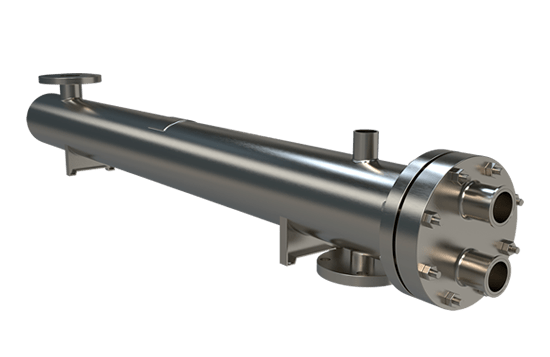
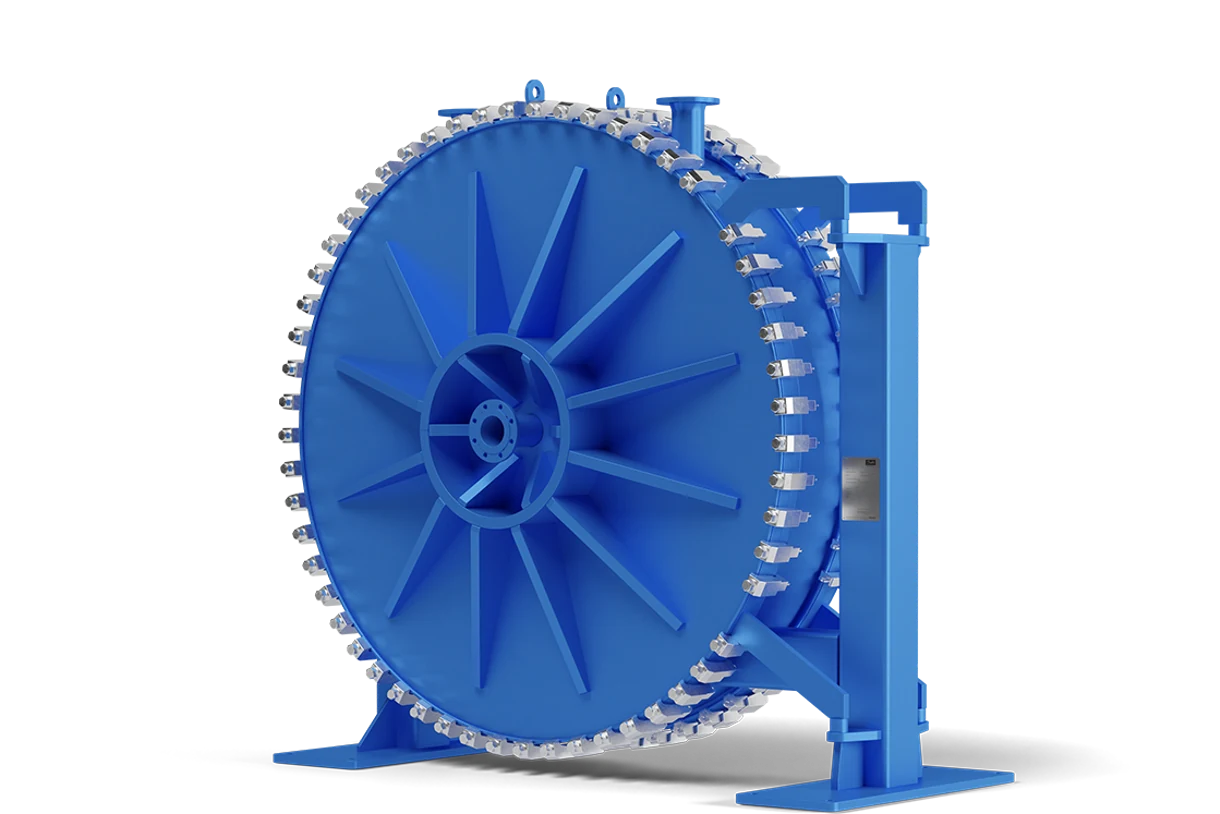
A vertical Fixed Tubesheet condenser with process vapor in the tubes is the conventional choice. It can be rated for full vacuum and for reactor design pressure, its straight tubes drain back cleanly, and it is available in 316L, Hastelloy or with titanium tubes for chlorinated or acidic chemistry. A shell expansion joint may be needed when the reactor cycles between hot reflux and cold standby. A Counterflow Spiral is better kept for the downstream solvent recovery condenser during distillation steps; its spiral passages do not drain countercurrent liquid back to the vessel.
For a quote, provide the solvent list and mixtures across all recipes, peak heat release or maximum boil-up rate, reactor design pressure and vacuum service, evolved gas or sweep rate, coolant temperature during the reaction step, and the vessel nozzle size.
Heat release
Peak exotherm rate during dosing or initiation of the batch
Solvent recipes
Every solvent and mixture the reactor runs under reflux
Inert gas
Nitrogen sweep or evolved gas leaving with the vapor
Vessel rating
Design pressure, full vacuum service and relief arrangement
Temperature Held
at the Solvent Boiling Point
1.
Exotherm Headroom
Sized from the peak heat-release rate rather than average batch duty, the condenser absorbs a fast dosing step without letting headspace pressure and batch temperature climb above the intended reflux point.
2.
Solvent Kept In
Solvent condensed at the head goes straight back to the mass, so concentration stays on recipe and both solvent make-up and vent abatement load per batch fall.
3.
One Unit, Two Modes
A condenser rated for full vacuum and reactor design pressure serves reflux steps and vacuum strip steps alike, with valving that routes condensate back to the vessel or forward to a receiver.
Reactor reflux condenser questions
Take the peak heat-release rate, subtract what the jacket removes at that moment, and divide the remainder by the solvent's latent heat at reactor pressure to get the vapor rate the condenser must handle. For toluene reflux at atmospheric pressure, latent heat is about 155 BTU/lb, so a net 1,000,000 BTU/hr exotherm boils 6,450 lb/hr of toluene. Ethanol at 370 BTU/lb would boil only 2,700 lb/hr for the same heat. Use the fastest dosing rate the recipe permits, not the planned one, and add 20 percent for the moment an operator opens the valve wider. The condenser cannot catch up once vapor backs into the headspace.
Nitrogen does not condense, so it collects at the tube wall as the solvent vapor around it condenses out, forming a gas film the remaining vapor must diffuse through. A sweep of only 2 to 3 percent by volume at the inlet can cut the local coefficient by half near the cold end of the tubes. In the plant this appears as a vent line that runs warm and smells of solvent while coolant flow is normal. Rate the condenser with the sweep included, keep the sweep to what inerting needs, and route the vent through a small glycol or brine stage so the solvent carried out by the nitrogen is recovered rather than lost.
Any reactor that is ever pulled to vacuum for stripping, drying or charging needs a condenser rated for full vacuum on both shell and tubes. The failure to design against is an operator opening the vacuum valve with the vapor line isolated, which puts the full 14.7 psi external load on a shell built for positive pressure only. On a 24-inch shell that is about 4,200 lb per foot of length trying to buckle it, and 6,600 lb on each head. Full vacuum rating usually adds only a thicker shell or a stiffening ring at fabrication, a small cost against the alternative, and no cost in operation.
Choose by the solvent's boiling point against the coolant temperature you have and the vent loss the batch record can accept. Cooling water at 85 F condenses toluene at 231 F or water easily, but with dichloromethane boiling at 104 F the driving force is thin and losses at the vent are heavy. Many plants put cooling water on the main knock-back and add a small glycol or brine stage after it, so the large unit stays inexpensive. Glycol on the whole condenser is justified when the solvent boils below about 130 F or when the reactor runs under vacuum, where the condensing temperature falls further still.
Yes, with a diverter below the condenser that sends condensate back to the reactor during reflux and forward to a receiver during a strip. Size it for whichever step gives the higher vapor rate: often the vacuum strip, where low pressure multiplies vapor volume even though the mass rate is lower. Check tube velocity at the strip pressure, not just at atmospheric reflux. The diverter valve and receiver nozzle should be sized so the condensate leg never backs up into the tubes; a flooded leg during a strip reduces area and raises reactor pressure. A condenser rated for both reactor design pressure and full vacuum serves both steps.
316L handles most solvent reflux, but once hydrochloric acid off-gas, wet chlorinated solvents or bromide salts are present, a nickel-chromium-molybdenum alloy such as C-276 for tubes and tubesheets is the usual upgrade. Titanium tubes suit oxidizing conditions and wet chlorine but fail in hot reducing acids and fluorides. Match the condenser to the reactor's own metallurgy: a glass-lined reactor with an alloy condenser is well balanced, but a stainless condenser on a glass-lined vessel becomes the first thing to corrode. The condensate at the tube wall is more concentrated in acid than the batch, so pick the alloy for the condensate analysis rather than the recipe.