
1-805-484-2992
Quotes - Engineering - SalesStill-Head Knock-Back Condensers
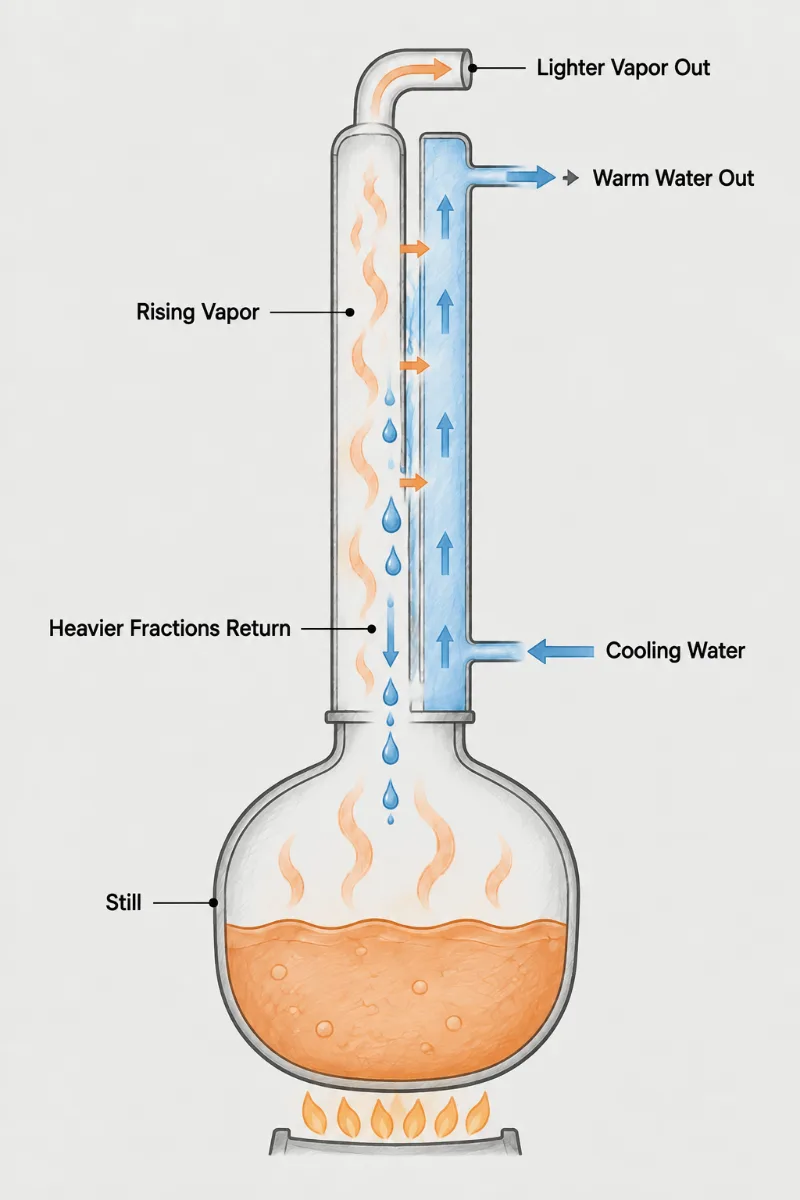
On a pot or kettle still, vapor rises from a heated charge of wash, wine, solvent or botanical extract, and a knock-back condenser at the head decides how much of it goes back for another pass. Condensing more at the head strips heavier components from the vapor, raising the proof or purity of what reaches the product condenser; condensing less speeds the run. Unlike a continuous column, the still's composition changes all the way through the batch, so the knock-back is adjusted from heads through hearts to tails, and foaming early in the run is a routine hazard.
- Cut Control: Coolant to the head condenser is adjusted as the run moves from heads to hearts to tails, so the unit must respond across a wide duty range.
- Kettle Vapor: Vapor off a direct-fired or steam-jacketed pot surges at the start and tapers as the charge strips; size for the opening surge.
- Foam Return: Protein-rich washes and some extracts foam early in the run, and the head condenser must pass foam back to the pot, not forward to the product line.
- Copper Contact: Many spirits stills rely on copper in the vapor path to remove sulfur compounds, so tube and bonnet metal is a flavor decision as well as a corrosion one.
- Ethanol Gradient: Vapor swings from high-proof heads to watery tails over a single batch, shifting condensing temperature and latent heat as it goes.
- Washdown Access: Residue from wash or extract coats the tubes over a season, so the vapor side should be open to rinsing from the top.
Running Cuts Through the Head Condenser
Why fit a knock-back condenser to the still head when the product condenser would catch everything anyway? Because the head condenser turns a single-pass pot still into a still with several stages of enrichment. Each pound condensed at the head runs back down through the rising vapor and into the pot, carrying heavier components with it. A distiller who wants higher proof off the spirit run turns up coolant to the head; one who wants more body, or a faster stripping run, turns it down.
That control is only useful if the condenser responds evenly across the batch. At the start, a hot charge flashes off its lightest components at a high rate, and protein or yeast in the wash can foam up the neck. Later, vapor rate falls and composition moves toward water. An undersized head condenser loses its grip in the opening surge and lets heads compounds through to the product line. An oversized one on cold well water stalls the run late in the batch. A tempered water loop set by the distiller, not raw city water, handles both ends.
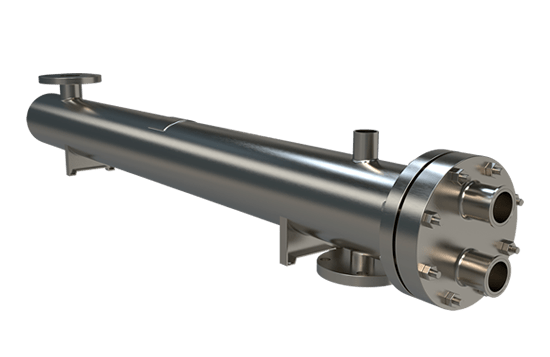
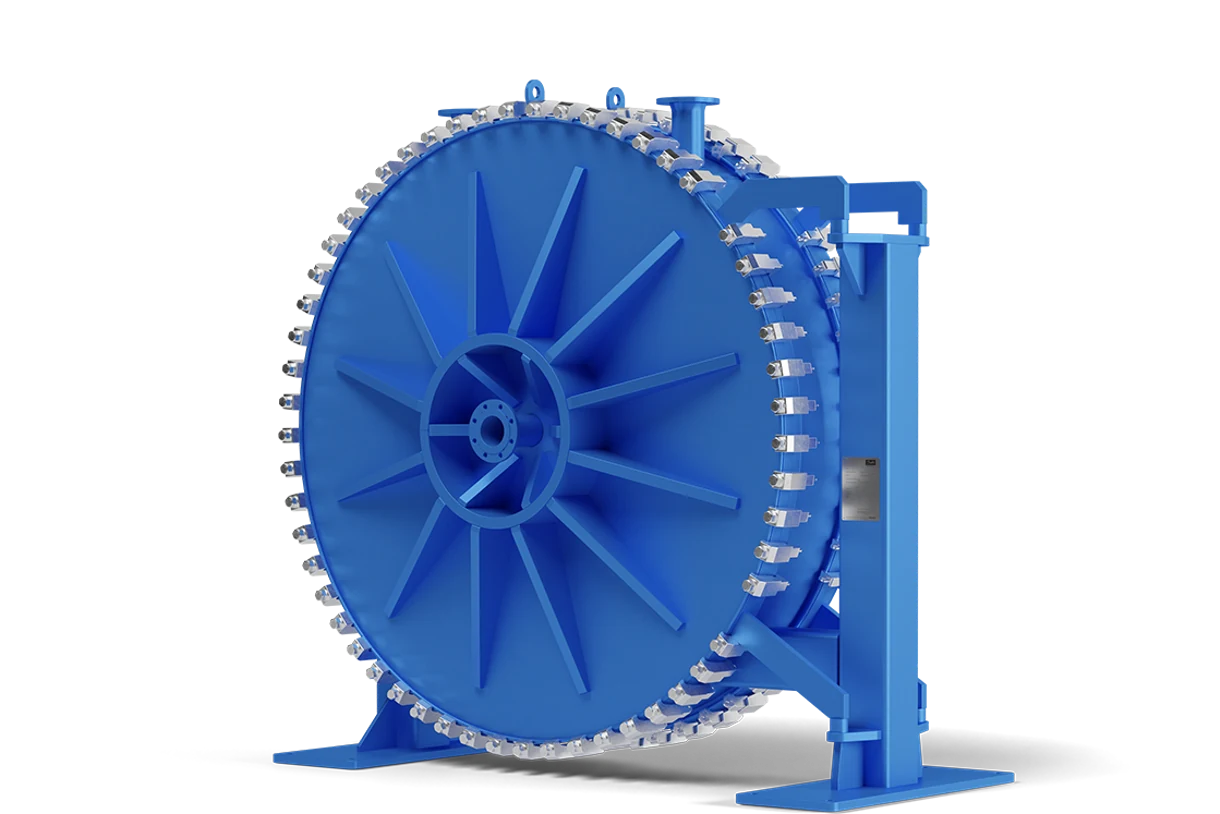
A vertical Fixed Tubesheet head condenser with vapor in the tubes is the common build, with copper or copper-alloy tubes for spirits where copper contact is wanted, or 316L for solvent, essential-oil and extract stills where it is not. Tubes should be large enough for foam to drain back and the top bonnet removable for rinsing. A Counterflow Spiral is not a head condenser. On a still it fits as the product condenser and cooler that follows, bringing distillate down close to coolant temperature in a compact footprint ahead of the parrot or receiver.
To size the head condenser, send the charge volume and composition, heat-up and full-boil heating rates, the proof or purity targets for each cut, whether the wash foams, coolant source and temperature, and the vapor neck size.
Charge details
Pot volume, wash or charge makeup and heating rate
Cut targets
Proof or purity wanted for heads, hearts and tails
Foam history
Whether the charge foams and how early in the run
Metal choice
Copper in the vapor path or stainless throughout
Proof and Purity
Set at the Still Head
1.
Adjustable Enrichment
Varying coolant to the head condenser changes how much vapor returns to the pot, giving the operator a direct handle on proof or purity of each cut without touching the heating rate.
2.
Cleaner Cut Points
Holding back the opening surge of light compounds at the head gives a sharper transition from heads to hearts, so less product ends up in the feints tank waiting for redistillation.
3.
Season-Long Washdown
Straight vertical tubes under a removable top bonnet let residue from wash, mash or botanical charges be flushed between runs, keeping head-condenser duty steady through a production season.
Still-head questions
Copper belongs in the head condenser when the wash carries sulfur compounds the spirit must shed, because the head is where vapor and returning liquid both wash over the tube wall. Copper reacts with hydrogen sulfide and thiols to form copper sulfide, which stays behind as a deposit, so the metal is slowly consumed. Specify tube walls of at least 0.049 inch and plan an inspection after each production season. Stills with copper in the pot, lyne arm or product condenser may not need more here; a grain-neutral run on a stainless still gains little from a copper head. Essential-oil and extract stills should stay stainless to keep copper out of the product.
In practice the two names describe the same device, a partial condenser at the head that returns its condensate to the still. Distillers tend to say dephlegmator for a shell-and-tube unit on a column still and knock-back for the simpler unit on a pot still. The engineering is identical: vapor in vertical tubes, coolant on the shell, gravity return, and a vapor velocity low enough that liquid can drain against it. One real difference is control range: a column still's dephlegmator is often run near total reflux during equilibration, so it should be rated for that duty as well as the normal partial condensing load.
Feeding 50 F well water to the head condenser condenses more vapor then the run needs, subcools the returning liquid, and forces the pot to reboil it, so the spirit run slows and can stall altogether in the tails. The returned liquid also lands on the charge far colder than its bubble point, which knocks down the vapor rate in the neck for several minutes. A tempered loop that keeps head-condenser water warmer than the product-condenser water, typically 110 to 140 F against 60 to 80 F, gives the distiller a steady hand on each cut and keeps the run on schedule.
Yes, provided the vapor side is 316L or the copper tolerates the chemistry, and the condenser is cleaned thoroughly between product types. Essential oils are mostly terpenes, which build sticky films on cold tubes and can carry the flavor of the previous botanical into the next spirit run. A hot-water or dilute caustic rinse through the top bonnet, followed by a clean water flush, is the usual routine before switching back. Also check the coolant setpoint: many oils co-distill with steam near 212 F and need a different knock-back fraction than a 170 F ethanol vapor. Run the still on water alone after a botanical batch and smell the condensate before trusting the next spirit run.
Foam is controlled in the pot: leave at least a third of the pot volume as headspace, bring the charge to a boil slowly, and dose antifoam early on washes known to foam. The head condenser helps only by giving foam a place to collapse and drain back, so tubes of 1 inch or larger and a bottom bonnet that slopes back to the neck are worth specifying. If foam still climbs the lyne arm, reduce the heating rate for the first 20 minutes of the run; a larger head condenser on its own will not stop a foam-over, and once foam reaches the product condenser the heads cut is already contaminated.