
1-805-484-2992
Quotes - Engineering - SalesPulling Condensables Out of Large Exhaust Flows
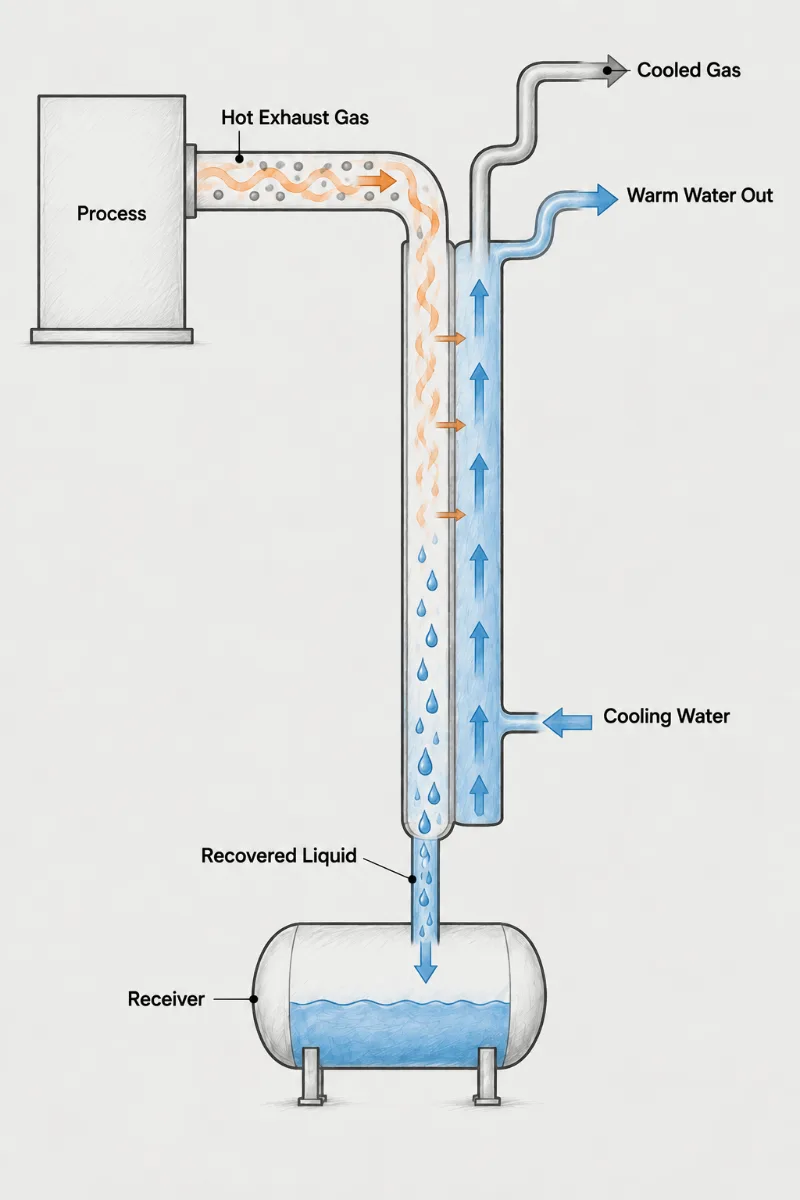
Exhaust from dryers, ovens, kilns and combustion equipment moves thousands of cubic feet a minute of air or flue gas carrying a modest fraction of water vapor or organics. Recovering that fraction, for heat, water or product, is a different exercise from condensing a pure vapor. Most of the gas never condenses, the condensing rate is set by how quickly vapor diffuses through it, and the fan pushing the exhaust usually has little pressure to spare. The exchanger ends up shaped by face area and pressure drop as much as by heat transfer surface.
- Face Velocity: Large gas flows need wide flow area; low velocity keeps added resistance inside what the existing fan can deliver.
- Fan Margin: Exhaust fans often have only a few inches of water column spare, and exceeding it starves process airflow upstream.
- Dew Point: Only gas cooled below its dew point gives up liquid; above it the exchanger is simply a gas cooler.
- Latent Heat: Condensing water from humid exhaust releases far more heat than sensible cooling of the dry gas fraction.
- Condensate Acidity: Flue gas condensate carries dissolved CO2 and sulfur compounds; wetted surfaces in stainless avoid carbon steel attack.
- Bypass Damper: A bypass lets the process keep running during cleaning or when recovery is not wanted.
Sizing for Volume, Not Vapor
Put a compact condenser into a large exhaust duct and the first thing you notice is the process: dryer airflow drops, the oven runs hotter, the burner needs retuning. The exchanger is not undersized thermally; it is too restrictive. Exhaust recovery units fail on pressure drop more often than on duty.
Low vapor concentration means a small partial-pressure driving force, so the condensing coefficient sits close to that of a dry gas, a small fraction of what a pure steam condenser sees. Heat and mass transfer track each other here, which is why extended surface and long, low-velocity gas paths help. Recovery climbs steeply once the gas is below its dew point: a dryer exhaust saturated at 150 F holds about seven times the water of the same air saturated at 90 F.
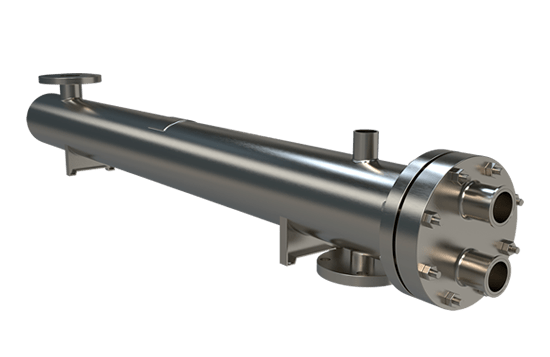
In a Fixed Tubesheet exchanger, the exhaust is best carried across the shell side in a crossflow or no-baffle layout with wide lanes, with water or process liquid in the tubes, which keeps gas-side drop to a few inches of water column. A Horizontal Fin Fan turns the arrangement around: exhaust flows inside finned tubes and ambient air does the cooling, a good fit for a steam-laden exhaust above 200 F at a site short of cooling water. Neither suits an exhaust carrying lint or sticky dust unless a filter or wash section comes first.
Bring flow in actual and standard cubic feet per minute, temperature, moisture and organic content, the fan curve, and where recovered heat or water will be used.
Exhaust conditions
Flow, temperature, and moisture or organic content
Fan curve
Existing fan performance and spare static pressure
Heat sink
Where recovered heat or condensate will be put to use
Duct layout
Space, duct sizes and any bypass required
More Recovered
Without Starving the Process
1.
Process Airflow Held
Laying out the exchanger for low gas velocity and generous flow area keeps added resistance within fan margin, so dryer or oven airflow, and therefore product quality, stays where it was before the retrofit.
2.
Latent Heat Captured
Cooling humid exhaust below its dew point releases latent heat that can preheat makeup water, boiler feed or process fluids, often several times the heat available from cooling the gas alone.
3.
Water Back in Use
Condensed water from clean exhaust can be treated and reused for washdown or cooling makeup, which matters at sites where water supply or discharge permits are tight.
Before you size one
Between half and four fifths of it on most dryer and oven exhausts, with the fraction set by how far below the dew point your available coolant can take the gas. Run the psychrometrics before anything else. Exhaust leaving a dryer at 180 F with a 130 F dew point carries about 0.11 lb of water per pound of dry air; cooling it to 100 F with 85 F tower water leaves about 0.043 lb, so roughly 60 percent of the water condenses.
Chilled water at 45 F could push recovery above 85 percent, but the refrigeration cost per gallon recovered then rises steeply. The last fraction is always the most expensive, because each degree of cooling near the coolant temperature buys less water and demands more surface.
Plate exchangers are built for liquids, and a gas flow of several thousand cfm through plate channels gives velocities and a pressure drop that no exhaust fan can carry. Consider a 10,000 cfm dryer exhaust through a plate pack with a flow area of 2 square feet: that is over 80 feet per second in the channels, an order of magnitude too fast for a gas-side drop measured in inches of water.
Lint, fiber and condensing residue then collect at the plate contact points, where nothing can reach them. A tube bundle with the gas across the shell side spreads the same flow over many square feet of face area. Keep the plate exchanger for the recovered-heat loop, where hot condensate or warm water transfers heat to boiler feed.
Only if the plant has a heat sink that runs as many hours as the exhaust does, and matching those two schedules is the first economic check on the project. A dryer that runs three shifts producing 2 million Btu/hr of recoverable heat in condensed moisture needs a user for about 200 gpm of 70 F water raised to 90 F, continuously. Boiler makeup, deaerator feed or a process wash loop can absorb that year-round.
Building heat absorbs it only from November through March, which leaves the condenser idling, or dumping to the tower, for most of the year. Compute the payback on the hours the heat is actually used, and if that number is under 4,000 a year, look hard at the project.