
1-805-484-2992
Quotes - Engineering - SalesSolvent Recovery from Nitrogen Purge Streams
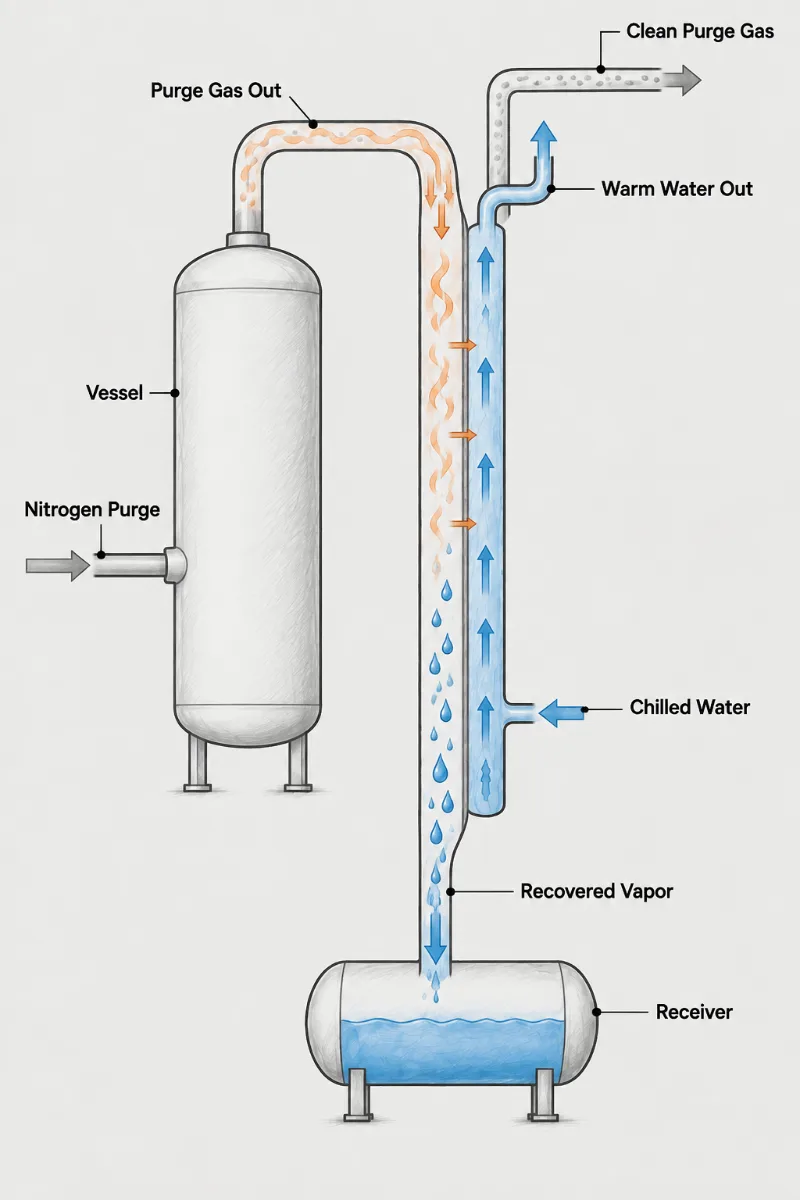
Nitrogen purges sweep vessels, dryers, filters and pipelines to keep oxygen out or clear solvent before a vessel is opened. The gas that leaves carries the solvent it picked up, often at high concentration early in the purge and tailing to almost nothing later. Because purges come and go with operations, a purge-gas condenser spends much of its life idle or lightly loaded, then sees a sharp peak. Nitrogen does not condense, so recovering solvent from it comes down to driving the exit temperature low enough that little solvent stays in the gas.
- Intermittent Flow: Purges start and stop; the condenser must take the first minutes of heavy solvent loading without breakthrough.
- Exit Temperature: Solvent leaving with nitrogen is fixed by its vapor pressure at the outlet, so colder coolant recovers more.
- Sweep Rate: Higher nitrogen flow dilutes the solvent and adds gas to cool; specify the maximum purge rate.
- Freezing: Glycol below freezing can ice out water or freeze high-melting solvents; staged cooling or defrost cycles prevent plugging.
- Standby Circulation: Keeping coolant moving at low flow between purges avoids a warm start when the next purge arrives.
- Solvent Purity: Condensate from purging a single-product dryer is often clean enough to reuse without further treatment.
Sizing for the Front of the Purge
The first few minutes of a purge carry most of the solvent. A condenser rated on average flow and average concentration looks fine on paper, then passes a visible slug to the vent every time a dryer is opened, because the surge arrives before the coolant side has settled.
Thermodynamics sets the ceiling. Toluene carried by nitrogen at atmospheric pressure falls from roughly 7 percent by volume at 100 F to about 1 percent at 40 F, so chilled water does a reasonable job; acetone or methylene chloride needs refrigerated glycol or brine well below freezing to reach comparable recovery. Water picked up from wet product then freezes on the tubes, which is why the coldest section usually follows a tempered first stage.
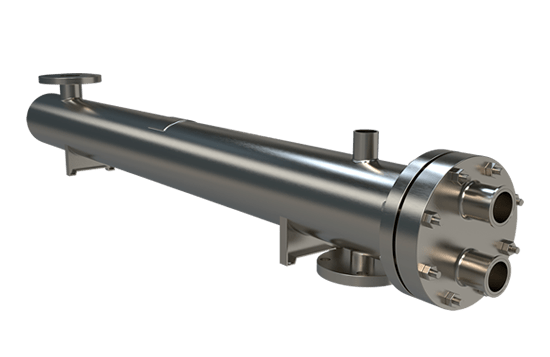
A vertical Fixed Tubesheet exchanger with purge gas in the tubes and chilled glycol on the shell is the standard arrangement. The shell-side coolant inventory also acts as a thermal buffer, absorbing the opening surge before the chiller responds. A Horizontal Fin Fan has a narrow role here: a first stage on a hot purge leaving a dryer, cooling it before the glycol section. It cannot reach the temperatures purge recovery depends on.
Bring the purge sequence with flow, duration and frequency, the solvent and how its concentration tails off, the coldest coolant available, and plans for the recovered liquid.
Purge sequence
Flow, duration and frequency of each purge event
Solvent loading
Starting concentration and how quickly it tails off
Coldest coolant
Lowest glycol or brine temperature the plant can supply
Reuse plans
Whether recovered solvent goes back to process
Solvent Kept
Out of the Nitrogen Vent
1.
Peak Captured
Rating on the opening minutes of the purge, with coolant already circulating, catches the solvent slug that drives most of the vent emissions and most of the lost product.
2.
Less Nitrogen Bought
On closed-loop dryers, purge gas stripped of solvent can be returned by a blower to the purge header, cutting nitrogen consumption along with emissions and leaving only a small bleed to vent.
3.
Freeze-Tolerant Layout
A water-cooled first section ahead of the glycol section removes water and heavy solvent before the coldest surface, so ice and frozen solvent do not close off tubes over repeated cycles.
Nitrogen purge questions
Cold enough that the solvent vapor pressure at the condenser outlet holds less solvent in the nitrogen than your emission limit or recovery target allows, and the answer differs by a hundred degrees between solvents. Compute it from the vapor pressure curve. If the target is 2 percent of toluene remaining, the outlet must be about 60 F, which chilled water reaches; the same 2 percent target with acetone needs about -10 F, and methylene chloride needs about -35 F, so refrigerated brine is unavoidable.
The mistake that costs the most is choosing the coolant before the target, usually by borrowing whatever glycol loop is nearby, then discovering that the loop temperature leaves a third of the solvent in the vent.
Water condenses with the solvent, and once the surface drops below 32 F it freezes into a layer that chokes the tubes within a few purge cycles. Where it comes from matters. Nitrogen from a liquid supply is dry, so the water you find came from wet product in a dryer, rinse water left in a filter or a vessel opened to humid air.
Half a percent of moisture by volume in a 500 scfm purge deposits more than a pound of ice during a ten-minute event, enough to bridge the inlet tube rows after a few cycles. A tempered first section at 45 F takes the water out as liquid ahead of the brine section, and a timed warm-glycol defrost between purges clears what still forms. Measure the moisture in the gas rather than assuming the nitrogen specification covers it.
The exchanger can sit idle for hours, but the coolant should keep circulating so the tube wall is at temperature when the first and richest gas of the next purge arrives. On a dryer purge, the first two minutes may carry a third of the solvent, so a condenser that spends those minutes cooling its own metal loses that third out the vent. Keep the shell-side glycol moving at 10 to 20 percent of design flow; the standby load is mostly insulation loss. A purge-start interlock that confirms coolant temperature before the nitrogen valve opens costs one thermocouple.
It pays on a closed-loop dryer or a vessel purged for hours a day, and it rarely pays on an open purge that runs a few minutes before a vessel is opened. The economics turn on nitrogen hours. A dryer sweeping 300 scfm for 16 hours a day consumes nearly 300,000 scf of nitrogen daily; a blower and controls that return 90 percent of it after the condenser pay back within a year at typical liquid-nitrogen prices.
A filter purged once a shift at 50 scfm for ten minutes uses 500 scf, not worth the loop. Recycling also raises the condenser's duty, since recirculated gas must be stripped lean enough that it does not re-saturate the product at the dryer inlet.
It does, because pressure-swing purging produces short bursts at high velocity and vacuum purging produces small volumes at low pressure, and a condenser rated for one performs poorly on the other. Take a 2,000 gallon vessel pressure-purged to 30 psig and vented: each vent releases about 540 cubic feet of saturated gas in under a minute, a peak of several hundred cfm through a condenser that otherwise sees nothing. The separator and the gas-side velocity, not surface, set that design.
The same vessel vacuum-purged moves the gas through the pump at 100 torr, where a condenser on the suction side must pass it with almost no pressure drop. State the method, the vessel volume and the purge pressure so the right case is rated.
Install a sight glass or level transmitter on the condensate receiver and log the level before and after every purge, then compare the gallons recovered against the solvent known to be in the product or vessel. The comparison tells you two things. A recovery that falls short of the charged solvent by a steady fraction points at the outlet temperature, which the vapor pressure curve will confirm.
A recovery that is fine on the first purge of the day and poor on later ones points at a warm coolant loop or a frosted cold section. A totalizing flowmeter on the drain works where the receiver is pumped out continuously, though with intermittent flow a simple level reading is more reliable than a meter that sees slugs.