
1-805-484-2992
Quotes - Engineering - SalesRecovering Condensables from Dirty Process Waste Gas
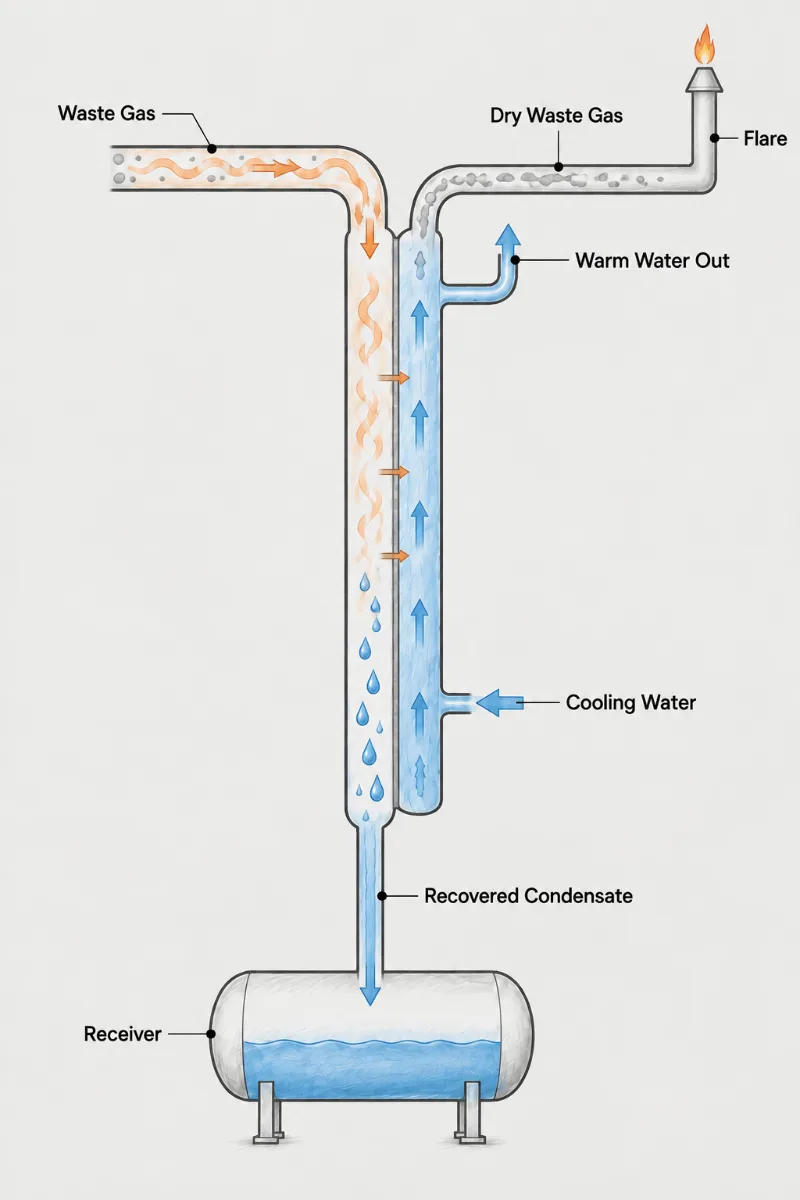
Process waste gas is what remains after a unit has taken what it wants from a stream: tail gas from an absorber, purge from a recycle loop, gas leaving a stripper or dryer. It is mostly noncondensable, yet often carries enough hydrocarbon, solvent or water to be worth recovering, along with material nobody planned for: polymer fines, salts, tars, subliming solids and trace acids. Condensing it means designing for a stream that will foul, and picking a construction that can be opened, cleaned and returned to service without shutting the plant down.
- Fouling Margin: Base extra surface on what the gas actually deposits, not a default factor; tars and polymers foul far faster than water scale.
- Desublimation: Some compounds pass straight from vapor to solid on cold walls; keep coolant above that point or plan switching units.
- Cleaning Access: Straight tubes with removable channel covers let crews rod or hydroblast the gas side in place.
- Gas Velocity: Moderate velocity sweeps deposits; too slow and solids settle, too fast and pressure drop climbs.
- Trace Acids: Small acid content concentrates in the condensate, so check chlorides and sulfur before settling on carbon steel.
- Parallel Units: Two exchangers with switching valves let one be cleaned while the other stays on line.
Fouling Is the Design Case
On a process waste gas condenser, the clean rating is the least useful number on the data sheet. What matters is performance after weeks in service, when deposits have built on the gas side and the outlet temperature has drifted up.
With a large noncondensable fraction, the gas-side film already controls heat transfer, so deposits on that side cut performance far more than the same layer on the coolant side. Heavy organics cooled quickly in a lot of inert gas also tend to form fine aerosol that passes through as haze; it counts as unrecovered emission and fouls whatever lies downstream. A gentler cooling profile and a coalescer after the condenser handle it.
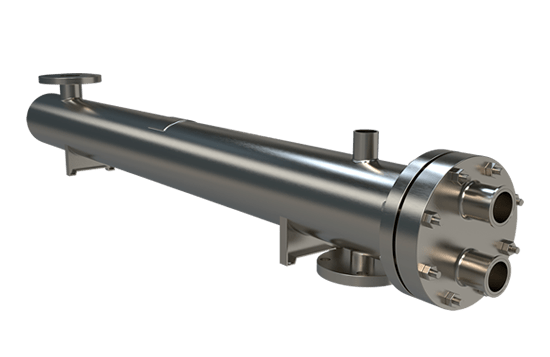
A Fixed Tubesheet exchanger with the waste gas in straight tubes is the right starting point for dirty service. The bores can be rodded or hydroblasted from the channel ends, vertical downflow lets condensate wash some deposits through, and only clean coolant sits on the shell side where nobody can reach. A Horizontal Fin Fan can serve where water is scarce, with gas inside finned tubes and plug-type headers giving access to each bore, but the fins collect plant dust on the air side and it cannot cool as deeply. Send samples or photos of deposits from existing equipment, along with the gas analysis, the fouling history, the downtime you can allow, and which liquids you want back.
Gas analysis
Main components plus traces, solids and known foulants
Deposit history
What has plugged before and how fast it built
Cleaning window
Downtime allowed and cleaning methods available on site
Recovery value
Which condensed liquids are wanted and their purity
Cleanable Design
for Gas That Fouls
1.
Cleaning in Place
A straight-tube bundle with the dirty gas in the tubes can be rodded or hydroblasted with the shell left in position, turning a multi-day pull-and-clean job into a short outage.
2.
Steady Performance
Sizing with a fouling margin based on observed deposit behavior keeps recovery and exit temperature acceptable between cleanings, instead of declining week by week from start-up.
3.
Easier Downstream Units
Condensing heavy residues before the gas reaches a flare, compressor or thermal treatment unit cuts the deposits, smoking and maintenance those units would otherwise see.
Dirty gas questions
Set it from what the gas already leaves behind in the plant, not from a handbook factor, because the deposit type decides wether a margin helps at all. Look at the upstream cooler, the duct elbows, the instrument taps and the knockout drum, and note how performence fell off over the first month in service. A soft, soluble deposit that water-washes away justifies a modest margin, perhaps 20 percent extra surface, plus a wash connection.
A hard polymer that builds a sixteenth of an inch in weeks will fill any margin you specify, and then the right answer is two units in parallel with switching valves. If nothing exists to inspect, a short test coupon in the existing gas line gives you the deposit sample in a few weeks.
In the tubes, for any gas that fouls, because a straight tube bore can be rodded, brushed or hydroblasted from the channel end while the exchanger stays in the pipe rack. Put the dirty gas on the shell side and the deposit collects in the baffle windows, at the shell-bundle gap and behind every tube in the first row, where no tool reaches without pulling the bundle.
Two consequences follow. The tube diameter should be larger than usual, 1 inch or 1.25 inch, so that a partially fouled bore still passes flow and a rod passes through. And vertical downflow lets condensate wash the walls, so the lower half of the bundle often stays cleaner than the top.
Haze is an aerosol of droplets a micron or less across, formed when a heavy organic cools past its dew point faster than it can diffuse to the tube wall. Once formed it passes through a condenser like dry gas, and adding surface does not help because the droplets already are liquid; they simply do not touch anything. Two levers work.
Cool more gently in the first section, with warmer coolant, so the heavy fraction condenses on the wall before supersaturation builds. Then collect what still forms with a fiber-bed coalescer sized for the submicron range after the condenser. A test is simple: a visible plume at the vent on a warm day that disappears with warmer inlet coolant confirms the diagnosis.
A spare is needed when the gas fouls faster than the plant can take an outage, which is a calendar comparison, not a design preference. A unit that loses half its recovery in six weeks on a plant with an annual turnaround needs a second unit and switching valves, so one can be cleaned while the other runs. The same unit on a batch process with a weekly cleaning window may need only good access. Decide using the cost of one unplanned outage against the price of the second exchanger. On tar-forming streams the spare gets used for more than cleaning: alternating units weekly keeps deposits thin enough to hydroblast rather than needing retubing.