
1-805-484-2992
Quotes - Engineering - SalesOff-Gas Condensers for Reactors and Fermenters
Off-gas leaves a reactor or fermenter carrying whatever the vessel gives up: sparge air or nitrogen, CO2 from fermentation, water, ethanol or reaction solvent, and sometimes foam or entrained droplets. Flow and composition change with the batch, from a trickle during a hold to a surge during charging, heat-up or peak respiration. A condenser on this line has two jobs, recovering or returning the condensable fraction and keeping vent filters and downstream systems dry, and it has to do both at the peak without flooding or overcooling at minimum flow.
- Batch Profile: Off-gas rate and vapor content shift with each phase; rate the condenser at the peak and check it at minimum.
- Vent Filter: Wet exhaust filters blind and can lose integrity; drying the off-gas upstream protects sterile filters on fermenters.
- Evaporative Loss: Returning condensate to the vessel limits volume loss over long runs and holds broth or batch concentration.
- CO2 Fraction: Fermenter off-gas can be largely CO2, which dilutes the vapor much as air does and slows condensation.
- Foam Carryover: Foam or droplets reaching the condenser foul surfaces; a knockout pot or foam breaker upstream helps.
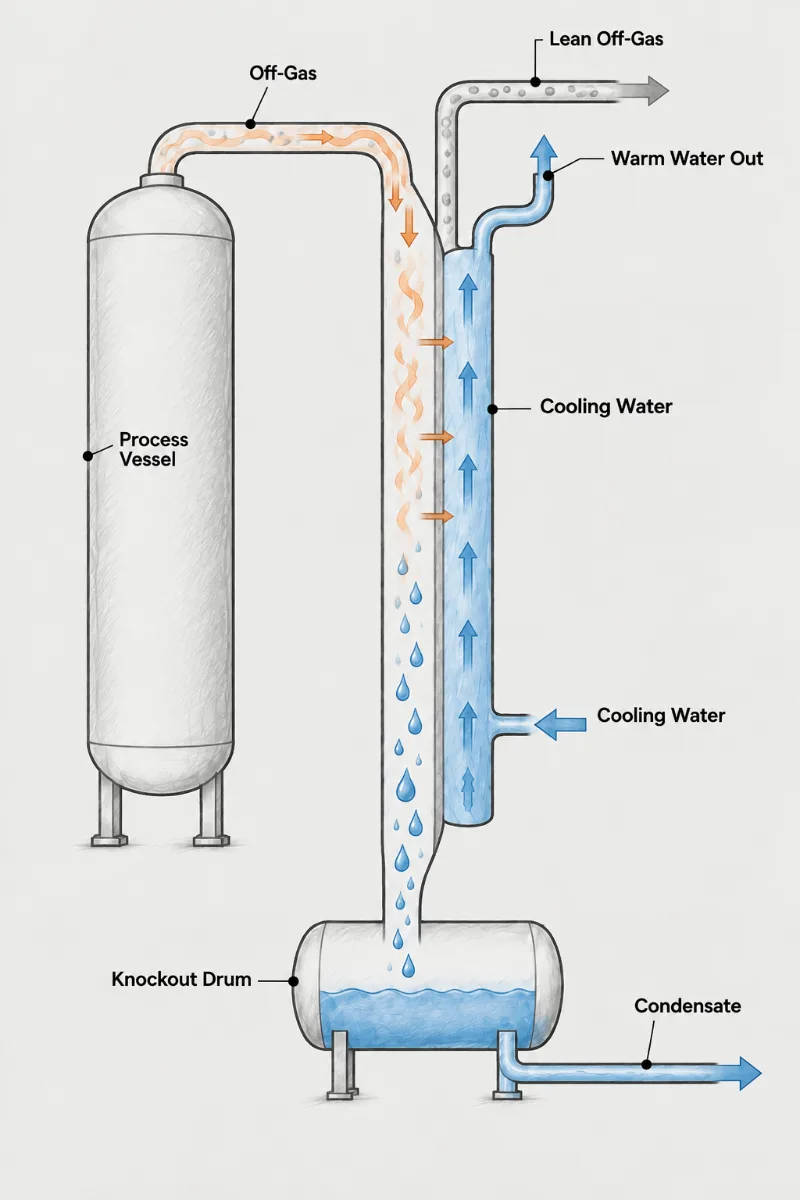
- Return Leg: Gravity return needs slope and a liquid seal so gas cannot bypass back into the vessel through the drain.
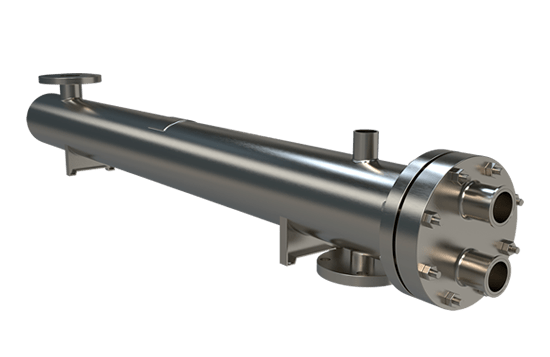
Handling Variable Off-Gas Without Losing Condensate
What does your off-gas look like at the worst minute of the batch, not the average hour? A reactor heating toward reflux or a fermenter at peak aeration can push several times the average vapor load through the vent line, and a condenser sized on the average will pass that surplus to the scrubber, the filter or the atmosphere.
The gas is mostly noncondensable, so condensing is limited by diffusion through it. Higher sparge rates lower the vapor fraction but raise the volume to be cooled; at low flow the gas cools fully and the condensate subcools, which is harmless unless it is returning to a vessel that must stay at temperature. Coolant control across that range matters more than raw surface.
A vertical Fixed Tubesheet unit, with off-gas flowing down the tubes and condensate draining by gravity to the return line, fits most reactors and fermenters. Fermenters usually call for 316L with a polished bore and a cleanable, self-draining layout so the condenser can join the vessel's CIP and SIP circuits. A Horizontal Fin Fan earns a place on large, hot reactor off-gas at outdoor sites short of water. On fermenters it does little: the broth runs only a little above ambient, so the gas leaving it is barely warmer than the air that would be cooling it.
Have off-gas rates for each batch phase, headspace pressure and temperature, the sparge or sweep gas, and where condensate should go.
Phase-by-phase flows
Off-gas rate and composition for each batch step
Vessel conditions
Headspace pressure, temperature and sweep gas
Condensate fate
Return to vessel, recovery tank or treatment
Hygiene class
Sanitary finish or standard industrial construction
Steady Recovery
Through Every Phase of the Batch
1.
Dry Vent Filters
Cooling the off-gas and removing liquid ahead of the exhaust filter keeps the membrane dry, holding its pressure drop down and avoiding the wetting that forces a mid-batch filter change or compromises sterility.
2.
Volume Kept in the Vessel
Condensing water and volatile product back to the vessel cuts evaporation loss over long runs, so concentration, yield and final volume match the recipe instead of drifting with airflow.
3.
Peak and Turndown
Rating across the full batch range avoids a unit that floods with condensate at low flow or passes vapor at the surge. Coolant control trims duty when the off-gas runs lean.
Reactor and fermenter questions
Because air leaving a 90 F broth is saturated, and over a multi-day run at one vessel volume per minute of aeration that saturated air hauls away a surprising amount of water and ethanol. Work a 10,000 liter fermenter at 1 vvm: about 350 cfm of air leaves saturated at 90 F, carrying roughly 0.031 lb of water per pound of dry air. Cooling it to 60 F drops that to 0.011 lb, so the condenser returns about half a pound of water a minute, close to 90 gallons a day that would otherwise leave the broth.
On an ethanol fermentation the product fraction leaves too. Keeping that volume in the vessel is why the condenser earns its place even when the gas is 95 percent air.
Return it when the condensate is the batch solvent and you want the batch concentration held; divert it when it carries something the reaction is trying to eliminate. The classic mistake is returning water from a reaction that forms it. In an esterification, water vapor leaving with the sparge is the by-product driving the equilibrium, and a gravity return leg sends it straight back and stalls conversion.
The piping differs too: a return leg needs slope and a liquid seal deep enough that off-gas pressure cannot push through the drain, while a diverted stream needs a receiver and a vent. Decide this during process design, because converting a return leg to a receiver after installation means cutting into sanitary piping.
Chilled water at 45 F is the usual choice on fermenter off-gas, since 85 F tower water can barely pull a 90 F stream below its dew point. Chilled water or glycol goes on reactor off-gas carrying low-boiling solvent, and a tempered loop belongs anywhere humid gas would otherwise meet a surface below 32 F. The pairing follows the broth or batch temperature. A fermenter at 90 F gives the condenser only a few degrees to work with on tower water, so the outlet stays close to the coolant and the return is modest. A reactor at reflux with dichloromethane in the off-gas wants 40 F glycol to hold the solvent. Avoid overcooling with the cold loop at low flow: condensate returning at 45 F to a 98 F mammalian cell culture chills the broth and alters growth.
Build the condenser as a sanitary vessel: 316L, polished and electropolished bore, orbital welds, no dead legs, a sloped return line, and a design that drains completely so nothing sits between batches. Then tie it in to the vessel's cleaning and sterilization cycles rather than treating it as utility equipment. The weak point is usually the return leg, where a horizontal run or a trap pocket keeps liquid standing at broth temperature for days.
A vertical tube-side gas path draining straight down into a sloped line with a liquid seal leaves no pocket. On a mammalian cell process, the condenser also has to survive SIP temperature on every cycle, which affects tube joint design. Specify these at order time; they cannot be retrofitted into a standard industrial condenser.
It can on a shared vent header, with the peaks of all vessels added or staggered, but shared service gives up the gravity return that makes a single-reactor condenser so simple. Once condensate from three reactors mixes, no leg can send it back to the right vessel, so it goes to a recovery drum and the batches lose volume. Each reactor also needs an isolation valve on its vent so that a vessel at pressure cannot push gas toward one that is open.
On fermenters the shared unit is worse again, because one vessel's off-gas touching another's vent path is a sterility question. Plants that share a condenser usually do so for solvent recovery on reactors, not for volume return on fermenters.