
1-805-484-2992
Quotes - Engineering - SalesVent Condensers for Tank Breathing and Filling Losses
Storage tanks and process vessels vent in two ways. They breathe as daily temperature swings expand and contract the vapor space, and they push out displaced vapor when they are filled. Both streams are air or nitrogen saturated with whatever liquid is stored, and both are intermittent: a few cubic feet per minute on a warm afternoon, then a large surge at the pumping rate when a truck unloads. A vent condenser on the tank or vent header returns that vapor to liquid, but it must be sized for the filling surge rather than the slow breathing.
- Fill Rate: Displaced vapor equals the liquid pumping rate, so a truck or railcar unload sets the peak gas flow.
- Thermal Breathing: Daily heating of the vapor space drives a slow, steady outflow that dominates annual losses on idle tanks.
- Roof Pressure: Atmospheric tanks tolerate only ounces of backpressure; condenser drop must fit under the vent valve setting.
- Inbreathing: When the tank is pumped out or cools, air returns through the vent, and the condenser must not restrict it.
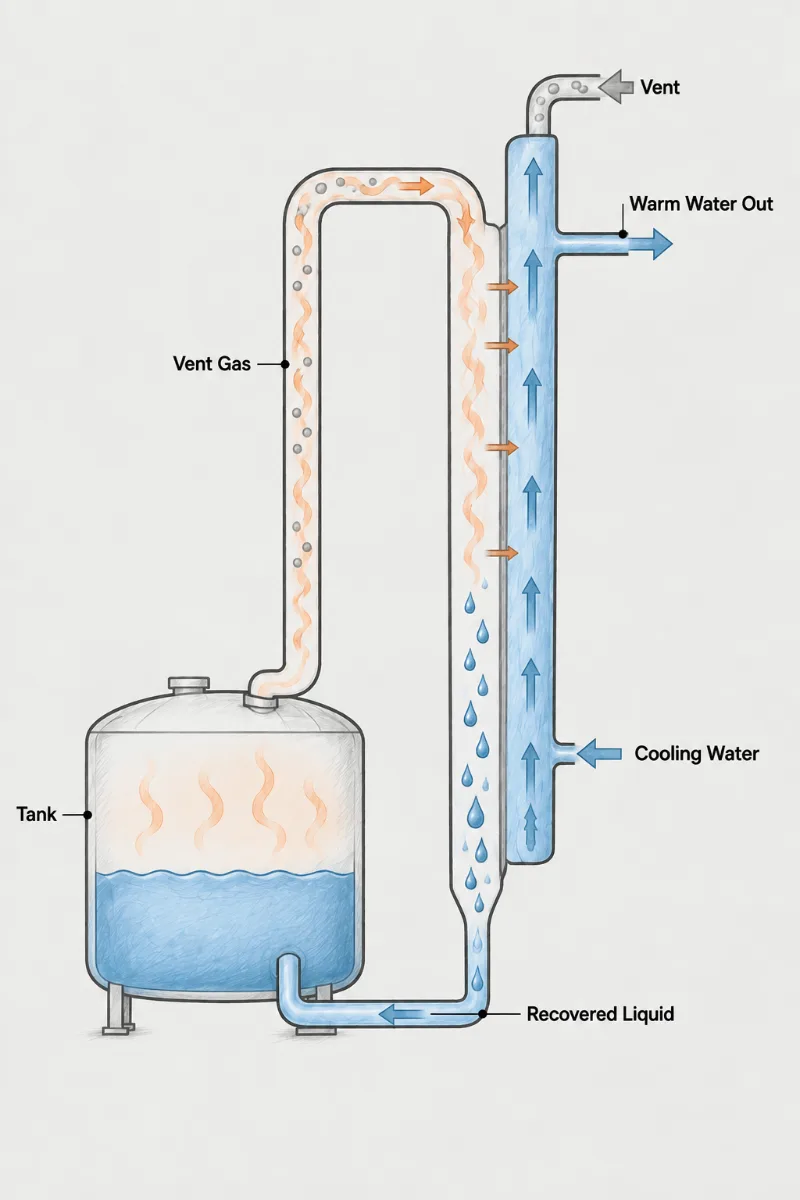
- Gravity Return: Condensate drains straight back to the tank through a sealed line, keeping the arrangement simple.
- Vapor Balance: Where a balance line to the delivery vehicle exists, the condenser handles only residual and breathing losses.
Atmospheric Tanks, Ounces of Pressure
How much pressure can your tank roof take? For a typical atmospheric storage tank the answer is measured in ounces per square inch or inches of water column, and that single number shapes a vent condenser more than the heat load does. Exceed it during a fast fill and the pressure-vacuum valve lifts, bypassing the condenser entirely. Any flame arrestor on the vent line takes its share of that same small allowance.
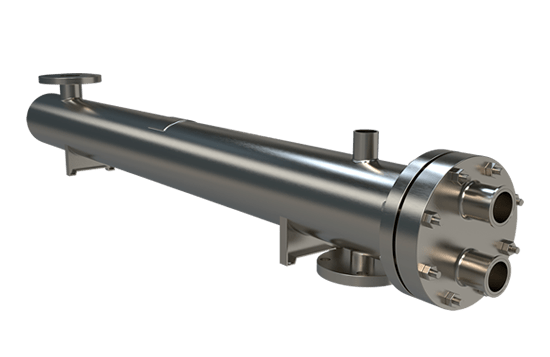
The vapor leaving a tank is saturated at the liquid surface temperature, mostly air or blanket nitrogen with a fraction of product. Recovery depends on how far below that temperature the gas can be cooled, and the gas path must also pass the reverse flow when the tank inbreathes. A Fixed Tubesheet exchanger mounted vertically on the roof nozzle or the vent header, with gas rising through the tubes and condensate running back down them to the tank, gives a low-resistance path in both directions on chilled water or glycol. A Horizontal Fin Fan suits heated storage, such as asphalt or heavy fuel oil tanks where vapor leaves hot, and remote tank farms without cooling water; for light solvents stored at ambient, air cooling achieves very little.
Bring the maximum fill and withdrawal rates, the stored product with its storage temperature and vapor pressure, pressure-vacuum valve settings and any arrestor, and the nozzle size and blanket gas details.
Fill and empty rates
Maximum pumping rates into and out of the tank
Stored liquid
Product, storage temperature and vapor pressure
Vent settings
Pressure and vacuum valve settings plus arrestor details
Tank details
Nozzle size, roof loading and any blanket gas
Breathing Losses
Returned to the Tank
1.
Product Stays Home
Vapor condensed at the vent drains back into the tank it came from, so working and breathing losses become recovered inventory instead of emissions or a gap in the tank reconciliation.
2.
Low Backpressure
Sizing the gas path for the filling surge keeps the tank within its pressure rating, avoiding lifted vent valves, stressed roofs and the emissions that follow whenever the condenser is bypassed.
3.
Simple Liquid Side
With condensate returning by gravity and coolant circulating continuously, the system needs no pumps or receivers for the recovered liquid, which suits remote tank farms with little operator attention.
Tank vent questions
Filling losses dominate on a tank turned over more than a few times a month; breathing losses dominate on a tank that sits full or near full for weeks. The numbers separate quickly. A 20,000 gallon tank receiving a 7,000 gallon truck displaces about 940 cubic feet of saturated vapor in the half hour the truck pumps, which is the peak the condenser must take.
The same tank breathing through a 30 F daily swing moves roughly 5 to 8 percent of its vapor space each day, at a rate of a few cubic feet per minute. Over a year the breathing total can match a dozen deliveries, so the annual recovery estimate depends on the tank's duty, while the condenser size depends only on the truck.
Not if the inbreathing path is checked as carefully as the outbreathing one, which means rating the condenser gas side for reverse flow at the maximum pump-out rate with a drop that leaves the vacuum valve margin intact. A tank being emptied at 500 gpm needs about 67 cfm of air to come back in, and the pressure-vacuum valve on a typical atmospheric tank opens at only a half ounce or an ounce of vacuum.
If the condenser passes that air through its tubes, the drop must be a small fraction of that setting, which argues for large tubes and few of them. The safer layout mounts the vacuum breather on its own nozzle, so the condenser only ever sees outbreathing flow.
Yes, on a vapor header, and for a farm of a dozen solvent tanks it is usually cheaper then a condenser on every roof, but the header changes what the condenser is. Instead of draining back to one tank, condensate from mixed products collects in a drum, which means a pump, a level control and a decision about where mixed liquid goes. Every tank needs a check valve or isolation so a truck filling one tank cannot push vapor toward another, and the header must be sloped and drained so no liquid leg builds.
Rate it on the worst simultaneous filling case, typically two trucks at once at a busy rack, rather than the sum of every tank, and confirm the header drop clears the lowest vent setting among the tanks.