
1-805-484-2992
Quotes - Engineering - SalesCondensing VOCs From Coating and Printing Lines
Web coating, converting and printing lines dry solvent-borne coatings in ovens that exhaust large volumes of warm air carrying toluene, ethyl acetate, MEK or alcohol blends at a fraction of the lower explosive limit. Seen from the emissions side, the question is how much of that VOC a condenser can take out before the stream reaches a carbon bed or oxidizer. In dilute oven exhaust the dew point sits far below ambient, so condensation earns its place only where the line concentrates its exhaust first.
- LEL Fraction: Ovens run at a set percentage of the lower explosive limit, and that percentage fixes VOC partial pressure and therefore the dew point.
- Air Volume: Dilute exhaust means cooling a great deal of air to condense a little solvent, so the sensible load can dwarf the latent load.
- Resin Mist: Plasticizers, oligomers and coating mist condense as sticky films on cold surfaces well before the solvent itself does.
- Mixed Solvents: Blends condense over a temperature range; the heaviest component drops out first and the lightest sets the final outlet temperature.
- Line Speed: Solvent load follows coat weight and line speed, so the condenser sees a different duty with every product change on the line.
- Downstream Device: Whatever the condenser misses goes to the oxidizer or carbon, so the two are sized as one system rather than separately.
How Far Condensation Gets You on Oven Exhaust
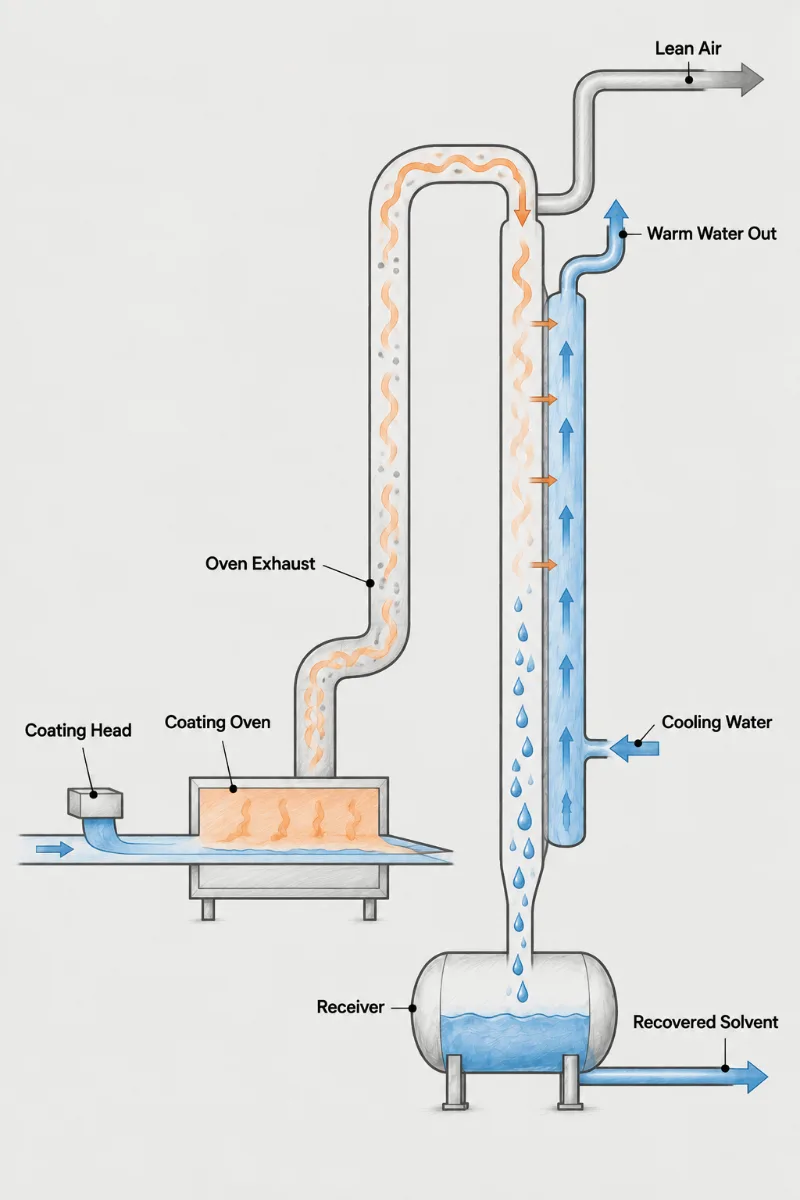
How much VOC can a condenser remove from coating oven exhaust? The answer comes from the dew point, not from a catalog. Toluene at about one percent by volume, a typical concentrated oven exhaust, has a dew point near the freezing point of water. Taking ninety percent of it out means cooling to roughly minus twenty F, where toluene's vapor pressure has fallen to a tenth of its value at the dew point. At a few tenths of a percent, common for an oven without recirculation, the dew point is colder still and condensation alone is a poor fit.
That is why condensers on coating lines usually follow a concentration step: oven air recirculated under LEL monitoring, a closed inert-gas oven, or the desorption stream of a concentrator wheel. On those streams the condenser recovers most of the solvent as reusable liquid, and the oxidizer behind it can be smaller.
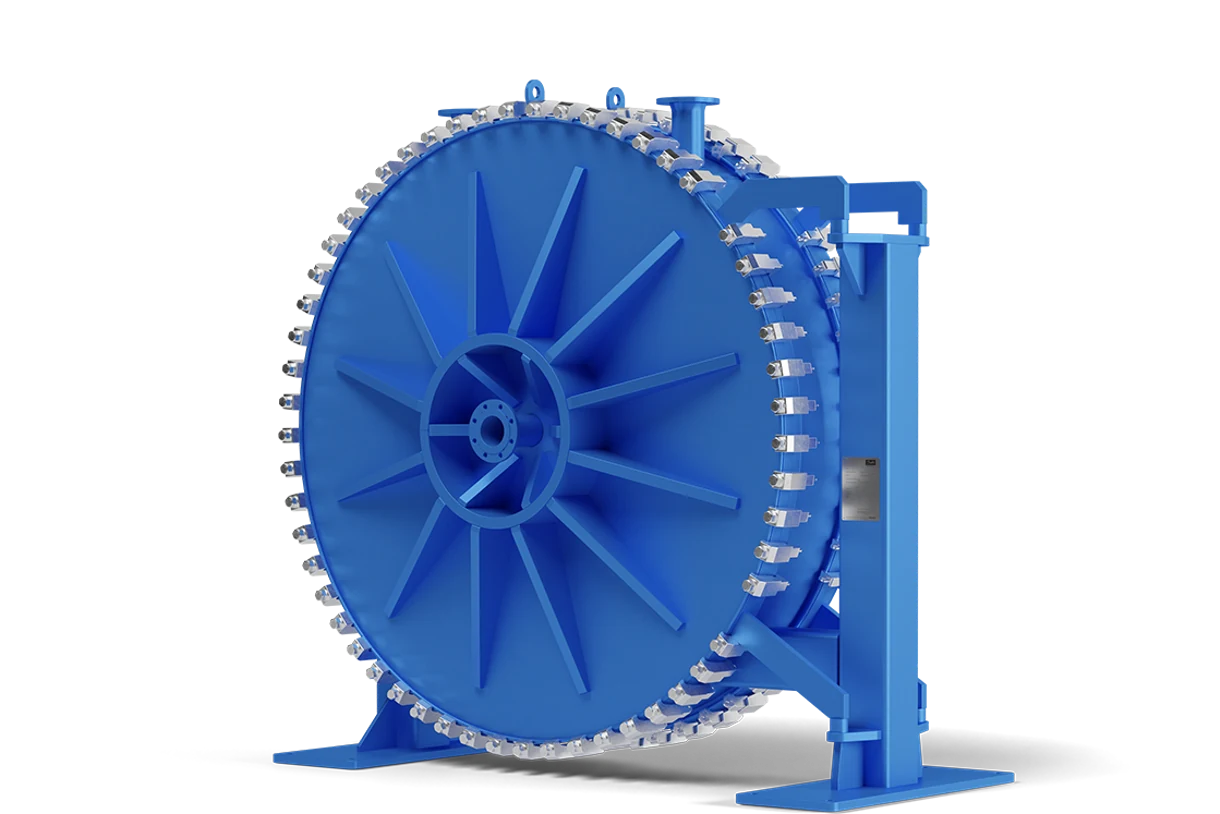
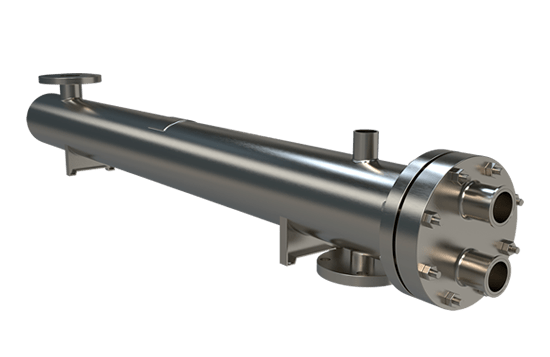
A Counterflow Spiral is a strong fit for the warm, dirty first stage. Its single channel resists the resin mist and plasticizer that plate out ahead of the solvent, and it opens for cleaning. A Fixed Tubesheet shell-and-tube with exhaust in the tubes suits the cold stage, where clean straight tubes can be defrosted and inspected. A gasketed plate pack is a poor choice on this duty, because oven solvents swell many elastomers and the narrow gaps foul.
Bring the oven exhaust flow and temperature, the solvent blend and its LEL percentage, coating solids that may carry over, the recovery or emission target, and the control device that sits downstream.
Exhaust flow
Oven exhaust volume, temperature and moisture content
Solvent blend
Each solvent in the coating and the operating LEL fraction
Coating carryover
Resin, plasticizer or mist expected in the exhaust air
Control train
Oxidizer or carbon behind the condenser and its target
Smaller Oxidizer,
Solvent Back as Liquid
1.
Two-Stage Cooling
A warm first stage on cooling water strips resin mist and heavy solvent and takes the sensible load cheaply. The refrigerated stage then handles only the light solvent fraction it was sized for.
2.
Cleanable First Pass
Spiral channels sweep sticky deposits at velocity and open on hinged covers. Coating residue is washed out during a line shutdown instead of accumulating until the exchanger falls short of its rating.
3.
Recovery Stated Plainly
Rating against dew point and LEL fraction shows what share of the VOC the condenser will capture and what the downstream device must still treat, so neither is oversized or left short.
Oven exhaust questions
Rarely on the raw exhaust: the refrigeration needed to reach a dew point that low will excede the value of the solvent recovered, and the oxidizer or carbon bed the line already needs handles the dilute stream at lower cost. The arithmetic is unforgiving. An oven at 10 percent LEL on toluene is about 0.11 percent by volume, with a dew point near minus 15 F; a 20,000 scfm exhaust at that concentration carries around 300 lb/hr of toluene, and chilling 20,000 scfm of air toward minus 50 F to catch most of it takes several hundred tons of refrigeration.
Raise the LEL fraction first through oven recirculation under monitoring, or let a concentrator wheel deliver its desorption air at ten to fifteen times the concentration, and the same 300 lb/hr arrives in a stream a modest condenser can handle.
It condenses first and in larger quantity than the solvent, and below 32 F it becomes frost that closes the cold stage. Plant air at 70 F and 50 percent humidity carries about 55 grains of water per pound, close to 0.8 percent by mass; a 20,000 scfm oven exhaust therefore brings in roughly 700 lb/hr of water, several times the solvent load on many lines.
Cooling that air to 40 F in a chilled stage ahead of the refrigerated one drops about a third of it as liquid, which goes to a drain along with the heavy fraction of a toluene blend floating on it. What remains in the gas, about 35 grains per pound, still frosts a minus 20 F stage, so that stage needs a defrost sequence or a pair of units alternating. Alcohol and ketone solvents dissolve in the water layer and are recovered only by distillation.
Yes for a single-solvent system once water is removed and the dissolved resin is checked, with more caution for a blend. Toluene from a rubber adhesive line separates from water in a decanter, and a residue test on an evaporated sample shows whether oligomer carried over; a few hundred ppm of resin rarely matters in the same adhesive but can in a clear coat.
A blend of toluene, MEK and ethyl acetate comes back in a different ratio, since the condenser catches the toluene preferentially and passes much of the MEK, and the coating viscosity and drying profile shift if the recovered mix is used as supplied. Send a sample to the coating supplier before putting it in a formulation. Most converters route recovered blend to press wash and cleanup, where ratio does not matter, and buy fresh solvent for the coating.
By condensing it on a warm surface first, where it comes off with a wash, instead of letting it reach the refrigerated stage where it hardens on fins or tubes under frost. Plasticizers and oligomers in a coating exhaust condense at temperatures well above the solvent dew point, often at 100 F or higher, so a first stage on cooling water at 85 F collects them with the heavy solvent fraction.
Keep gas velocity high enough through that stage that the sticky film is scoured rather than left to thicken, which is what a spiral channel does. Build it with hinged covers or a removable bundle, schedule a hot-solvent wash at each line shutdown and put a differential pressure gauge across it. The cold stage downstream then sees clean, nearly resin-free gas and can be inspected rather than scraped.