
1-805-484-2992
Quotes - Engineering - SalesCondensers Within a VOC Control Train
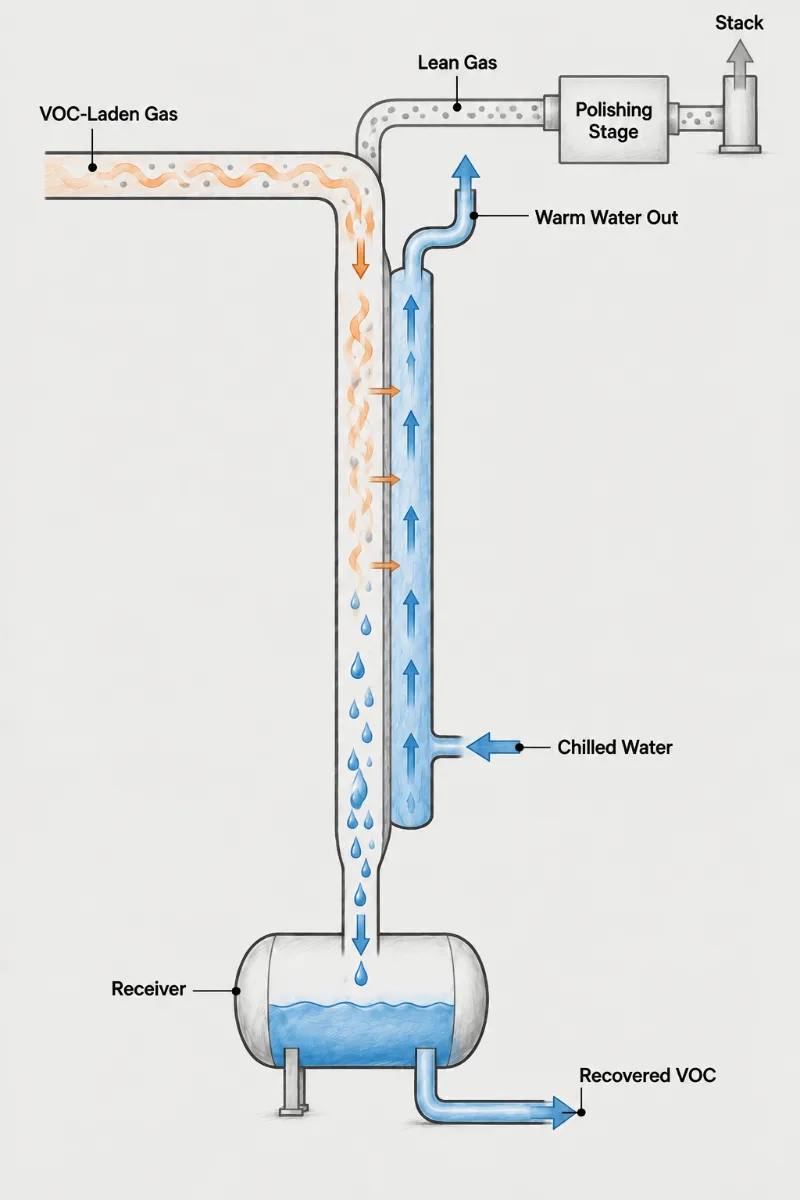
In an emissions-control system the condenser is rarely the only device; it is a stage. Ahead of a carbon adsorber it removes water and heavy organics that would load the carbon, and on rich streams it takes out enough VOC that the carbon only polishes. Ahead of a thermal oxidizer it can capture halogenated compounds before they form acid gases. On high-concentration vents, a cascade of cooling water, chilled glycol and low-temperature refrigeration can be the primary control. Each position calls for a different outlet temperature.
- Stage Role: Decide whether the condenser is primary control, pretreatment for carbon or a guard for an oxidizer; the outlet target follows from that decision.
- Cascade Steps: Splitting cooling among tower water, glycol and deep refrigeration puts each part of the load on the cheapest coolant able to carry it.
- Removal Efficiency: Permit limits are written as percent removal or outlet concentration, and either one translates into a required condenser outlet temperature.
- Freeze Points: Water and high-melting organics such as benzene solidify on surfaces below their freezing points and must leave in an earlier, warmer stage.
- Carbon Protection: Cool, dry gas entering carbon limits bed temperature rise from adsorption heat and stops water from taking up capacity.
- Halogen Capture: Condensing chlorinated VOC before an oxidizer reduces acid gas formation and the size of the scrubber that follows it.
Placing the Condenser in the Control Train
The condenser's outlet temperature should be set by what the next device needs, not by how cold the chiller can go. Ahead of activated carbon the goal is gas that is cool, below water saturation and lean in heavy organics, and a moderate glycol temperature often achieves it. As primary control on a rich vent, the outlet must reach the temperature at which the remaining VOC partial pressure meets the permit, which for light solvents can mean deep refrigeration or liquid nitrogen.
Staging keeps that affordable. A cooling-water stage takes sensible heat and high boilers; a glycol stage takes water and much of the solvent, letting moisture drain before anything freezes; a low-temperature stage finishes the job. Each stage's outlet sets the next stage's inlet dew point, so each coolant works within its economic range. Where a low stage must run below the freezing point of water or a high-melting organic, twin exchangers alternate between service and defrost.
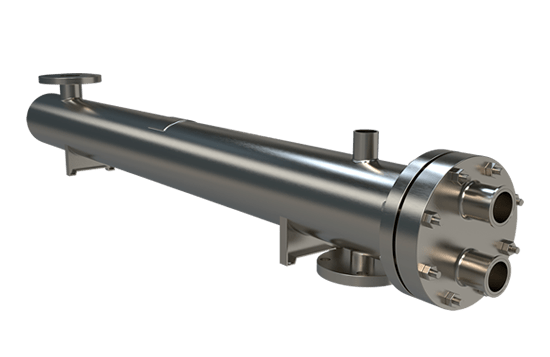
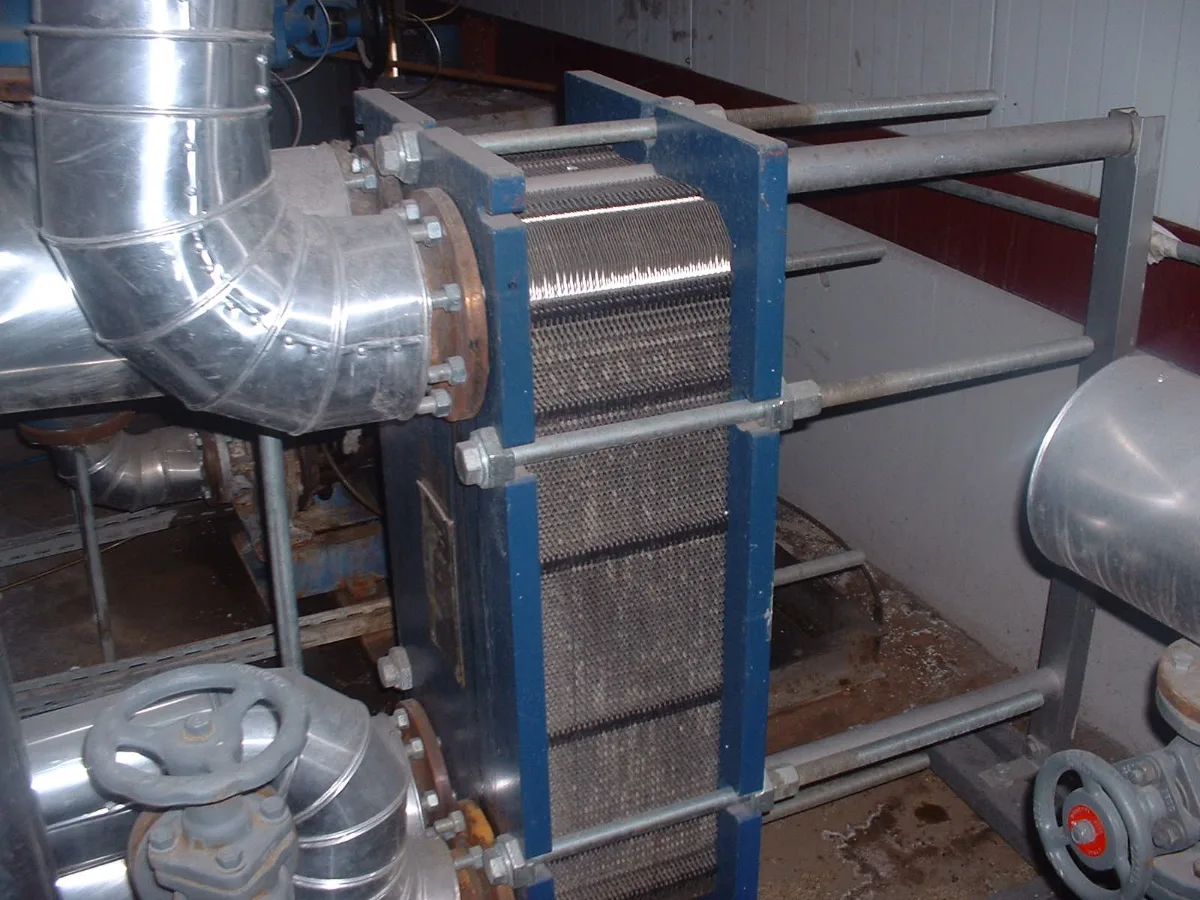
A Fixed Tubesheet shell-and-tube is the workhorse for every stage. It carries refrigerant or glycol pressure, takes the thermal cycling of defrost, and its tube side can be steamed or warm-flushed. A Welded Plate exchanger suits intermediate stages where the gas is clean and a close approach matters, and it saves weight on skid-mounted systems; it is less suited to a frosting low-temperature stage, where narrow channels close quickly.
Bring the vent gas composition and flow range, the permit basis, the downstream device and it's inlet limits, and the coolants available on site.
Permit basis
Required removal efficiency or outlet concentration limit
Vent stream
Gas flow range, VOC species, water and inerts
Downstream device
Carbon, oxidizer or scrubber and its inlet limits
Site coolants
Tower water, glycol, refrigeration or liquid nitrogen on hand
A Control Train
That Works as a System
1.
Right Stage, Right Coolant
Matching each part of the load to the cheapest coolant that can carry it keeps refrigeration demand down. The low-temperature stage sees only the VOC the warmer stages could not remove.
2.
Longer Carbon Life
Removing water and heavy organics ahead of the adsorber leaves its capacity for the compounds it is there to catch, extending the interval between regenerations or carbon change-outs.
3.
Halogens Kept From the Flame
Capturing chlorinated solvents as liquid before an oxidizer reduces hydrochloric acid in the flue gas, protecting the oxidizer refractory and shrinking the scrubber needed behind it.
Control train questions
A condenser can stand alone when the vent is small and rich enough that cooling to a reachable temperature drops the remaining VOC partial pressure below the permit limit, with no carbon or oxidizer behind it. Work it from the vapor pressure curve. A nitrogen-blanketed storage vent saturated with methylene chloride at 80 F carries roughly 55 percent solvent by volume; chilling that gas to -20 F leaves about 5 percent, better than a 90 percent cut on a stream of a few scfm that liquid nitrogen or a cascade refrigeration unit handles cheaply.
A paint booth exhaust at 10,000 scfm and 200 ppm never qualifies: the inert gas volume to be cooled is enormous and the partial pressure starts far too low. If your permit is written as an outlet concentration in ppm rather than as percent removal, confirm the final-stage temperature you can afford actually reaches it before committing to condensation alone.
Keep the freezing components out of the cold stage by condensing them upstream, and give the cold stage a defrost cycle so whatever still frosts can be melted off on a schedule. The error that fills service logs is specifying one deep-refrigeration exchanger for a wet solvent vent, then watching pressure drop climb over a shift as ice bridges the first tube rows.
A glycol stage held at 40 F pulls most of the water out as liquid first; the refrigerated stage behind it then sees gas with a dew point low enough that frost builds slowly. Twin exchangers with switching valves let one defrost with warm glycol or a slip of recirculated gas while the other runs. Rate the frost-up interval alongside the clean duty; an interval shorter than a shift is unworkable for operators.
No, in most cases, because the VOC you condense out was supplementing the burner, and a leaner inlet means more natural gas to hold combustion temperature. The savings show up elsewhere. Recovered solvent has resale or reuse value, and chlorinated compounds taken out as liquid mean less hydrochloric acid in the flue gas, which shrinks the caustic scrubber and protects the refractory.
There is also a sizing case: if the condenser knocks the vent concentration down far enough, a smaller oxidizer, or a regenerative unit instead of a recuperative one, may be purchased. Run the fuel balance both ways before deciding, because on a lean vent with no halogens the condenser can cost more in refrigeration power than it ever returns.