
1-805-484-2992
Quotes - Engineering - SalesCondensing High-Purity Clean Steam
High-purity clean steam is generated from purified water in a pure steam generator, and once it condenses it must meet the same chemistry as Water for Injection: low conductivity, low total organic carbon and a tight endotoxin limit. That changes what a condenser is for. In most services the condensate is a by-product; here the liquid leaving the outlet is the product that gets sampled, tested and released. A sample cooler or clean steam condenser that sheds iron, picks up a trace of cooling water or holds stagnant liquid will fail the steam itself, even when the generator is performing perfectly.
- Conductivity Limit: Condensate is judged against WFI conductivity, so a pinhole leak admitting even a little cooling water shows up immediately as an out-of-specification sample.
- TOC and Endotoxin: Wetted surfaces must not shed organics or harbor biofilm; electropolished 316L and full drainage keep the outlet sample representative of the steam.
- Leak Barrier: A double tubesheet gives any tube-joint leak a vented path to atmosphere instead of into the product, which is the main defense against cross-contamination.
- Rouge Control: High-temperature pure steam slowly forms iron-oxide rouge on stainless; specify low-sulfur 316L, passivation, and a finish that can be repassivated in place.
- Sample Temperature: Analyzers and grab samples typically need condensate well below boiling, so the cooler must subcool the sample without flashing at the sampling valve.
- Dryness and Gases: Where the condenser serves a steam-quality test, its geometry must not trap noncondensable gas or alter dryness fraction before the measurement point.
Why the Condenser Outlet Is the Product
Ask a validation engineer why a clean steam sample failed and the answer is rarely the generator. More often the sampling condenser added something: a few parts per billion of iron from rouged tubes, a conductivity spike from a weeping tube-to-tubesheet joint, or TOC from condensate that sat in a low spot between samples. Because the release test is taken at the condenser outlet, every wetted square inch between the steam header and the sample valve is part of the quality system.
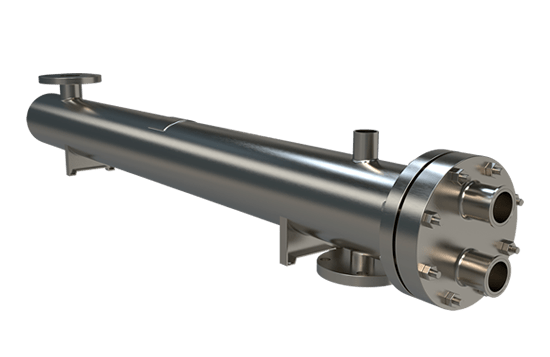
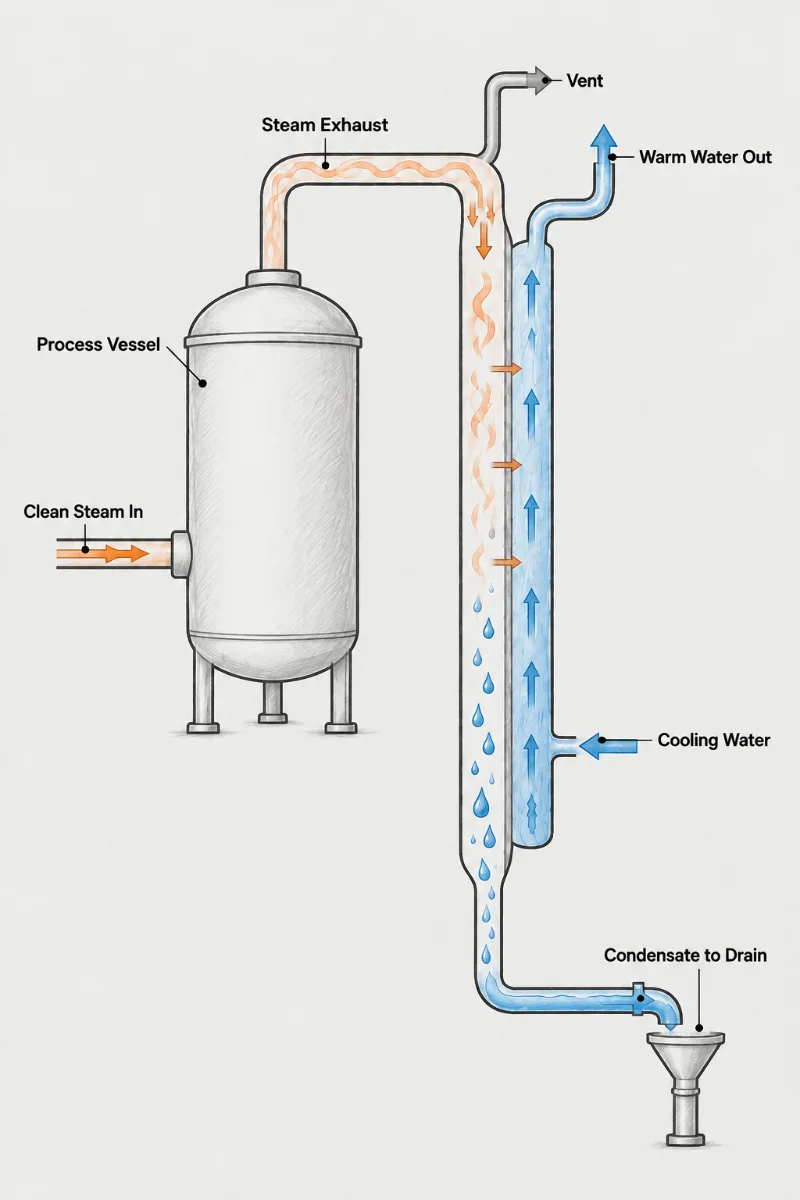
That points to a Fixed Tubesheet shell-and-tube design with clean steam inside straight 316L tubes and cooling water on the shell side. Straight tubes can be borescoped and drained in one direction, and a double tubesheet, with a vented gap between the inner and outer sheets, means a leaking joint discharges to atmosphere where it can be seen. Keep cooling-water pressure below the product side as a second barrier, and slope the unit so no condensate is retained when steam is shut off.
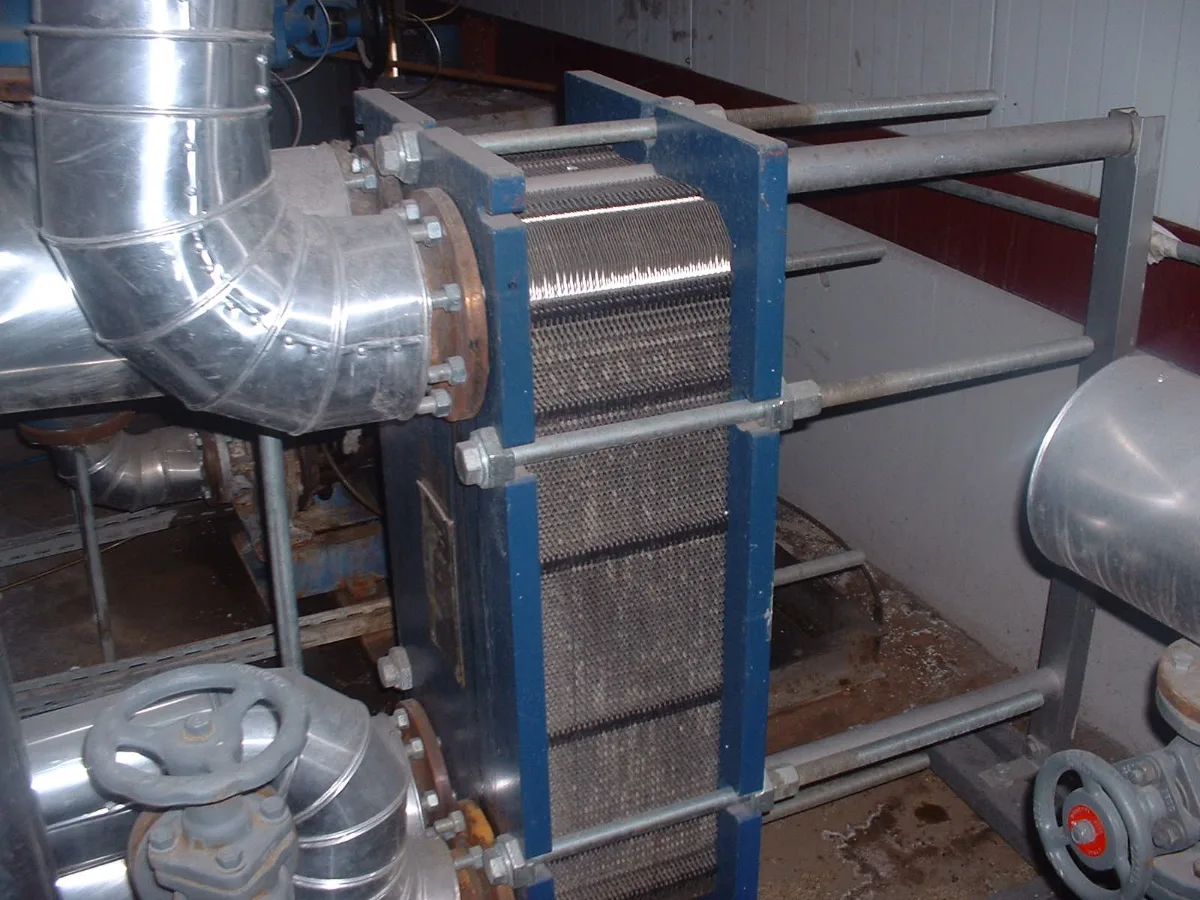
A Gasketed Plate & Frame exchanger is the wrong tool for the product side of this duty. Each plate is sealed by an elastomer gasket, a single plate wall separates product from coolant, and the narrow channels are difficult to drain completely. Plate units do have a place on high-purity skids, such as cooling the utility water loop that serves the condenser, where the fluid never touches clean steam.
Undersizing shows up as a warm, flashing sample and an analyzer reading that drifts with steam demand. Bring the clean steam pressure, the sample or condensing rate, required outlet temperature, coolant type and supply temperature, surface finish requirement and whether the unit will be electropolished, plus the steam-quality standard your site tests against.
Steam conditions
Header pressure and the condensing or sample rate needed
Outlet temperature
How cool the sample must be at the analyzer
Purity basis
Conductivity, organic carbon and endotoxin limits you release against
Finish and barrier
Surface roughness, electropolish and double tubesheet requirement
Built So
the Sample Tells the Truth
1.
Visible Leak Path
With a vented double tubesheet, any tube-joint leak drips out where operators can see it rather then diluting the product, so a cooling-water intrusion never masquerades as a generator problem.
2.
Nothing Left Standing
Straight tubes, sloped mounting and a low-point outlet let the condenser drain completely between samples, removing the stagnant condensate that drives up organic carbon and endotoxin results.
3.
Finish That Holds
Electropolished 316L with documented roughness slows rouge formation and can be repassivated in place, keeping iron pickup out of the condensate across years of continuous steam service.
Sample integrity questions
Because cooling water, not steam, is reaching the sample, and the cooler is the only place in the sample path where the two are separated by a tube wall and a joint. The arithmetic is unforgiving. WFI conductivity is held near 1.3 microsiemens per centimeter at 77 F, and tower water runs 500 to 1,500, so a leak of one part in a thousand lifts the sample past the limit.
Check for it by shutting the steam, holding the cooling water at pressure, and watching the product side for a slow weep; a double tubesheet with its vented interspace will show it as a drip from the vent. If the cooler is single tubesheet, the joints will have to be pressure-tested or the unit replaced.
It does, because rouge is iron oxide that sheds as particles and dissolved iron, and both show up at the sample point as color, iron and sometimes elevated conductivity. Class I rouge, the orange film carried in from upstream carbon steel or from the generator, usually wipes off and points at the source. Class III rouge, the dark magnetite film that forms in place on 316L under pure steam above 250 F, is the one a condenser creates for itself.
Low-sulfur 316L and an electropolished bore slow it, and a passivation certificate at delivery gives the qualification team a baseline. When a sample starts trending in iron, derouging with a chelant and repassivating in place restores it without pulling the unit.
Enough to deliver condensate to the analyzer below its rated inlet limit, which for most conductivity and TOC analyzers is 77 F to 95 F, with no flashing anywhere between the tube outlet and the sampling valve. Consider the flash case: condensate held at 30 psig and 274 F flashes about 6 percent on reaching atmosphere, and the vapor fraction carries off volatile organics, so TOC and conductivity on what remains no longer represent the steam.
For a 30 psig header and a 1 gpm sample flow, the cooler removes about 475,000 Btu/hr of latent heat plus the sensible load, and 85 F tower water cannot reach a 77 F outlet; chilled water is the usual answer at that level.
Not well, because a sample cooler wants a tiny holdup and a short, fresh path so the sample reflects the steam now, while a bulk condenser wants surface and volume to handle hundreds of pounds per hour. Tap a sample off the big unit and it has sat in a channel with a thousand times the sample volume, mixing new condensate with old. Residence time drives TOC, and a bulk unit at low load may hold liquid for minutes.
A dedicated sample cooler holding under a pint, with the sample line sloped and no pocket, passes a representative sample within seconds of opening the valve. The two can share a steam header and a coolant loop, not a shell.