
1-805-484-2992
Quotes - Engineering - SalesFinal Condensers for WFI Stills
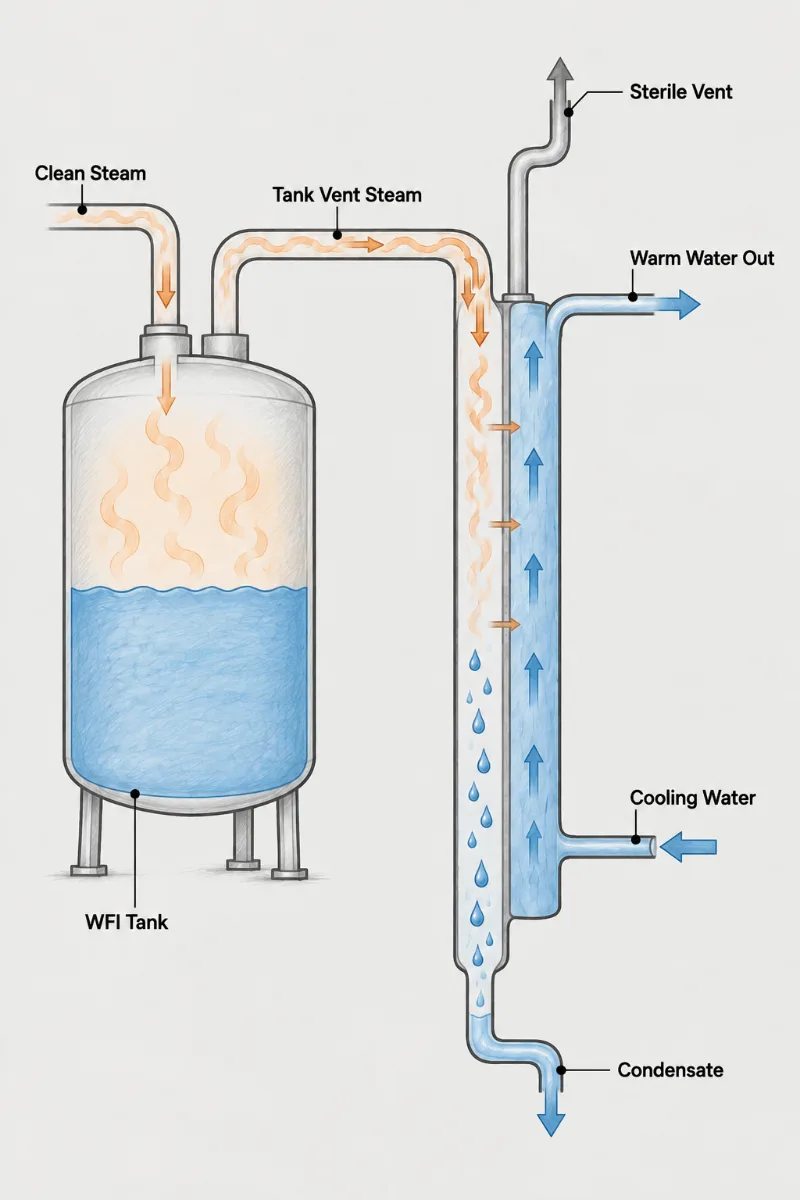
In a multiple-effect or vapor compression still, the condenser is the last step that turns pure steam into Water for Injection. Everything upstream, the evaporation, the separators that knock out droplets carrying endotoxin, exists to deliver pyrogen-free vapor to this exchanger. Its job is to condense that vapor without adding anything: no entrained droplets carried past the separator, no coolant leaking across, no air drawn in through the vent. Unlike a sample cooler, it typically delivers WFI hot to a storage tank held above the temperature where bacteria grow.
- Pyrogen-Free Output: Endotoxin removal happens in the still's separators, so the condenser must not bypass them or let droplets reach the outlet with the condensate.
- Double Tubesheet: Separate inner and outer tubesheets with a vented gap keep any tube-joint leak of cooling or feed water from reaching WFI.
- Sterile Vent: Noncondensables leave through a hydrophobic filter, heated or jacketed so condensate never wets it and blocks the vent.
- Hot Delivery: WFI often goes to hot storage, so the condenser condenses with little subcooling rather than chilling the product.
- Feed Preheat: In many stills the incoming purified water cools the condenser, recovering the latent heat to preheat the still's own feed.
- Pressure Differential: Hold the WFI side at a higher pressure than the coolant, so a breach pushes product out rather than letting coolant in.
The Last Barrier Between Pure Steam and the WFI Tank
Why would a still with good separators produce a failing endotoxin result? Most often the separators were bypassed or overloaded at peak output, but the condenser can contribute: a leaking tube-to-tubesheet joint lets feed water into the distillate, or a vent filter that has wetted out stops venting and the unit floods with air, slowing condensation until liquid backs into the last effect. Treat the condenser as part of the still's purification train, not as an accessory.
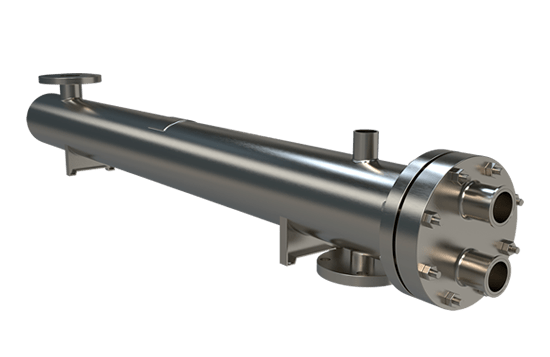
The standard construction is a Fixed Tubesheet shell-and-tube unit with double tubesheets, pure steam condensing on one side of 316L tubes and cooling or feed water on the other. The vented interspace drains any leak to atmosphere, the straight tubes drain completely when the still stops, and there are no elastomers in the WFI path. The vent connection at the high point goes to a sterile hydrophobic filter, kept warm so condensate cannot block it.
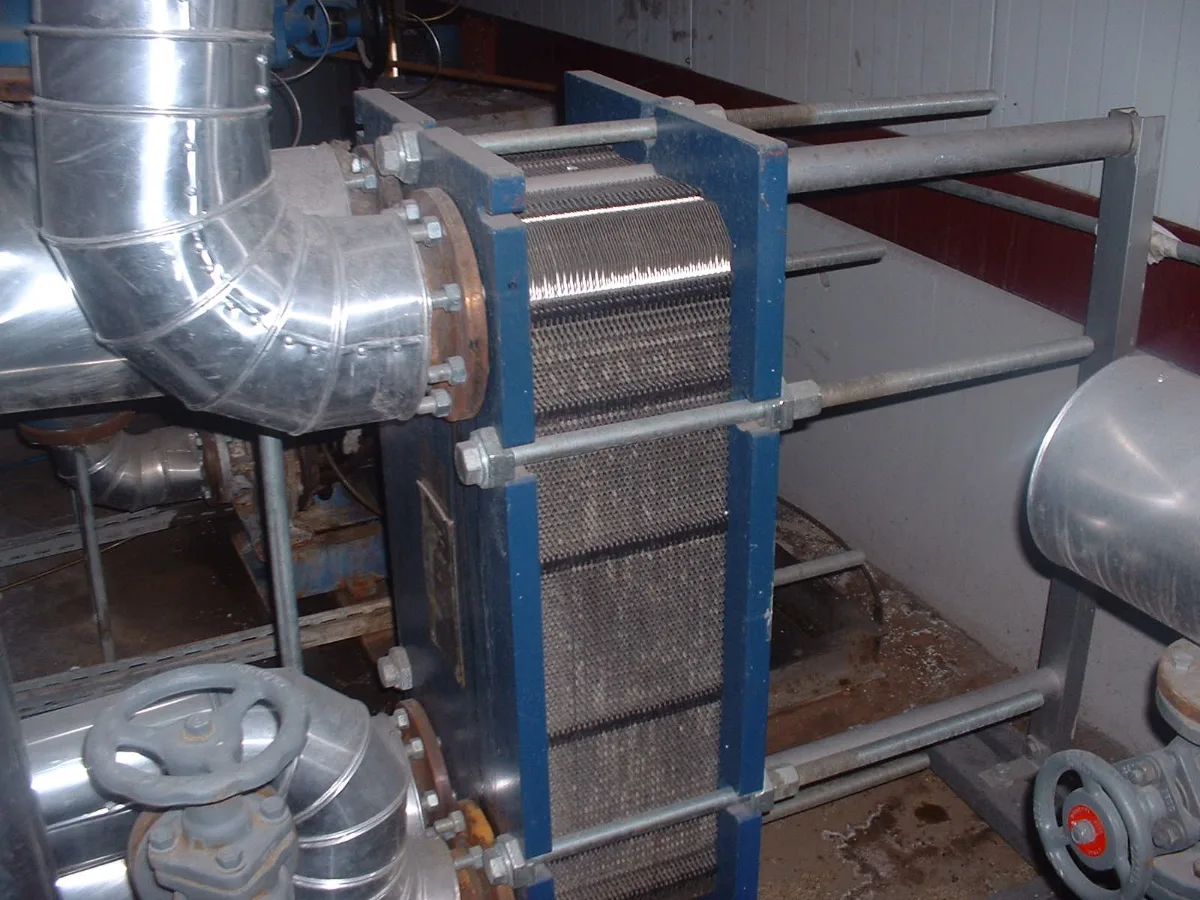
Gasketed Plate & Frame exchangers are not used on the WFI side. A single gasket separates distillate from coolant, and a gasket or plate failure lets coolant contaminate the product without any external sign. Plate units are appropriate further out, such as point-of-use coolers on a separate loop with their own protection.
Undersizing this condenser shows up as a still that cannot reach rated output: uncondensed vapor raises back pressure on the last effect and production falls. Before requesting a quote, gather the still's rated WFI output, last-effect pressure and temperature, the coolant or feed water used and its temperature, the WFI delivery temperature to storage, vent filter arrangement and your surface-finish requirement.
Still rating
Rated WFI output and pressure of the last effect
Coolant side
Whether feed water or plant cooling serves the condenser
Delivery target
WFI temperature required at the storage tank
Vent and finish
Sterile vent filter arrangement and internal surface finish
Condensing WFI
Without Adding Anything
1.
Leaks Go Outside
A vented double tubesheet routes any joint leak to atmosphere where it can be detected, rather then letting cooling or feed water mix silently into the Water for Injection.
2.
A Vent That Stays Open
A warmed hydrophobic filter on the high-point vent lets noncondensables leave while blocking outside air, and because it stays dry it never wets out, blinds and leaves the condenser flooded with air.
3.
Heat Kept in the Loop
Using incoming purified water as coolant recovers latent heat into the still's feed, cutting heating steam to the first effect and lowering cooling-water use without compromising WFI quality.
WFI still questions
A double tubesheet gives a leak somewhere to go other than into the product, and that visible path is what validation engineers and auditors want to see. Each tube passes through an inner and an outer sheet with an air gap between them, and a weep hole or drain on that gap shows any leak as a drip during routine checks. The gap also means the two seals fail independently, so a single joint defect never bridges coolant and WFI. The cost is a longer bundle and a few percent more surface, which is small against the price of a contaminated batch.
A wetted hydrophobic vent filter stops passing gas, so noncondensables build up in the tubes and the still's last effect sees back pressure within minutes rather then hours. Capacity falls faster than a plugged tube would cause, because the gas layer blankets the coldest surface where most of the condensing happens. You will see WFI output drop while still steam pressure stays normal. The cure is a filter housing kept above the condensing temperature by a steam jacket or trace heating, mounted with the vent line sloping back toward the condenser so any condensate drains away before it reaches the membrane.
No more then a few degrees, because hot WFI going to a storage tank held above 176 F only has to be reheated if the condenser chills it. A 2,000 lb/hr still that subcools to 140 F instead of delivering at 190 F throws away about 100,000 Btu/hr that the tank's heating jacket must replace. Set the coolant flow so the condensate leaves 5 to 10 F below saturation at the last-effect pressure, which is enough to prevent flashing in the transfer line. Deep cooling belongs on a point-of-use cooler, where the demand for cold WFI actually sits.
Yes, and in most multiple-effect stills the incoming purified water is the condenser coolant, which is why the first effect uses less heating steam then a simple calculation of still output would predict. The catch is that feed flow equals product output plus blowdown, so the coolant quantity is fixed by the still, not by the condenser designer. If the feed arrives at 70 F and must preheat to near the condensing temperature, the condenser needs enough surface to do that with a small approach, and a trim cooler on plant water may be required at full output. Rate the condenser at minimum and maximum still turndown.
No, because a plate pack puts only one gasket and one thin plate between the distillate and the coolant, and a failure across either shows no external sign. Validation of a WFI system expects a construction where any breach is detectable, and a double tubesheet shell-and-tube unit meets that; a gasketed pack cannot. There is a second reason: plate gaskets are elastomers in the WFI path, which complicates extractables testing and limits the sanitization temperature. If an older still already carries a plate unit as its final condenser, the usual retrofit is a double tubesheet shell-and-tube unit rated for the same coolant flow, which normally fits the existing skid and vent.