
1-805-484-2992
Quotes - Engineering - SalesProduct Condensers for Distillate Recovery
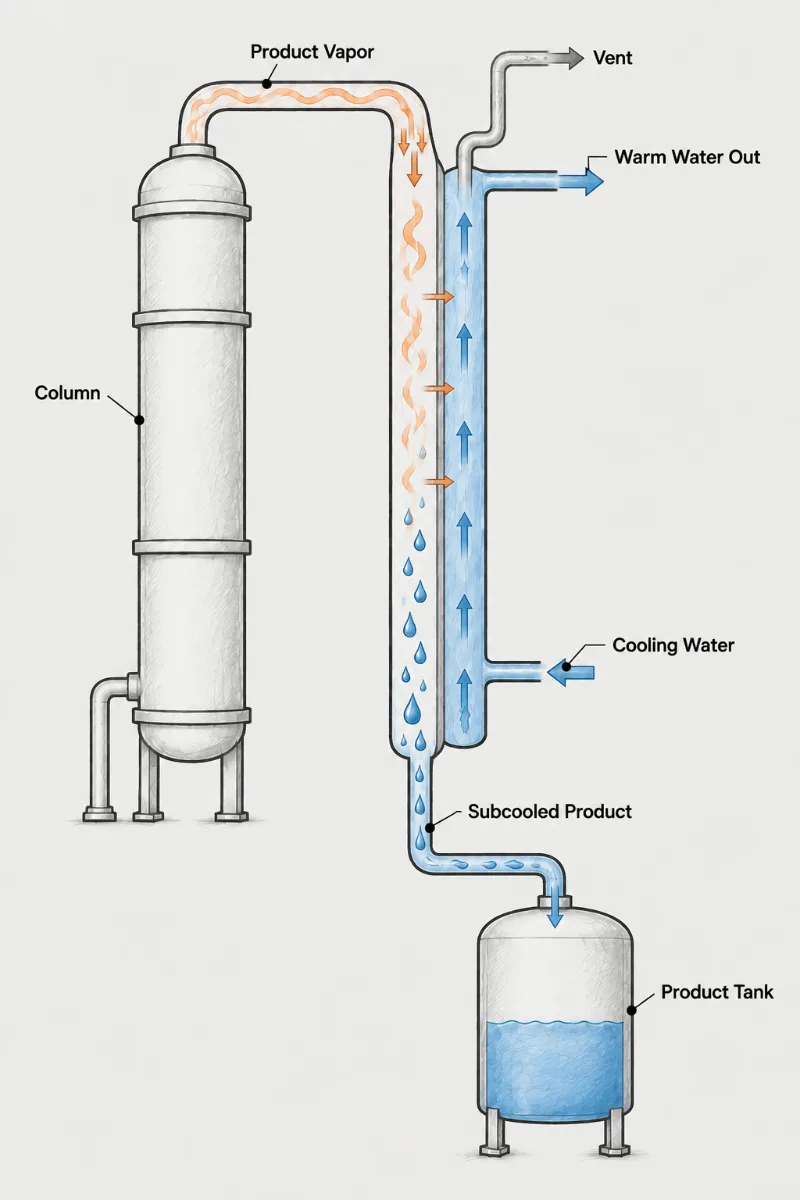
A product condenser turns a finished vapor stream into liquid that goes straight to storage, loading or the next process, rather than back to a column. Its job is defined by the product: the liquid must leave at the temperature the receiving tank expects, at the purity the column achieved, and without picking anything up from the coolant. That puts more weight on subcooling, leak integrity and wetted materials than on the column-pressure control that drives overhead and reflux condenser design.
- Storage Temperature: Liquid sent hot to an atmospheric tank flashes and breathes vapor out the vent, so the outlet is usually set comfortably below the product's bubble point.
- Subcooling Section: Liquid-phase heat transfer runs at a much lower coefficient than condensing and needs its own allotted area, often a flooded zone or a separate cooler.
- Leak Integrity: A tube leak can put cooling water into finished product or product into the cooling tower, so joint type and pressure testing deserve attention.
- Product Purity: Wetted materials must not add metals or color; 316L stainless is the usual baseline for solvents, pharmaceutical intermediates and food-grade distillates.
- Metering Stability: Flow meters and custody-transfer equipment downstream need single-phase liquid; any flashing at the meter shows up as erratic readings.
- Pressure Balance: Which side runs at higher pressure decides which way a leak travels, product into coolant or water into finished liquid, so choose it deliberately.
Specifying Condensers That Feed Storage
What temperature does the receiving tank want? That question sets more of a product condenser's design than the vapor rate does. Distillate condensed at its bubble point and piped to an atmospheric tank will flash at the tank inlet, lose light material through the vent, and count against emission permits. Subcooling the liquid ten to twenty degrees below its bubble point at tank pressure stops that, but the subcooling area is easy to underestimate because liquid-side coefficients run well below condensing coefficients.
The subcooling can happen inside the condenser, by holding a controlled liquid level over the bottom tubes of a horizontal shell, or in a separate liquid cooler. A flooded zone is compact but couples outlet temperature to level control. A separate subcooler lets each exchanger be optimized and can run on colder water or glycol when the product must be stored cold.
Leak direction is the other design decision particular to product service. A Fixed Tubesheet exchanger with welded tube-to-tubesheet joints, or double tubesheets where cross-contamination cannot be tolerated, gives the most secure barrier. A U-Tube bundle has a single tubesheet and so fewer joints, which also helps, and it can be pulled to inspect for corrosion. Set the relative pressures so that a leak, if one occurs, travels in the direction that does the least harm.
For pricing, send the vapor rate and composition, condensing pressure, required liquid temperature at the tank, purity or contamination limits, coolant type and pressure, and whether the product is regulated, for example pharmaceutical or food-grade, so materials and surface finish can be matched.
Receiving tank
Tank pressure and the liquid temperature it should receive
Purity limits
Allowable contamination, metals pickup and color requirements
Leak policy
Which side should leak first, and joint preferences
Vapor stream
Product vapor rate, composition and condensing pressure
Liquid Ready
for Storage or Shipment
1.
Controlled Outlet Temperature
Dedicated subcooling surface delivers product below its bubble point at tank pressure, so storage tanks stop breathing light ends and flow meters see single-phase liquid.
2.
Protected Product
Welded joints, double tubesheet options and a chosen pressure balance keep cooling water out of finished distillate, protecting batches that would otherwise be lost to a single tube leak.
3.
Matched Wetted Materials
Product-contact surfaces in 316L, duplex or higher alloys, with polished finishes where required, keep metals and color out of the liquid your customer receives and hold up to the cleaning chemicals used between runs.
Storage and purity questions
Subcool it far enough that the liquid is still below its bubble point at tank pressure after the transfer line has warmed it, and no further, because the extra surface is expensive for what it does. The liquid-side numbers show why. Taking 10,000 lb/hr of a solvent with a specific heat of 0.5 down 15 F is only 75,000 BTU/hr, about 5 percent of a 1,500,000 BTU/hr condensing load, but at a liquid coefficient of 50 and a 20 F driving force it needs around 75 ft2, close to a third of the condensing surface.
Check the tank side too: a product arriving at 100 F in a tank whose vent is set for 120 F vapors still breathes on a hot afternoon, so size the subcooling against summer tank temperature rather than the annual average.
A separate subcooler is the better choice when the product must leave more than about 20 F below its bubble point or when the tank is chilled. Integral subcooling wins on cost when a small margin is enough and the level control can be trusted. The integral version has a quiet weakness: a level transmitter drifting a few inches changes the flooded area, so outlet temperature wanders with it, and on a product bound for a flow meter that shows up as erratic readings nobody connects to the condenser. A separate unit also lets the condenser run on cooling water while the subcooler takes glycol, which keeps refrigeration load to the liquid only. For food and pharmaceutical products, two smaller exchangers are also easier to drain and clean than one shell with a standing liquid level.
Hold the product side at higher pressure than the cooling water, specify welded tube-to-tubesheet joints, and hydrotest each side separately, so a failed tube pushes product in to the coolant rather than the reverse. Put numbers on the margin: a product condenser at 30 psig against a cooling-water loop at 60 psig is backwards for this purpose, so either feed the water from a lower-pressure branch or move the product side up. Where even a few gallons of product in the tower is not tolerable, double tubesheet construction with a vented gap gives an early warning, and a conductivity probe on the gap drain will catch a weep of a few drops per minute. Add a pressure-decay test at every turnaround, which finds a pinhole long before an analyzer does.
Only when the product is regulated as food, beverage or pharmaceutical grade, and even then only to the level the receiving process actually certifies. A solvent distillate going to a general tank farm needs 316L and a smooth, drainable design, not a polished finish or a weld map; adding sanitary construction to it can raise cost by half or more with no benefit to the product. Between the two is a middle ground many plants miss: a flavor, fragrance or fine-chemical product that is not under a hygiene code but cannot tolerate color pickup. Those units get 316L with a descaled interior, no copper-bearing parts, and a wash procedure, which is cheaper than a sanitary build and avoids the complaint that the first batch after a shutdown comes out tinted.