
1-805-484-2992
Quotes - Engineering - SalesSolvent Evaporator Vapor Condensers
Falling-film, rising-film and wiped-film evaporators strip solvent from a product that has to stay cool: botanical extracts in ethanol, resins in acetone, pharmaceutical intermediates in methanol. They run under vacuum so the solvent boils at a temperature the product tolerates, and the condensing temperature drops along with it. The vapor is large in volume, nearly pure solvent, and may carry droplets of concentrated product. Recovery here is about handling volume and keeping entrained product off the condensing surface so the solvent comes back clear.
- Condensing Temperature: Under deep vacuum ethanol condenses not far above room temperature, so tower water may be too warm and chilled water becomes part of the design.
- Vapor Volume: Low pressure means many cubic feet per pound; nozzle and passage sizes are often set by velocity limits rather than by heat-transfer area.
- Entrainment: Droplets of concentrated product carried over from the separator foul the condenser and tint the recovered solvent, so mist elimination comes first.
- Pressure Budget: Every torr lost across the condenser raises the boiling point in the evaporator, which is exactly what the vacuum was there to prevent.
- Solvent Reuse: Recovered solvent usually returns to extraction, so color, odor and residue limits matter as much as recovery percentage.
- Cleaning Access: Sticky resins and waxes build up where entrainment lands; specify a construction that opens or can be flushed hot with solvent.
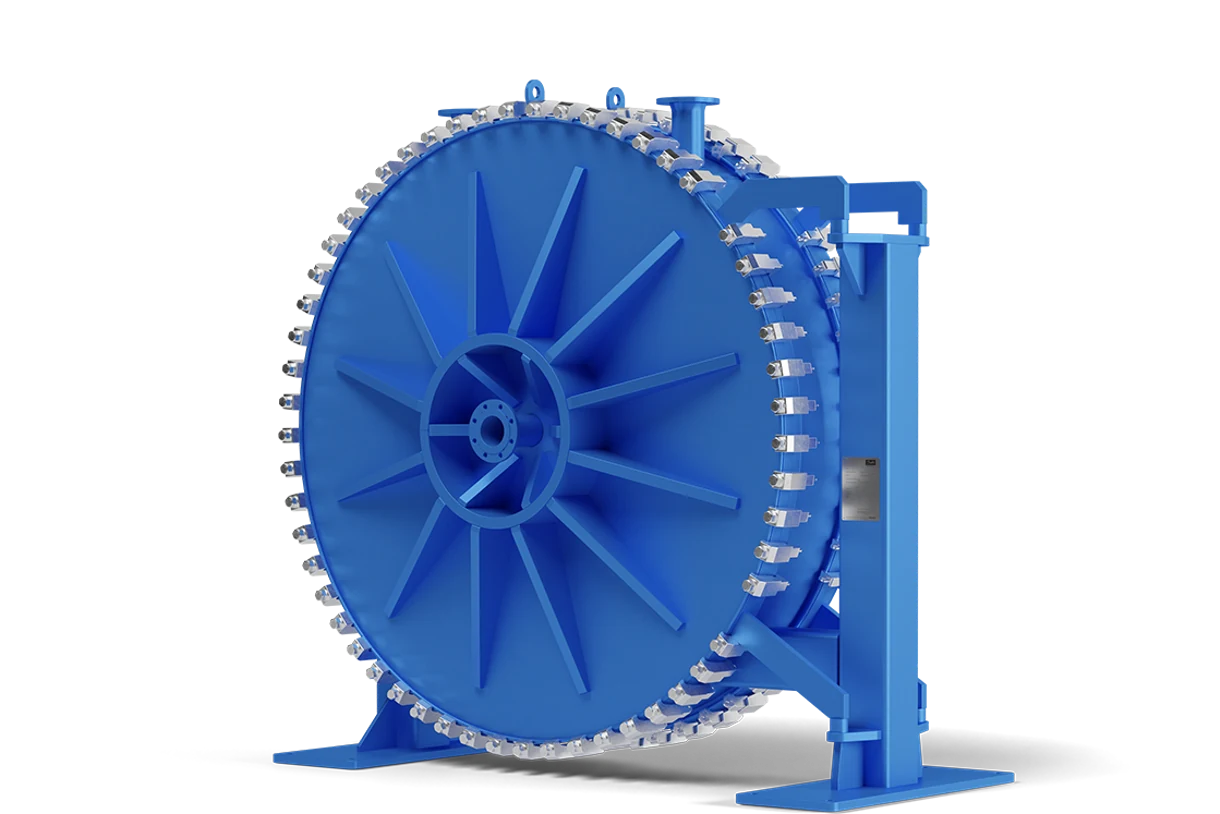
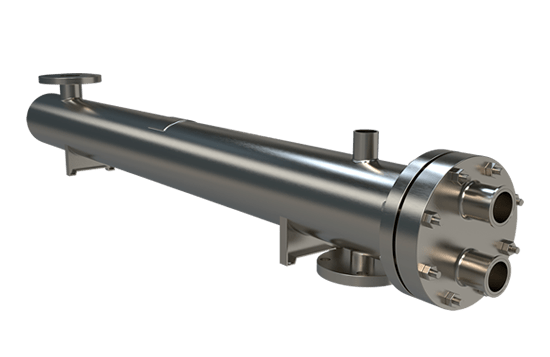
Low-Pressure Solvent Vapor, High Recovery
The failure on an evaporator condenser rarely announces itself as lost solvent. It shows up as an evaporator that will not reach its vacuum: the condenser is undersized or fouled, vapor backs up, pressure rises, and the product side boils hotter than the recipe allows. Extract darkens, throughput falls, and the vacuum pump starts handling solvent it was never meant to see.
Two features drive the design. First, specific volume: ethanol vapor at deep vacuum occupies many times the volume it does at atmospheric pressure, so the condenser must pass that flow with only a few torr of loss. Second, temperature: the lower the evaporator pressure, the lower the condensing temperature and the narrower the gap to the coolant. A ten to fifteen degree F approach against chilled water is common, and tower water may leave too little driving force.
A Counterflow Spiral handles both concerns on small and mid-size systems. It has a large vapor inlet, a short gas path and a self-scouring channel that tolerates the waxy or resinous carryover common in botanical extraction. A Fixed Tubesheet shell-and-tube with vapor on the shell side and generous baffle spacing is the choice for higher vapor rates; its tubes take chilled water and can be rodded, and the shell can be flushed with hot solvent.
For a firm price, send the solvent and its evaporation rate, evaporator operating pressure, maximum product temperature, coolant type and supply temperature, the separator or demister in place, and how the recovered solvent will be reused.
Solvent and rate
Which solvent, and how much evaporates per hour
Evaporator vacuum
Operating pressure and the product's temperature limit
Coolant available
Chilled water or glycol supply temperature and flow
Carryover control
Separator or demister type and expected product entrainment
Clear Solvent
Back to Extraction
1.
Vacuum Held at the Vessel
Low vapor-side pressure loss lets the evaporator run at the pressure the recipe calls for. The product stays below its degradation temperature, and the vacuum pump sees noncondensables instead of solvent.
2.
Fouling Under Control
Spiral channels scour themselves at velocity, and a straight-tube shell can be flushed hot. Either way, resin carryover comes off before it costs area, and the recovered solvent does not pick up color from old deposits.
3.
Lower Make-Up Purchases
Every gallon condensed is a gallon not bought or hauled in. On ethanol extraction lines solvent make-up is often one of the largest operating costs, so condensing efficiency moves directly into margin.
Vacuum evaporator questions
Only at modest vacuum, and even then with the surface rated on August tower water, not on the annual average. The limit is the condensing temperature. Ethanol boils at 173 F at atmospheric pressure, near 95 F at about 100 torr, and close to 65 F at 40 torr. With tower water arriving at 85 F in summer, a 40 torr evaporator leaves nothing to work with and a 100 torr evaporator leaves a thin margin that disappears on a hot afternoon.
The plant sees it as an evaporator that cannot hold vacuum, so the operator raises the product temperature to keep rate. The usual compromise is a two-stage unit: tower water takes the bulk condensing where the gap allows, and a chilled-water or glycol stage set at a 10 to 15 F approach finishes the duty and cools the noncondensables.
Large enough that velocity at the design boil-up holds inlet losses to a fraction of the total pressure budget, which at deep vacuum usually means a nozzle the same size as the evaporator vapor line or one size larger. Put a number on it. Ethanol vapor at 40 torr occupies roughly 150 cubic feet per pound, so 500 lb/hr of boil-up is about 1,300 cfm; through a 10 inch nozzle that is 40 ft/s, through a 6 inch nozzle it is 110 ft/s and the inlet loss alone is several torr.
A reducer at the condenser inlet is the telltale that somebody bought on area and ignored volume. Specify the nozzle by velocity, add an impingement plate or an open vapor belt under it, and keep the first baffle well back from the inlet.
Because concentrated extract is reaching the condensing surface, and the film that builds there leaches color into every gallon of condensate that runs over it. Trace the path. Foaming in the evaporator or a separator too small for the vapor velocity sends droplets over the top; a yellow tint in the first gallons after startup, fading as the run continues, points to the deposit on the condenser, while a tint that follows evaporator feed rate points to live entrainment.
Check the separator velocity against its rated limit and wether an antifoam or a lower feed rate stops the carryover. Then decide whether the condenser can be opened or hot-flushed with solvent without a bundle pull. A unit that cannot be cleaned keeps tinting after the entrainment is fixed. Color in recovered ethanol also carries into the next extraction, so it costs product quality as well as solvent.