
1-805-484-2992
Quotes - Engineering - SalesClosed-Loop Dryer Solvent Condensers
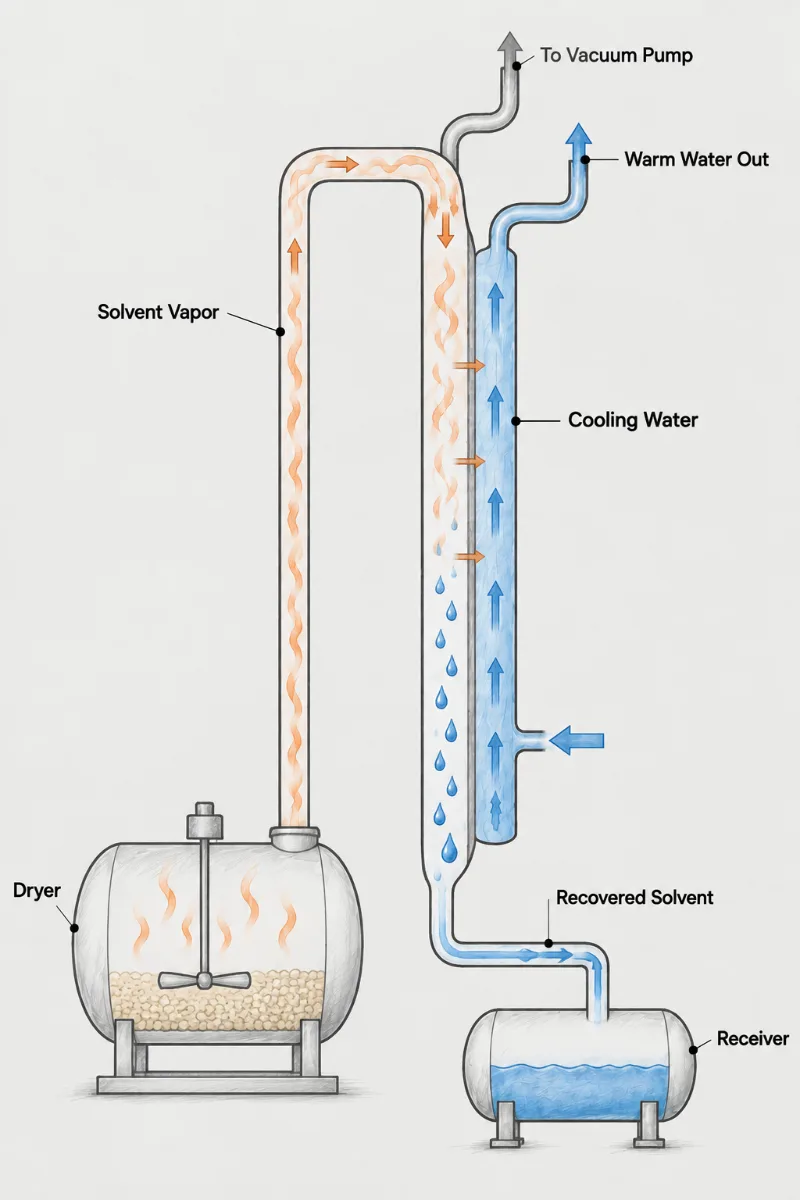
Paddle, fluid-bed, spray and vacuum dryers handling solvent-wet cake often run a closed nitrogen loop. Hot inert gas picks up solvent in the dryer, a condenser chills the gas to drop the solvent out, and the stripped gas is reheated and sent back. Solvent concentration in that loop reaches levels that would be explosive in air, which is why the loop runs on nitrogen. The condenser outlet temperature sets how much solvent rides back into the dryer, and with it how fast the product dries.
- Loop Dew Point: Gas returning to the dryer carries solvent at the condenser outlet saturation; the colder that outlet, the greater the drying driving force on the next pass.
- Chilled Coolant: Low outlet dew points usually take chilled glycol or brine, so confirm chiller capacity and supply temperature before fixing the condenser size.
- Water Pickup: Wet cake releases water along with solvent; below freezing, that water can ice the cold end of the condenser unless coolant temperature is controlled.
- Product Fines: Dust escaping the dryer filter or cyclone lands on wet condenser surface and cakes, so the bag filter and condenser are planned together.
- Drying Curve: Solvent release peaks early in a batch and tails off, so the condenser carries its full latent load for only part of the cycle.
- Blower Head: Loop blowers develop modest pressure, and every inch of water column lost across the condenser comes out of gas circulation through the dryer.
Why the Condenser Sets the Dryer's Pace
What limits drying rate in an inert-loop dryer? Often it is not the heater or the dryer itself but the condenser. Nitrogen leaving the condenser is saturated at the outlet temperature, so when that outlet drifts up from a cold setpoint, the gas going back to the dryer already carries a large share of solvent and picks up much less on the next pass. The symptom is a batch cycle that stretches every time the chiller is shared with another unit.
Most of the heat removed is sensible cooling of nitrogen rather than latent heat of solvent, especially late in a batch, so the gas-side coefficient governs the area. It is a gas-cooling problem with condensation on the wall, and it needs a design that keeps gas velocity up without spending the blower's limited head.
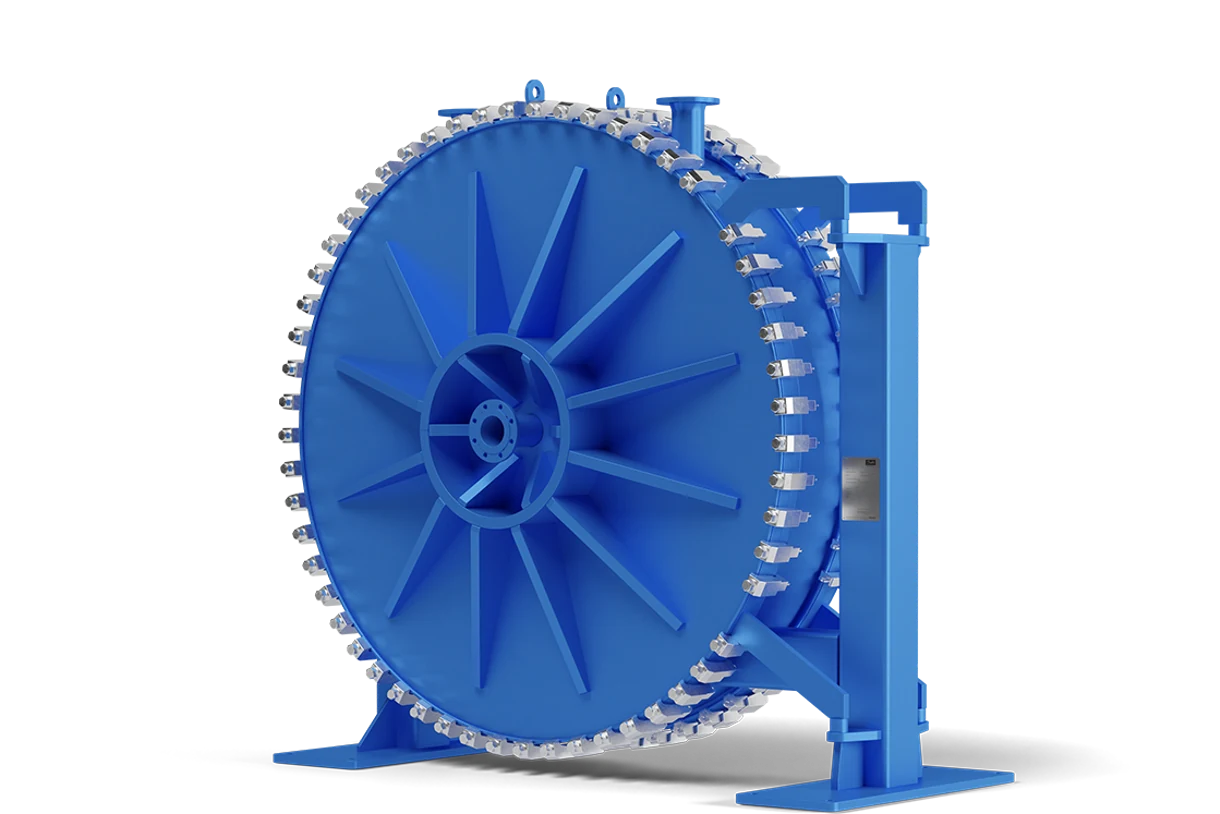
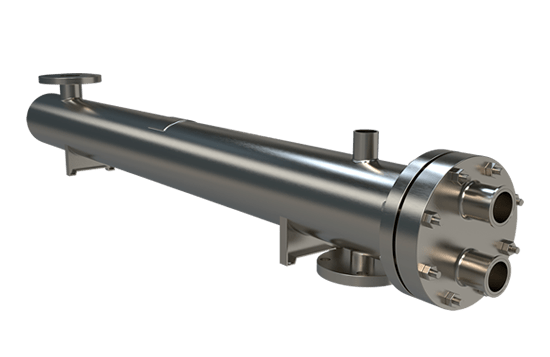
A Counterflow Spiral fits this duty well. The single curved channel gives true countercurrent flow for a close approach against chilled glycol, and its scrubbing velocity resists fines that would settle in a shell. It also opens for cleaning without pulling a bundle. A Fixed Tubesheet shell-and-tube with gas in the tubes is the conventional alternative and suits larger loops; straight tubes can be brushed out when fines get past the filter. Neither tolerates coolant below the freezing point of the water in the condensate without a control strategy.
To size it, send the nitrogen circulation rate, dryer outlet gas temperature, solvent and water evaporation rates across the batch, the target return dew point, coolant type and supply temperature, and the blower's available pressure drop.
Loop gas rate
Nitrogen circulation and dryer outlet gas temperature
Evaporation profile
Solvent and water released early, mid and late batch
Return dew point
Solvent content you can tolerate in gas back to the dryer
Chiller and blower
Glycol supply temperature, chiller capacity, available fan head
Shorter
Batch Cycles Through Colder Gas
1.
More Drying Per Pass
Leaner return gas absorbs more solvent on each trip through the dryer. Plants that lower the condenser outlet temperature typically see the falling-rate period shorten, with no change to heater or dryer hardware.
2.
Fines Tolerance
A single-channel spiral keeps velocity high enough to sweep fines that escape the filter, and it's covers swing open for washing. Surface stays active instead of losing area to a paste on the cold end.
3.
Solvent Back in the Drum
Condensate collects as liquid ready for reuse or a polishing distillation, and nitrogen makeup falls because the loop is not purged to dump solvent vapor the condenser failed to catch.
Closed-loop dryer questions
Cold enough that the return gas carries a small fraction of the solvent it brought from the dryer, which for most solvents means an outlet between 20 F and 0 F on glycol or brine. The numbers for methanol make the point. At 40 F the methanol vapor pressure is near 0.8 psia, so saturated nitrogen returns to the dryer at about 5 percent methanol by volume; at 0 F the figure is close to 0.2 psia and about 1 percent.
Return gas four times leaner picks up proportionally more solvent per pass during the falling-rate period, which is where batch time is spent. Set the target from the dryer outlet concentration late in the batch, not early, because that is the pass the condenser has to win. Then check the chiller can deliver that glycol temperature at full load.
It will, once the coldest wall sits below 32 F and the gas carries any water, and the ice shows up as rising pressure drop over two or three batches rather than a sudden blockage. The water load is often larger than people expect: a cake carrying 2 percent water by weight on a 2,000 lb batch gives 40 lb of water, which lands on the cold end of the condenser in the first part of the cycle.
Three arrangements work. A first stage on cooling water pulls the water out above freezing before the glycol stage. A control loop that holds the glycol supply just above 32 F while water is still coming off, then lowers it for the solvent tail, avoids extra hardware. Or two units alternate, one defrosting with warm glycol while the other runs.
No for a small loop with spare chiller capacity, yes when refrigeration is the bottleneck, because sensible cooling of nitrogen is the larger share of the duty and tower water removes it at a fraction of the cost per BTU. Cooling 1,000 scfm of nitrogen from 180 F to 90 F takes about 100,000 BTU/hr; doing that on cooling water instead of glycol frees roughly 8 tons of chiller capacity for the solvent tail, where it buys drying rate.
The precooler also catches most of the water from the cake above freezing, which takes the ice question off the cold stage. The price is a second vessel, another few inches of water column in blower head, and a condensate drain carrying a water and solvent mix that needs separation.
They stick to the first wet surface they touch, and on a glycol-cooled condenser that is the inlet zone, where fines mixed with condensed solvent become a paste that insulates the wall and raises gas-side pressure drop. The symptom in the plant is a return dew point that creeps upward over a campaign while glycol temperature stays steady.
Design for it on the assumption that a few pounds per batch will arrive. A spiral channel running at 20 to 30 ft/s keeps most fines suspended until they leave with the condensate, and the covers open for a wash between campaigns. In a shell-and-tube unit, put the gas in the tubes so they can be brushed, and add a drain on the inlet channel. Sample the condensate for solids now and then; a rising solids count means the dryer filter needs attention before the condenser does.
Not as a closed loop, because the solvent concentration in recirculated gas climbs well above the lower explosive limit within the first minutes of a batch. Isopropanol has an LEL near 2 percent by volume, and a loop returning gas saturated at a 40 F condenser outlet already carries close to that, with the dryer outlet several times higher.
Oxygen must therefore stay below the limiting concentration, typically 8 to 10 percent for common solvents with a safety margin below that, which means a nitrogen pad, an oxygen analyzer on the loop and an interlock. The condenser plays its part by being tight: a welded process side, a sealed condensate drain to a receiver and no gasketed covers opened while the loop is hot. A once-through air dryer with partial recovery is a different duty and a different condenser.