
1-805-484-2992
Quotes - Engineering - SalesReactor Overhead Condensers for Solvent Reflux and Recovery
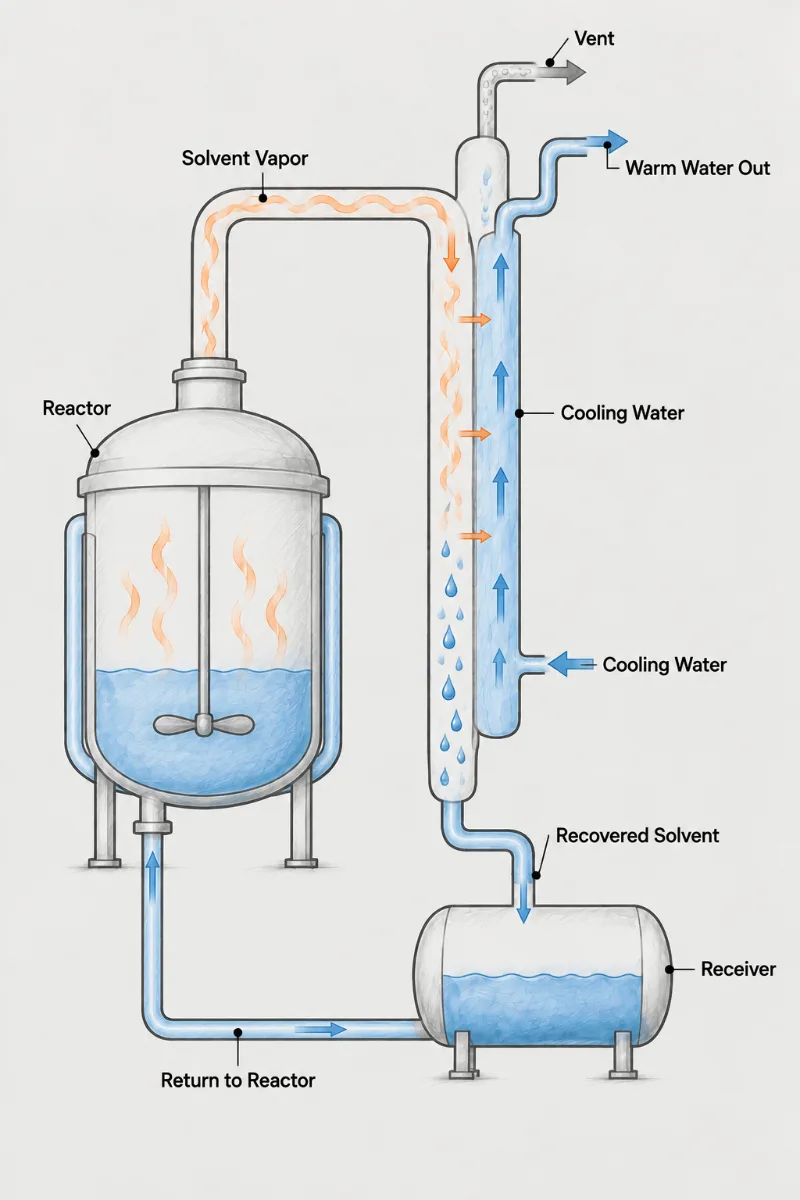
A batch reactor's overhead condenser usually has two jobs in one cycle. During reaction it runs at total reflux, condensing boiling solvent and returning it so the batch holds temperature at its boiling point. When the reaction is complete, valves switch and the same condenser becomes a distillation condenser, stripping solvent off to a receiver for reuse. The reflux duty sets the heat removal; the recovery step sets purity and how long the reactor is tied up between batches.
- Reaction Exotherm: Under reflux the condenser is the reactor's heat sink, so size it for peak heat release during dosing, not the batch average.
- Reflux Return: Condensate must drain back by gravity without holding up liquid in the vapor line, which makes mounting height and line slope part of the design.
- Strip-Off Rate: Recovery speed is capped by condenser capacity at full jacket heat input, so an undersized unit lengthens every batch.
- Campaign Changes: Multipurpose reactors boil different solvents; drainable, cleanable surfaces stop one campaign's solvent from contaminating the next.
- Acid Carryover: Reactions that release HCl or other acids put them in the overhead, steering tube and tubesheet metallurgy toward Hastelloy.
- Receiver Routing: Switching between reflux and take-off must not trap vapor or liquid, so condenser outlet and valving are laid out together.
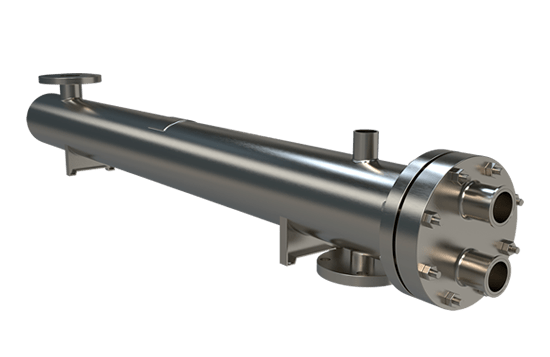
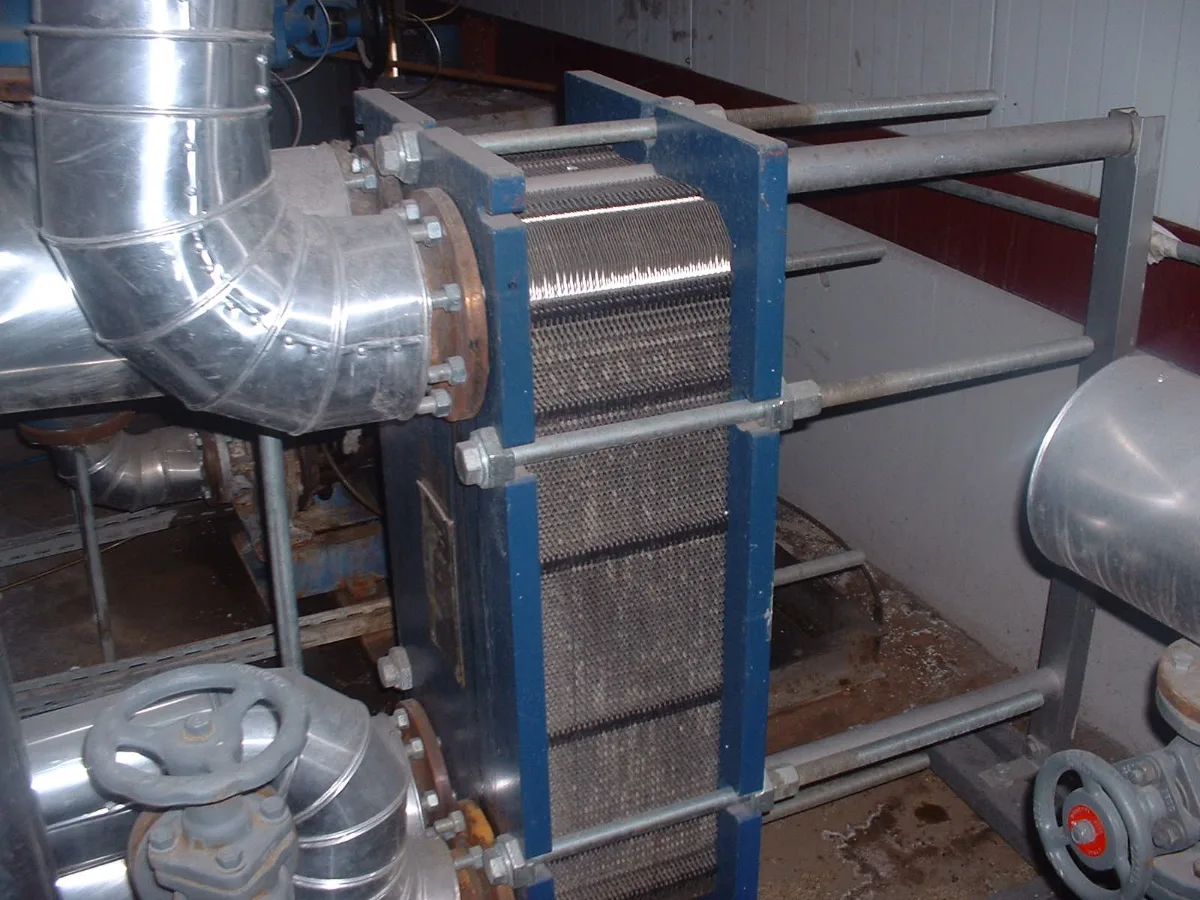
One Condenser, Two Jobs: Reflux and Strip-Off
Which duty should size a reactor condenser, the reflux or the recovery? Usually the reflux, because during an exothermic step the condenser is the only thing keeping the batch at its boiling point. If it runs out of capacity while reagent is being dosed, vapor that cannot condense raises reactor pressure, the relief system gets involved, and dosing has to stop. The recovery step then checks the design: at full jacket heat input the condenser must take the strip-off rate without letting solvent pass to the vent.
Vertical mounting over the reactor, with vapor rising through the tubes and condensate draining against it, is common on smaller reactors; flooding at the tube inlet limits vapor velocity. Larger units go horizontal with a gravity return leg. In both cases subcooling of the reflux should stay modest, because cold reflux falling into a boiling batch disturbs temperature control.
A Fixed Tubesheet shell-and-tube is the standard answer. It can be built in 316L, duplex or Hastelloy to match the chemistry, cleaned between campaigns and mounted vertically on the reactor nozzle. A Welded Plate exchanger suits a reactor bay without headroom for a tall vertical unit, provided the reflux path drains completely; a plate pack that holds condensate is a cross-contamination risk on a multipurpose train.
Send the solvent list for each campaign, peak exotherm and jacket heat input, the reactor pressure range, desired strip-off time, coolant conditions and any acid or halide content.
Peak heat release
Exotherm during dosing plus jacket heat input
Solvent campaigns
Every solvent the reactor will boil off across products
Mounting space
Headroom above the reactor and vapor nozzle size
Strip-off target
Hours allowed to distill solvent off after reaction
Batch Control
and Faster Turnaround
1.
Exotherm Held in Check
Condensing capacity sized to peak heat release keeps the batch pinned at its boiling point during dosing. Reactor pressure stays flat, and the dosing pump does not trip on a high-pressure interlock.
2.
Quicker Strip-Off
When the condenser keeps up with full jacket heat, solvent comes off as fast as the jacket can supply it, shortening the time the reactor sits between reaction and the next charge.
3.
Clean Campaign Switches
Drainable tubes and cleanable heads let a multipurpose reactor move from one solvent to another without carrying traces forward, so recovered solvent from each campaign can be reused within that product line.
Reflux and strip-off questions
Vertical on the reactor nozzle for most reactors up to a few thousand gallons, horizontal with a return leg once peak vapor rate or headroom rules the vertical unit out. The vertical unit has advantages beyond short piping: holdup is a few gallons, reflux returns within seconds, and there is no pocket where solvent from the last campaign can hide.
Its limit is flooding in the tubes at high vapor rate, which pushes the bundle toward larger tubes or more of them, and at some point the unit becomes too tall for the bay. A horizontal unit takes larger duties with vapor on the shell side, but it needs a sloped return line with a loop seal and a vent so liquid drains back steadily and does not build a slug that drops into the batch at once. Decide by peak vapor rate and headroom together, not either alone.
Flooding, the point at which rising vapor holds the falling condensate film in the tube and the reflux stops draining. For a 1 inch tube condensing a solvent of moderate density, the flooding velocity falls in the range of 10 to 20 ft/s at the tube inlet, and design practice holds the inlet velocity to about half that.
The symptom on the plant floor is a condenser that handles the batch at steady reflux but loses control during a fast heat-up or a vigorous dosing step, when vapor rate spikes: condensate hangs in the tubes, reactor pressure rises, and the relief valve or rupture disk becomes the next line of defense. More tubes of larger diameter, a bell-mouth tube inlet and a vapor nozzle sized for the peak rather than the average all raise the limit. Rating on area alone misses it.
It can if it is rated for the solvent that governs each parameter, and the governing solvent is rarely the same one across all of them. Dichloromethane sets the coolant temperature: boiling at 104 F, it needs chilled water or glycol to condense with a reasonable approach, and tower water at 85 F leaves almost nothing. Surface at strip-off follows the solvent with the smallest gap to the coolant at full jacket heat input, usually that same low boiler, while toluene or xylene set the jacket demand and the vapor-side pressure drop.
A 316L bundle covers most organics, but one campaign releasing acid vapor moves the whole unit to a higher alloy. Rate each campaign on its own sheet, list the governing case for coolant, area, materials and pressure, and build to those. The unit will be oversized for some campaigns, which costs little; being undersized on one costs a batch.
Because the overhead condenser is a total condenser, and anything that boiled with the solvent during strip-off condenses with it. Low-boiling reagents, byproduct alcohols or water formed in the reaction leave the batch at their own volatility and arrive at the receiver together with the solvent.
A fore-cut is the simplest fix: send the first 5 to 10 percent of the strip-off, where the light component is concentrated, to a waste receiver and switch to the recovery receiver once a sample is clean. A short packed section between reactor and condenser, with a little reflux returned, sharpens the cut further. Where the impurity is much lighter than a heavy solvent, holding the condenser outlet warm enough to pass the light material to the vent while condensing the solvent can work, but it costs some solvent to the vent and needs careful control.
Hold the reflux within a few degrees of its bubble point, and return it in to the vapor space above the liquid surface rather than through a dip pipe into the batch. A reflux stream 30 F below the boiling point of toluene, at 2,000 lb/hr, absorbs about 24,000 BTU/hr as it warms back up, and the jacket controller sees that as a load swing every time the condenser outlet drifts.
Two controls prevent it. A tempered coolant loop that blends warm return water into the supply keeps the tube wall warm enough that condensate leaves close to saturation. Or a temperature loop on the reflux line adjusts the coolant valve to a setpoint a few degrees under the boiling point. Either way, measure the reflux return temperature with its own sensor, because the shell outlet reading is not the same number once the liquid has drained.
A nickel-molybdenum-chromium alloy such as C-276 for the tubes, tubesheets and channels, with the shell in carbon steel when the coolant is plain water. Wet hydrogen chloride attacks 304 and 316 quickly through pitting and chloride stress cracking, and titanium, often proposed because it handles wet chlorine well, is corroded by hot reducing acid.
The hazard peaks at strip-off: as solvent is distilled off, the acid concentration in the condensate climbs, and the last part of the run may send concentrated hydrochloric acid through the same tubes. Glass-lined or graphite condensers are alternatives at low pressure and are common on halide chemistry reactors, but they are fragile and limited in pressure. Specify the acid rate per batch and the maximum condensate concentration so the alloy choice is based on the worst hour, not the average.