
1-805-484-2992
Quotes - Engineering - SalesPrecondensers and Intercondensers in Vacuum Service
Steam-jet ejector systems pulling vacuum on dryers, stills and evaporators handle whatever vapor reaches them. If that includes solvent, the motive steam has to compress it, and the solvent ends up mixed with steam condensate in every intercondenser. A precondenser ahead of the first ejector, and well-designed intercondensers between stages, take solvent out as clean liquid at the lowest practical pressure, cut motive steam use and keep solvent out of the hotwell. The design trade is pressure drop against condensing temperature.
- Suction Pressure: The precondenser operates at process vacuum, so its pressure loss adds directly to the absolute pressure the process vessel sees.
- Motive Steam: Each pound of solvent vapor removed before the first stage is a pound the ejector no longer has to entrain and compress.
- Condensate Purity: Liquid from a precondenser is mostly solvent; liquid from an intercondenser is steam condensate carrying dissolved or layered solvent.
- Inert Load: Air leakage and dissolved gases set the vapor ejectors must still move; chilling those noncondensables before they leave strips out the solvent they carry.
- Barometric Legs: Condensate leaves the vacuum through a sealed leg or pumped receiver, so leg height or pump suction head is part of the layout.
- Stage Pressures: Intercondenser pressure is fixed by ejector staging, and coolant temperature limits how low that interstage pressure can go.
Taking Solvent Out Before the Ejector Does
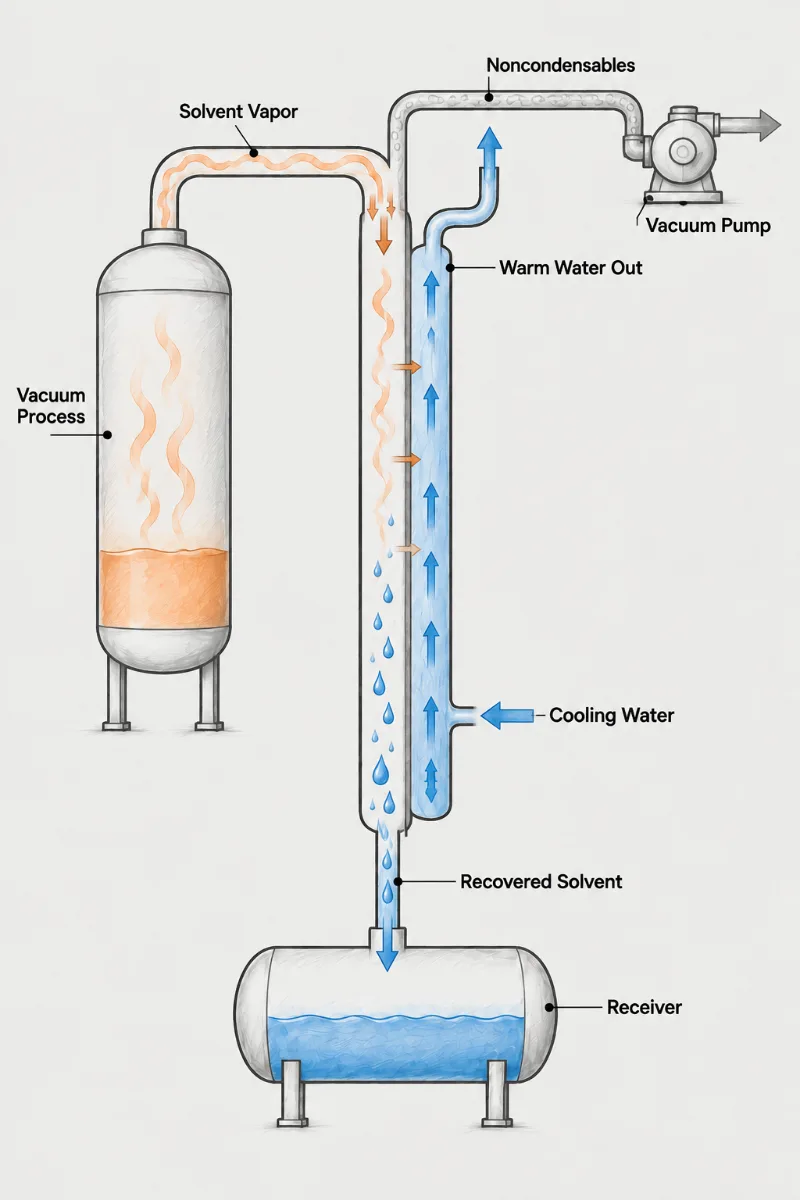
A precondenser pays for itself twice: once in solvent recovered as liquid, and again in motive steam the ejector no longer needs. Without it, solvent vapor travels to the first ejector, is compressed with steam, and condenses in the intercondenser dissolved in or floating on steam condensate. That stream goes to wastewater or a stripper, and the solvent is lost or has to be recovered a second time.
The constraint is pressure drop. At a suction pressure of a few torr, losing one torr across the precondenser can raise process pressure by a third or more. Shell-side condensing with a wide-open vapor path, an unobstructed inlet zone and the gas outlet at the coldest point is the usual arrangement. Noncondensables are cooled as far as possible before they leave, because whatever solvent they carry at saturation goes on to the ejector.
Intercondensers between stages run at higher pressure and condense motive steam along with any remaining solvent. They need area for the steam latent load and a drain leg tall enough to seal against stage pressure.
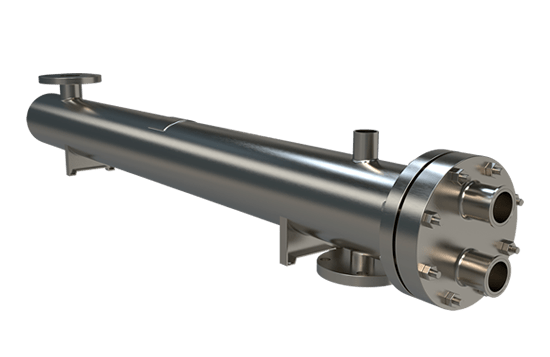
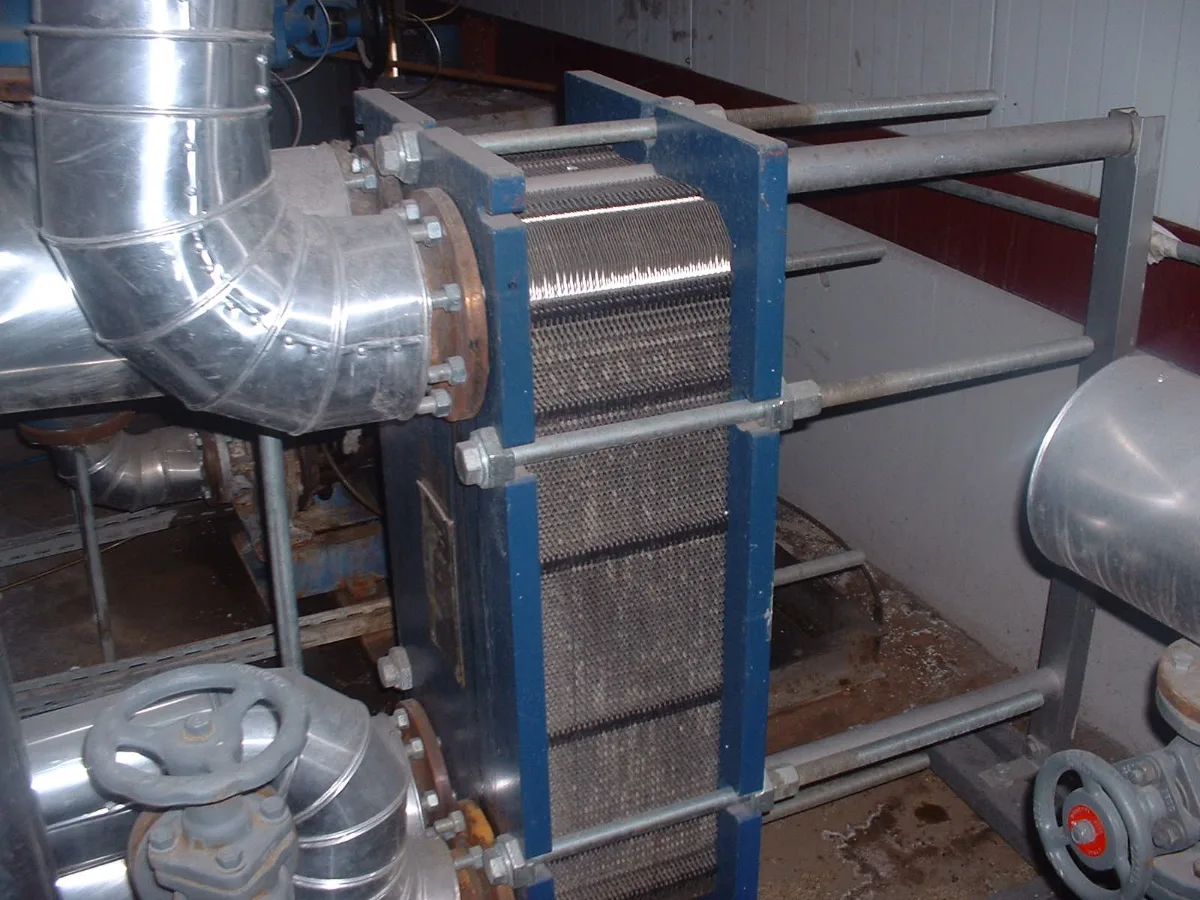
A Fixed Tubesheet shell-and-tube is the standard choice in both positions: straight tubes carrying cooling or chilled water, condensing outside, and a shell built for full vacuum. A Welded Plate exchanger with a low-loss vapor side can serve as a precondenser on smaller systems or where a close approach to chilled water is needed, but at deep vacuum its channel geometry must be checked carefully against the pressure budget.
Send the process pressure, solvent and inert flows at suction, ejector staging and interstage pressures, motive steam pressure, coolant conditions and how condensate will leave the vacuum.
Suction conditions
Process vacuum with solvent and inert flow at suction
Ejector staging
Stage count, interstage pressures and motive steam pressure
Pressure budget
Allowable loss across the precondenser at design vacuum
Condensate exit
Barometric leg height or pumped receiver arrangement
Less Steam,
More Solvent Recovered Clean
1.
Smaller Motive Load
Removing solvent before the first ejector lowers the vapor mass it must entrain. Plants retrofitting a precondenser often reduce motive steam consumption, or reach a deeper vacuum with the same ejector set.
2.
Solvent Kept Separate
Condensing at process vacuum, ahead of any motive steam, delivers solvent that has never mixed with steam condensate. It goes back to the process instead of to the wastewater stripper.
3.
Vacuum Budget Protected
Open vapor paths and a cold-end gas outlet keep precondenser loss to a fraction of a torr where the process requires it, so the vacuum the ejectors build actually reaches the vessel.
Ejector and precondenser questions
At the coldest point on the shell, where the coolant enters, so the inert gas leaves the bundle after passing all of the surface and at the lowest temperature the design allows. Cooling the inert outlet from 60 F to 40 F cuts acetone vapor pressure roughly in half, from about 130 torr to about 70 torr, which halves the solvent each pound of air carries to the first stage.
Shield the outlet with a baffle or a small shroud so vapor cannot bypass straight from inlet to vent, and run the outlet nozzle vertically upward to keep liquid from being pulled toward the ejector. On a horizontal unit the outlet belongs at the far end from the vapor inlet, above the condensate level, with the condensate drain at the bottom. Mid-shell outlets waste the cold end entirely.
Yes, as long as the vacuum you want is above the vapor pressure of whatever is condensing at the coolant temperature, and the ejector stage behind it is rated for the leaner load. The precondenser cannot run below the pressure where its own condensate boils: water condensing against 45 F chilled water bottoms out around 10 torr in practice, allowing a 5 F approach, and no amount of surface gets lower.
Within that limit, chilled water helps twice. It shrinks the solvent vapor passed to the first ejector, which may let an overloaded stage pull deeper, and in the intercondensers it lowers the interstage pressure, so each stage compresses less and motive steam falls. Check the condensate drain leg too, since a lower condenser pressure needs a taller leg. Where the target is below 10 torr, the condenser becomes a solvent trap and the ejectors do the rest.
Because solvent that reaches the first ejector is compressed with the motive steam and condenses with it in the intercondenser, and the hotwell is where that condensate collects. Methanol, acetone and IPA dissolve completely, so the hotwell runs at a few percent organics and the overflow to drain carries them away; toluene or heptane float as a layer that skimmers catch only partly, and the rest leaves emulsified.
The volume is larger than most people expect, since an ejector set uses several pounds of steam per pound of air handled, and all of that steam condenses. A precondenser at process vacuum removes the bulk of the solvent before it meets steam and returns it as a clean stream. On an existing system, measure the hotwell organics for a week before deciding; that number is the business case for the precondenser.
Not the heat transfer, but it changes the outlet temperature target and the tolerance for condensables in the gas the pump sees. A liquid-ring pump tolerates some vapor, but a solvent condensing in the ring dilutes or contaminates the seal fluid, and water-sealed rings absorb miscible solvents until the seal liquid must be replaced. A dry screw or claw pump wants no liquid at all and runs hot, so the precondenser outlet is chosen so that gas warming in the suction line stays above its dew point.
On a hybrid train, ejector first and mechanical pump behind, the precondenser carries the same pressure-drop rule as before and the pump suction pressure replaces the last ejector stage. Give us the pump type and its allowable inlet condensable fraction with the rest of the data.
Tall enough for the liquid column to balance atmospheric pressure against condenser pressure, which for water at full vacuum is about 34 ft and for a lighter solvent proportionally more. Work it as height equals 2.31 ft per psi of pressure difference divided by the liquid specific gravity. Water at 14.7 psi gives 34 ft; a precondenser condensing ethanol at a specific gravity of 0.79 needs 43 ft; hexane at 0.66 needs 52 ft.
Add 2 to 3 ft of margin for pressure swings and a seal pot at the bottom with its outlet below the liquid level, so air cannot climb the leg. Where that height is not available, the condensate goes to a receiver under vacuum and a pump rated for the suction conditions lifts it out; the receiver then needs its own level control and a balance line back to the condenser.